Department of Pharmacology, Affiliated Hospital of Integrated Traditional Chinese and Western Medicine, Nanjing University of Chinese Medicine, Nanjing, Jiangsu 210023, P.R. China.
State Key Laboratory of Natural Medicines, Research Department of Pharmacognosy, China Pharmaceutical University, Nanjing, Jiangsu 211198, P.R. China.
Int J Mol Med. 2018 Dec;42(6):3157-3170. doi: 10.3892/ijmm.2018.3896. Epub 2018 Sep 25.
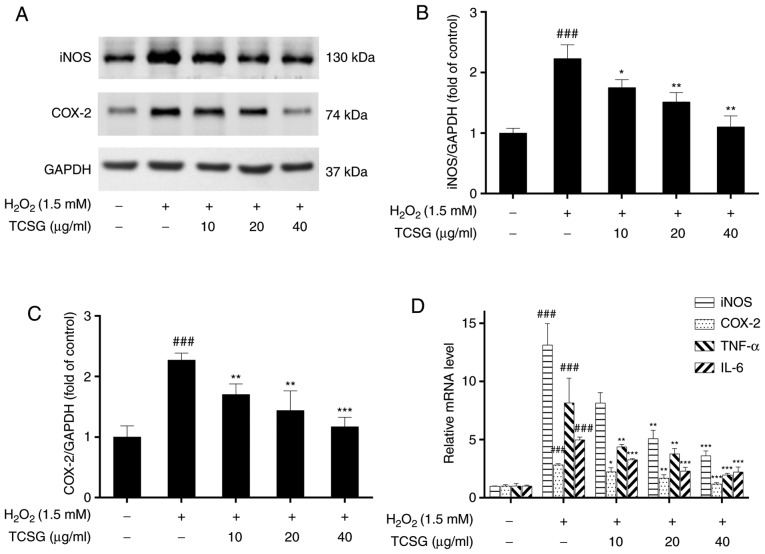
Oxidative stress plays an important role in the pathology of liver disorders. Total C‑21 steroidal glycosides (TCSGs), isolated from the root tuber of Cynanchum auriculatum Royle ex Wight, have been reported to exert numerous effects, including liver protective and antioxidant effects. In order to investigate the potential mechanisms underlying the protective effects of TCSGs on liver function, the present study used the human normal liver cell line, L02, to evaluate the effects of TCSGs on hydrogen peroxide (H2O2)‑induced oxidative injury and inflammatory responses. The L02 cells were pretreated with various concentrations of TCSGs, followed by exposure to 1.5 mM H2O2. Cell viability was determined by a 3‑(4,5‑dimethylthiazol‑2‑yl)‑2,5‑diphenyltetrazolium bromide (MTT) assay. The levels of alanine aminotransferase (ALT), aspartate aminotransferase (AST), lactate dehydrogenase (LDH) and nitric oxide (NO) were measured using colorimetric assays. The activities of superoxide dismutase (SOD), catalase (CAT), glutathione peroxidase (GSH‑Px) and the production of malondialdehyde (MDA) were also determined. Intracellular reactive oxygen species (ROS) levels were detected using a fluorescent probe. H2O2‑induced oxidative toxicity was attenuated following treatment with TCSGs, as indicated by the increase in cell viability, the decreased levels of ALT, AST, LDH, NO, MDA and ROS, and the increased activities of SOD, CAT and GSH‑Px. To further explore the possible mechanisms of action of TCSGs, the nuclear factor erythroid 2‑related factor 2 (Nrf2) and nuclear factor‑κB (NF)‑κB pathways were examined. The results revealed that treatment with TCSGs markedly induced Nrf2 nuclear translocation and upregulated the expression of heme oxygenase‑1 (HO‑1) in the L02 cells damaged by H2O2. In addition, pretreatment with TCSGs inhibited the NF‑κB signaling pathway by blocking the degradation of the inhibitor of nuclear factor κBα (IκBα), thereby reducing the expression and nuclear translocation of NF‑κB, as well as reducing the expression of tumor necrosis factor‑α (TNF‑α), interleukin-6 (IL‑6), inducible nitric oxide synthase (iNOS) and cyclooxygenase 2 (COX‑2). On the whole, the findings of this study demonstrate that TCSGs can protect L02 cells against H2O2‑induced oxidative toxicity and inflammatory injury by increasing the expression of Nrf2 and HO‑1, mediated by the NF‑κB signaling pathway.
氧化应激在肝脏疾病的病理学中起着重要作用。从鹅绒藤根中分离得到的总 C-21 甾体糖苷(TCSGs)已被报道具有多种作用,包括肝保护和抗氧化作用。为了研究 TCSGs 对肝功能的保护作用的潜在机制,本研究使用人正常肝细胞系 L02 评估 TCSGs 对过氧化氢(H2O2)诱导的氧化损伤和炎症反应的影响。用不同浓度的 TCSGs 预处理 L02 细胞,然后用 1.5mM H2O2 孵育。通过 3-(4,5-二甲基噻唑-2-基)-2,5-二苯基四唑溴盐(MTT)测定细胞活力。通过比色法测定丙氨酸氨基转移酶(ALT)、天冬氨酸氨基转移酶(AST)、乳酸脱氢酶(LDH)和一氧化氮(NO)的水平。超氧化物歧化酶(SOD)、过氧化氢酶(CAT)、谷胱甘肽过氧化物酶(GSH-Px)的活性和丙二醛(MDA)的产生也进行了测定。使用荧光探针检测细胞内活性氧(ROS)水平。结果表明,用 TCSGs 处理后,H2O2 诱导的氧化毒性减弱,细胞活力增加,ALT、AST、LDH、NO、MDA 和 ROS 水平降低,SOD、CAT 和 GSH-Px 活性增加。为了进一步探讨 TCSGs 的可能作用机制,研究了核因子红细胞 2 相关因子 2(Nrf2)和核因子-κB(NF)-κB 途径。结果表明,TCSGs 处理明显诱导了 Nrf2 的核转位,并上调了 H2O2 损伤的 L02 细胞中血红素加氧酶-1(HO-1)的表达。此外,TCSGs 通过抑制核因子κBα(IκBα)的降解来抑制 NF-κB 信号通路,从而减少 NF-κB 的表达和核转位,以及减少肿瘤坏死因子-α(TNF-α)、白细胞介素-6(IL-6)、诱导型一氧化氮合酶(iNOS)和环氧化酶 2(COX-2)的表达。总的来说,本研究的结果表明,TCSGs 通过增加 Nrf2 和 HO-1 的表达,通过 NF-κB 信号通路介导,可保护 L02 细胞免受 H2O2 诱导的氧化毒性和炎症损伤。