Räihä Meri R, Puolakkainen Pauli A
Department of Surgery, Helsinki University Hospital and University of Helsinki, Helsinki 00014, Finland.
Chronic Dis Transl Med. 2018 Sep 3;4(3):156-163. doi: 10.1016/j.cdtm.2018.07.001. eCollection 2018 Sep.
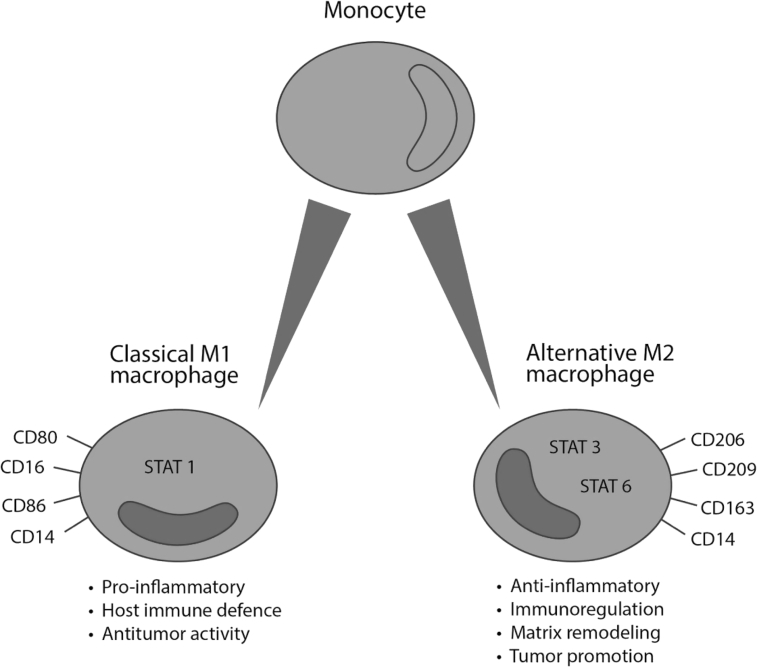
Gastric adenocarcinoma is one of the most common types of cancer worldwide, with an incidence of a million new cases annually. In addition to having a high mortality rate due to often delayed detection and its poor response to cancer therapy, it also spreads aggressively. Inflammation has been shown to play a role in carcinogenesis. Consequently, macrophages are important in phagocytosis, antigen presenting and producing cytokines and growth factors. As a response to microenvironmental signals, they may polarize into tumor resisting M1 or tumor promoting M2 macrophages. Recently, studies have indicated that M2-type macrophage resembling tumor-associated macrophages (TAMs) might be used as an independent prognostic factor for gastric cancer. This review will discuss the possible use of TAMs as prognostic tools for gastric cancer and whether they are suitable for use in clinical environment.
胃腺癌是全球最常见的癌症类型之一,每年新增病例达100万例。除了因常常延误检测以及对癌症治疗反应不佳而死亡率高之外,它还具有很强的侵袭性。炎症已被证明在致癌过程中起作用。因此,巨噬细胞在吞噬作用、抗原呈递以及产生细胞因子和生长因子方面很重要。作为对微环境信号的反应,它们可能极化为抗肿瘤的M1型或促肿瘤的M2型巨噬细胞。最近,研究表明,类似于肿瘤相关巨噬细胞(TAM)的M2型巨噬细胞可能用作胃癌的独立预后因素。本综述将讨论TAM作为胃癌预后工具的可能用途以及它们是否适用于临床环境。