School of Electronic and Information Engineering, Xi'an Jiaotong University, Xi'an, Shaanxi 710049, People's Repubic of China.
Phys Med Biol. 2018 Oct 24;63(21):215008. doi: 10.1088/1361-6560/aae5cd.
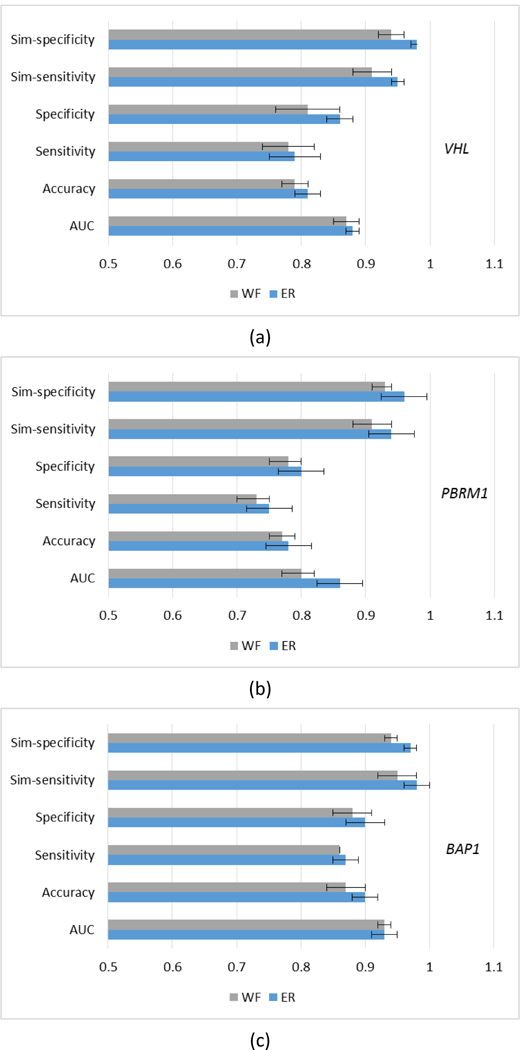
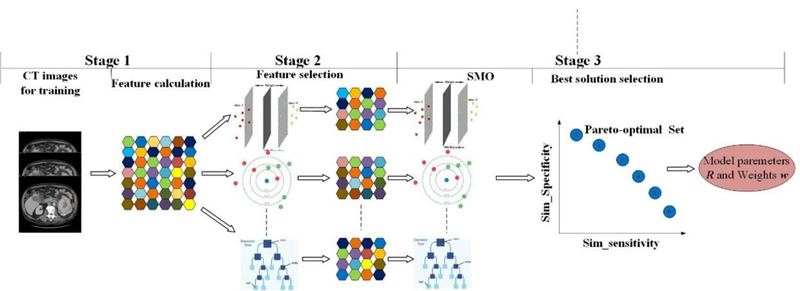
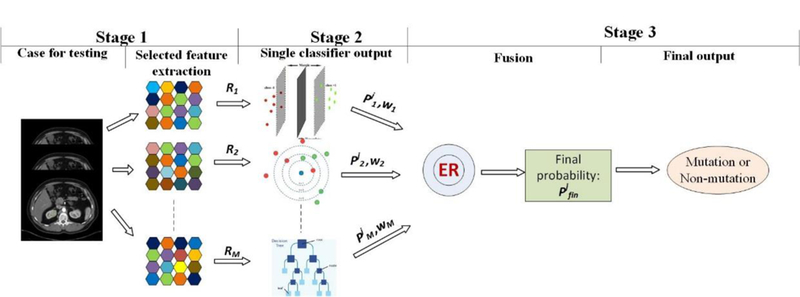
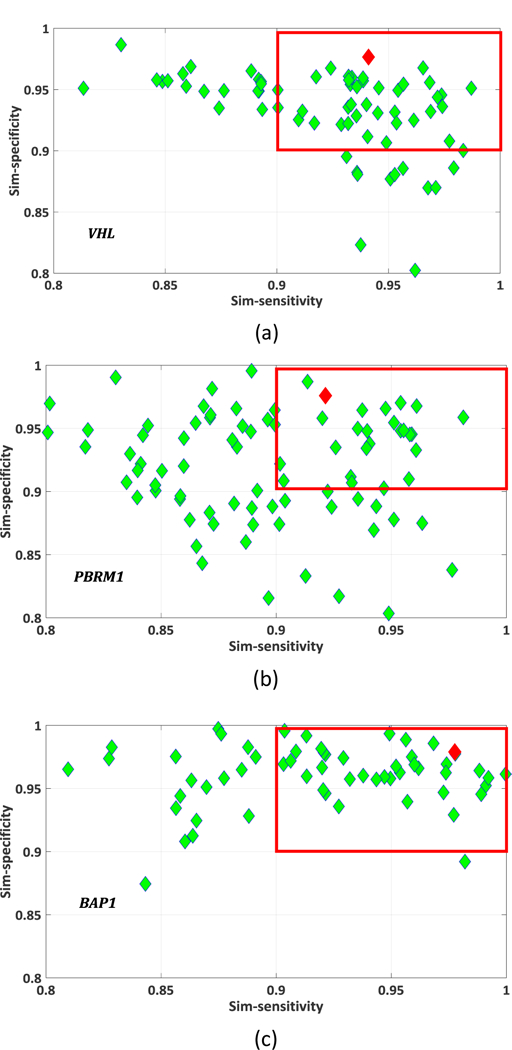
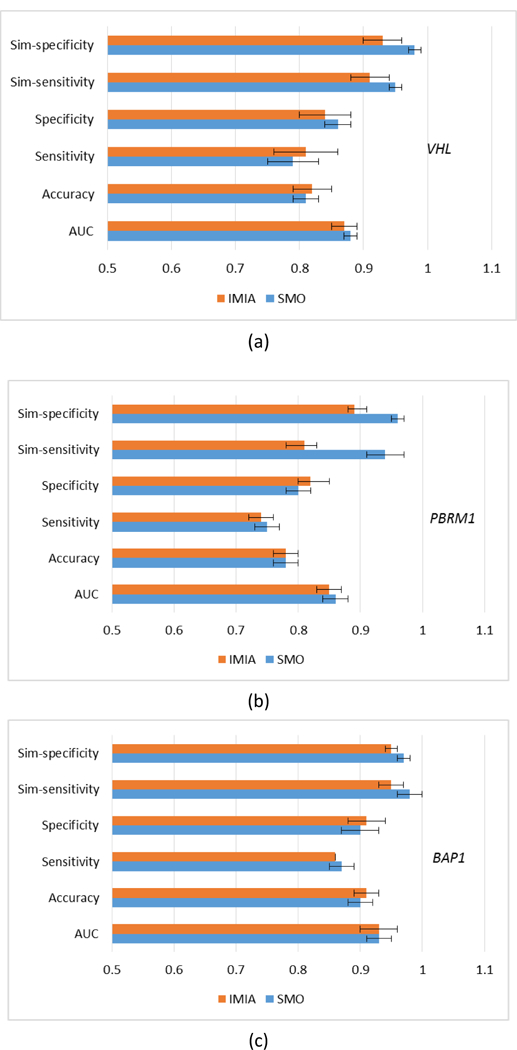
Genetic studies have identified associations between gene mutations and clear cell renal cell carcinoma (ccRCC). Since the complete gene mutational landscape cannot be characterized through biopsy and sequencing assays for each patient, non-invasive tools are needed to determine the mutation status for tumors. Radiogenomics may be an attractive alternative tool to identify disease genomics by analyzing amounts of features extracted from medical images. Most current radiogenomics predictive models are built based on a single classifier and trained through a single objective. However, since many classifiers are available, selecting an optimal model is challenging. On the other hand, a single objective may not be a good measure to guide model training. We proposed a new multi-classifier multi-objective (MCMO) radiogenomics predictive model. To obtain more reliable prediction results, similarity-based sensitivity and specificity were defined and considered as the two objective functions simultaneously during training. To take advantage of different classifiers, the evidential reasoning (ER) approach was used for fusing the output of each classifier. Additionally, a new similarity-based multi-objective optimization algorithm (SMO) was developed for training the MCMO to predict ccRCC related gene mutations (VHL, PBRM1 and BAP1) using quantitative CT features. Using the proposed MCMO model, we achieved a predictive area under the receiver operating characteristic curve (AUC) over 0.85 for VHL, PBRM1 and BAP1 genes with balanced sensitivity and specificity. Furthermore, MCMO outperformed all the individual classifiers, and yielded more reliable results than other optimization algorithms and commonly used fusion strategies.
遗传研究已经确定了基因突变与透明细胞肾细胞癌(ccRCC)之间的关联。由于无法通过对每个患者进行活检和测序来确定完整的基因突变全景,因此需要非侵入性工具来确定肿瘤的突变状态。放射基因组学可以通过分析从医学图像中提取的特征量来识别疾病基因组学,这可能是一种很有吸引力的替代工具。目前大多数放射基因组学预测模型都是基于单个分类器构建的,并通过单一目标进行训练。然而,由于有许多分类器可供选择,因此选择最佳模型是具有挑战性的。另一方面,单一目标可能不是指导模型训练的好方法。我们提出了一种新的多分类器多目标(MCMO)放射基因组学预测模型。为了获得更可靠的预测结果,定义了基于相似度的灵敏度和特异性,并在训练过程中同时将其视为两个目标函数。为了利用不同的分类器,使用证据推理(ER)方法融合每个分类器的输出。此外,还开发了一种新的基于相似度的多目标优化算法(SMO),用于使用定量 CT 特征训练 MCMO 来预测 ccRCC 相关基因突变(VHL、PBRM1 和 BAP1)。使用所提出的 MCMO 模型,我们在 VHL、PBRM1 和 BAP1 基因上实现了超过 0.85 的接收器操作特征曲线下的预测面积(AUC),具有平衡的灵敏度和特异性。此外,MCMO 优于所有单个分类器,并产生了比其他优化算法和常用融合策略更可靠的结果。