Universidad de Buenos Aires. Facultad de Ciencias Exactas y Naturales, Laboratorio de Eco-Epidemiología, Ciudad Universitaria, Buenos Aires, Argentina.
Consejo Nacional de Investigaciones Científicas y Técnicas-Universidad de Buenos Aires. Instituto de Ecología, Genética y Evolución de Buenos Aires (IEGEBA), Ciudad Universitaria, Buenos Aires, Argentina.
PLoS Negl Trop Dis. 2018 Oct 2;12(10):e0006804. doi: 10.1371/journal.pntd.0006804. eCollection 2018 Oct.
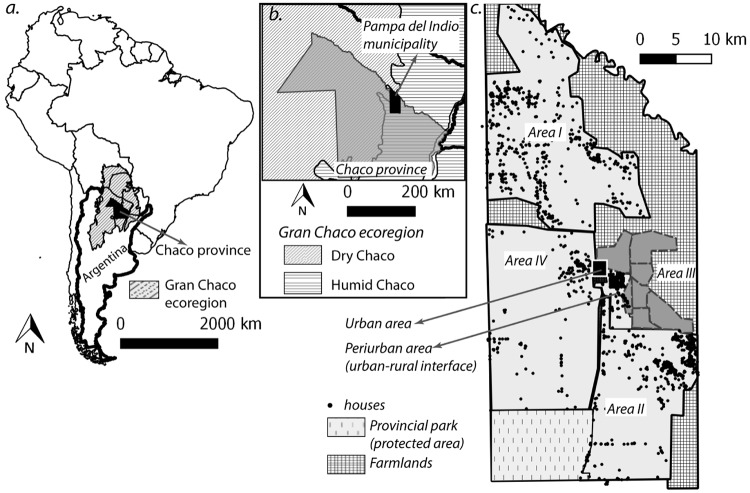
Rapid reinfestation of insecticide-treated dwellings hamper the sustained elimination of Triatoma infestans, the main vector of Chagas disease in the Gran Chaco region. We conducted a seven-year longitudinal study including community-wide spraying with pyrethroid insecticides combined with periodic vector surveillance to investigate the house reinfestation process in connection with baseline pyrethroid resistance, housing quality and household mobility in a rural section of Pampa del Indio mainly inhabited by deprived indigenous people (Qom).
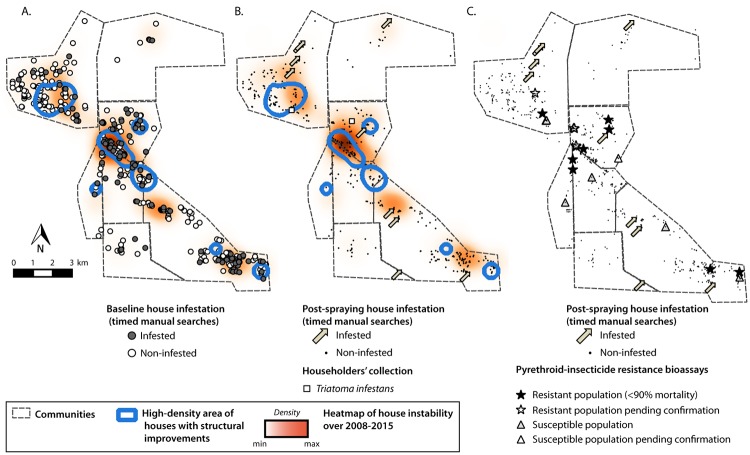
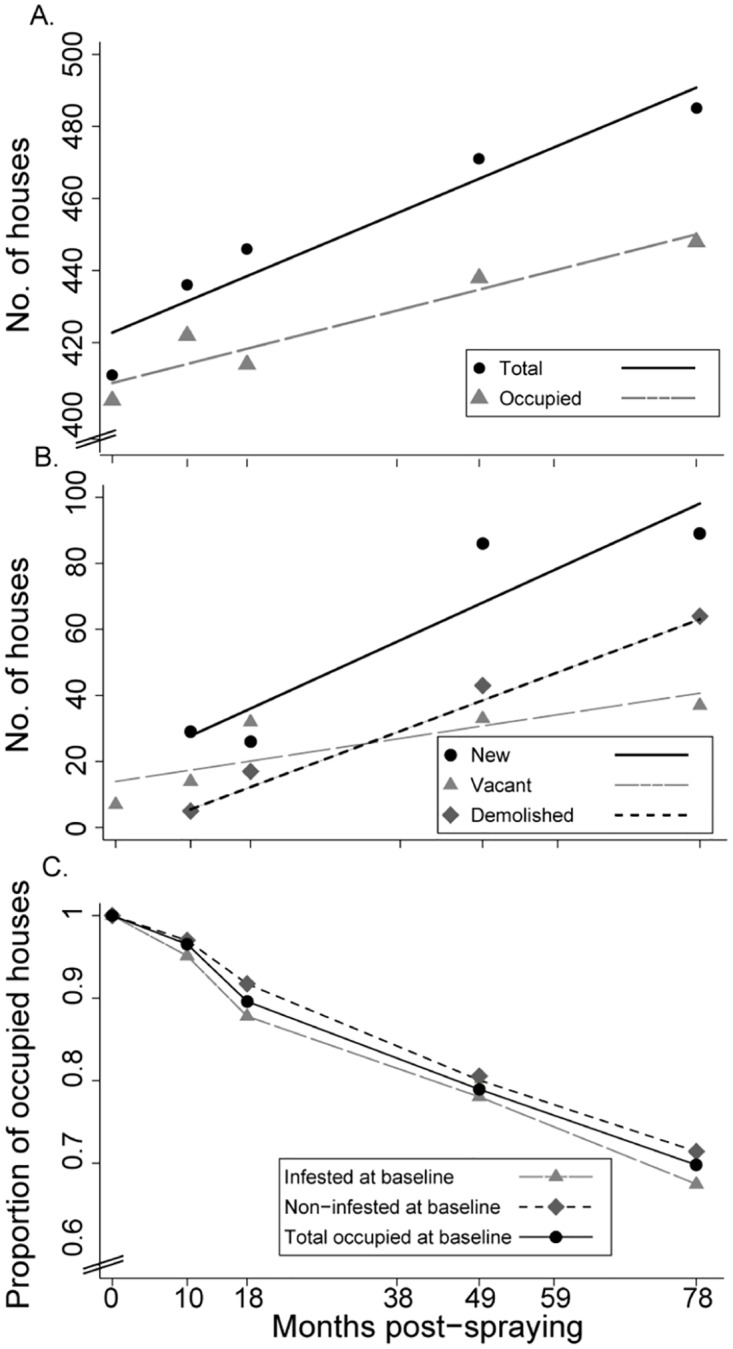
METHODOLOGY/PRINCIPAL FINDINGS: Despite evidence of moderate pyrethroid resistance in local T. infestans populations, house infestation dropped from 31.9% at baseline to 0.7% at 10 months post-spraying (MPS), with no triatomine found at 59 and 78 MPS. Household-based surveillance corroborated the rare occurrence of T. infestans and the house invasion of other four triatomine species. The annual rates of loss of initially occupied houses and of household mobility were high (4.6-8.0%). Housing improvements did not translate into a significant reduction of mud-walled houses and refuges for triatomines because most households kept the former dwelling or built new ones with mud walls.
CONCLUSIONS/SIGNIFICANCE: Our results refute the assumption that vector control actions performed in marginalized communities of the Gran Chaco are doomed to fail. The larger-than-expected impacts of the intervention program were likely associated with the combined effects of high-coverage, professional insecticide spraying followed by systematic vector surveillance-and-response, broad geographic coverage creating a buffer zone, frequent housing replacement and residential mobility. The dynamical interactions among housing quality, mobility and insecticide-based control largely affect the chances of vector elimination.
经杀虫剂处理的住宅迅速再次滋生昆虫,这阻碍了查加斯病主要媒介——刺股锥蝽在大查科地区的持续消灭。我们开展了一项为期七年的纵向研究,包括对整个社区使用拟除虫菊酯杀虫剂进行喷洒,并结合定期的病媒监测,以调查在一个主要居住着贫困土著人(高乔人)的潘帕德尔因迪奥农村地区,与基线拟除虫菊酯抗性、住房质量和家庭流动性有关的住宅再滋生过程。
方法/主要发现:尽管当地锥蝽种群存在中度拟除虫菊酯抗性的证据,但房屋感染率从基线时的 31.9%下降到喷洒后 10 个月时的 0.7%,在喷洒后 59 和 78 个月时未发现任何三锥虫。以家庭为基础的监测证实了罕见的锥蝽发生和其他四种三锥虫物种对房屋的入侵。最初居住房屋的年流失率和家庭流动性很高(4.6-8.0%)。住房改善并没有显著减少泥墙房屋和三锥虫的避难所,因为大多数家庭保留了原来的住所或用泥墙建造了新的住所。
结论/意义:我们的结果驳斥了在大查科边缘化社区开展病媒控制行动注定会失败的假设。干预计划产生的影响大于预期,这可能与高覆盖率、专业杀虫剂喷洒以及随后的系统病媒监测和应对、广泛的地理覆盖范围创造缓冲区、频繁的住房更替和居住流动性相结合的综合效应有关。住房质量、流动性和基于杀虫剂的控制之间的动态相互作用在很大程度上影响了病媒消除的机会。