Brito Raíssa N, Gorla David E, Diotaiuti Liléia, Gomes Anália C F, Souza Rita C M, Abad-Franch Fernando
Grupo Triatomíneos, Instituto René Rachou-Fiocruz Minas Gerais, Belo Horizonte, Minas Gerais, Brazil.
Laboratorio de Eco-Epidemiología Espacial de Enfermedades Transmitidas por Vectores, Instituto de Altos Estudios Espaciales Mario Gulich-CONAE / Universidad Nacional de Córdoba-CONICET, Falda del Cañete, Córdoba, Argentina.
PLoS Negl Trop Dis. 2017 Nov 16;11(11):e0006035. doi: 10.1371/journal.pntd.0006035. eCollection 2017 Nov.
Insecticide spraying efficiently controls house infestation by triatomine bugs, the vectors of Trypanosoma cruzi. The strategy, however, is ineffective against sylvatic triatomines, which can transmit Chagas disease by invading (without colonizing) man-made structures. Despite growing awareness of the relevance of these transmission dynamics, the drivers of house invasion by sylvatic triatomines remain poorly understood.
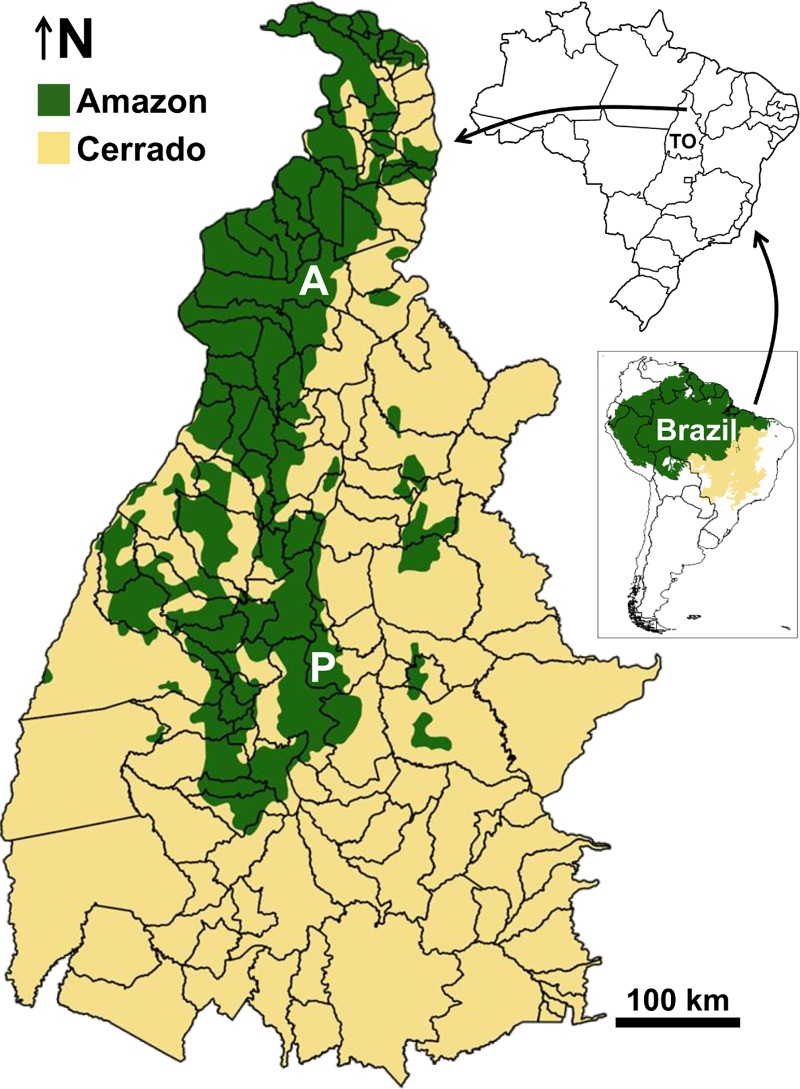
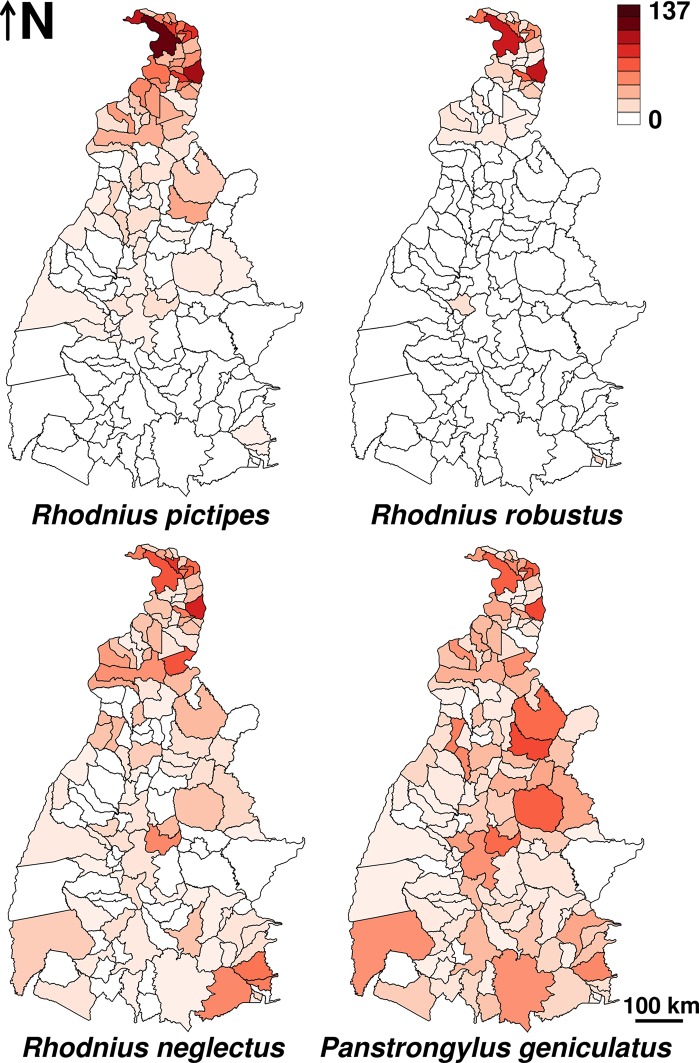
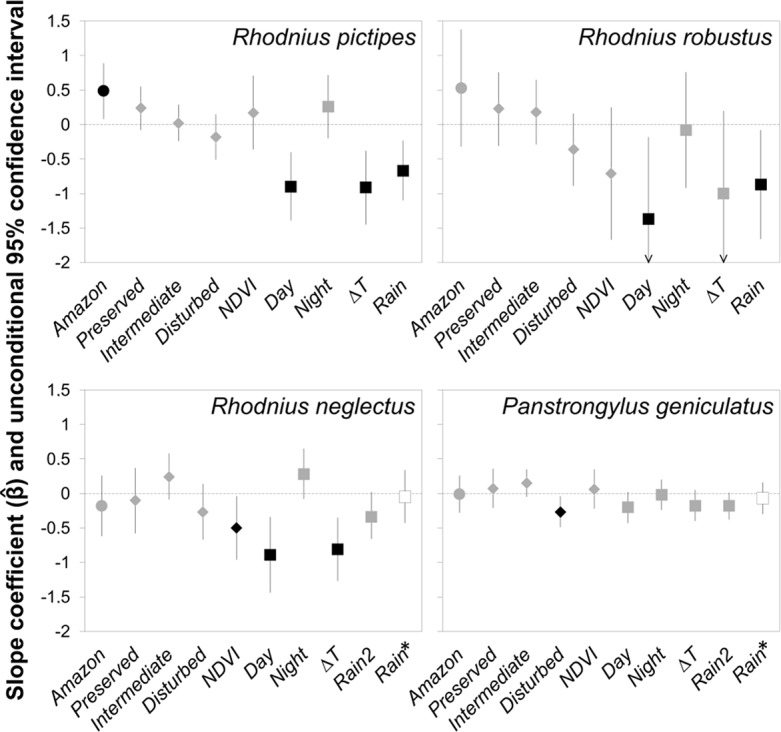
METHODS/FINDINGS: About 12,000 sylvatic triatomines were caught during routine surveillance in houses of Tocantins state, Brazil, in 2005-2013. Using negative binomial regression, information-theoretic model evaluation/averaging, and external model validation, we investigated the effects of regional (Amazon/Cerrado), landscape (preservation/disturbance), and climate covariates (temperature, rainfall) on the municipality-aggregated numbers of house-invading Rhodnius pictipes, R. robustus, R. neglectus, and Panstrongylus geniculatus. House invasion by R. pictipes and R. robustus was overall more frequent in the Amazon biome, tended to increase in municipalities with more well-preserved land, and decreased in rainier municipalities. Across species, invasion decreased with higher landscape-disturbance levels and in hotter-day municipalities. Invasion by R. neglectus and P. geniculatus increased somewhat with more land at intermediate disturbance and peaked in average-rainfall municipalities. Temperature effects were more pronounced on P. geniculatus than on Rhodnius spp.
We report widespread, frequent house invasion by sylvatic triatomines in the Amazon-Cerrado transition. Our analyses indicate that readily available environmental metrics may help predict the risk of contact between sylvatic triatomines and humans at coarse geographic scales, and hint at specific hypotheses about climate and deforestation effects on those vectors-with some taxon-specific responses and some seemingly general trends. Thus, our focal species appear to be quite sensitive to higher temperatures, and might be less common in more heavily-disturbed than in better-preserved environments. This study illustrates, in sum, how entomological routine-surveillance data can be efficiently used for Chagas disease risk prediction and stratification when house-colonizing vectors are absent.
喷洒杀虫剂能有效控制锥蝽(克氏锥虫的传播媒介)对房屋的侵扰。然而,该策略对野生锥蝽无效,野生锥蝽可通过侵入(而非定居)人造建筑来传播恰加斯病。尽管人们越来越意识到这些传播动态的相关性,但对野生锥蝽侵入房屋的驱动因素仍知之甚少。
方法/发现:2005年至2013年期间,在巴西托坎廷斯州的房屋进行常规监测时捕获了约12000只野生锥蝽。我们使用负二项回归、信息论模型评估/平均以及外部模型验证,研究了区域(亚马逊/塞拉多)、景观(保护/干扰)和气候协变量(温度、降雨量)对聚集在各市镇的侵入房屋的美饰锥蝽、强壮锥蝽、忽视锥蝽和膝状锥猎蝽数量的影响。美饰锥蝽和强壮锥蝽侵入房屋的情况总体上在亚马逊生物群落中更为频繁,在土地保存较好的市镇有增加趋势,而在降雨较多的市镇有所减少。在所有物种中,侵入情况随着景观干扰水平的提高以及在天气较热的市镇而减少。忽视锥蝽和膝状锥猎蝽的侵入在中等干扰程度且土地较多的情况下有所增加,并在平均降雨量的市镇达到峰值。温度对膝状锥猎蝽的影响比对锥蝽属物种更为明显。
我们报告了在亚马逊 - 塞拉多过渡地区野生锥蝽广泛且频繁地侵入房屋的情况。我们的分析表明,现有的环境指标可能有助于在粗略的地理尺度上预测野生锥蝽与人类接触的风险,并暗示了关于气候和森林砍伐对这些媒介影响的具体假设——有一些特定分类群的反应以及一些看似普遍的趋势。因此,我们关注的物种似乎对较高温度相当敏感,并且在受干扰严重的环境中可能比在保存较好的环境中更不常见。总之,这项研究说明了在没有定居房屋的媒介时,昆虫学常规监测数据如何能有效地用于恰加斯病风险预测和分层。