Buendía-Monreal Manuel, Gillmor C Stewart
Laboratorio Nacional de Genómica para la Biodiversidad (Langebio), Unidad de Genómica Avanzada, Centro de Investigación y de Estudios Avanzados del Instituto Politécnico Nacional (CINVESTAV-IPN), Guanajuato, Mexico.
Front Plant Sci. 2018 Sep 18;9:1349. doi: 10.3389/fpls.2018.01349. eCollection 2018.
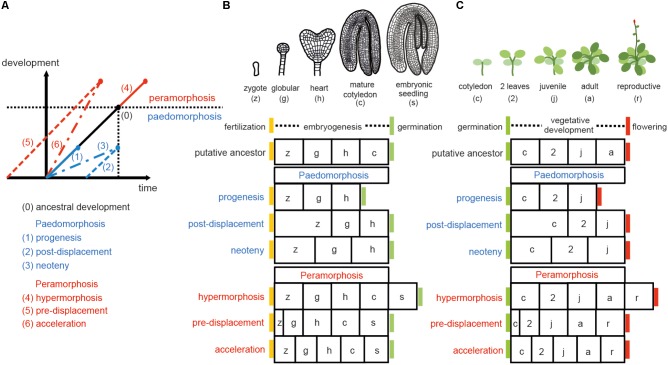
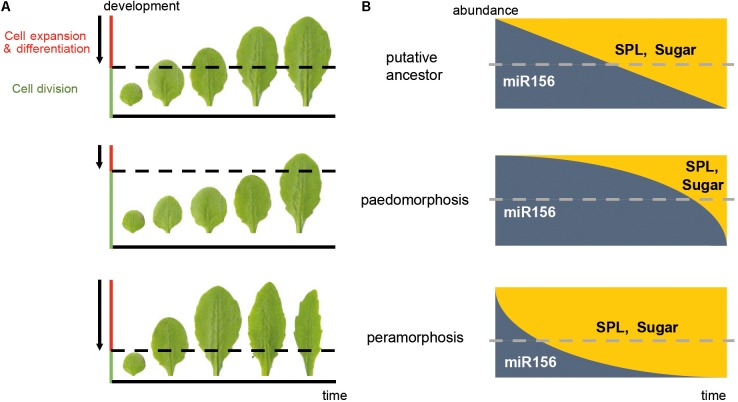
Alterations in the timing of developmental programs during evolution, that lead to changes in the shape, or size of organs, are known as heterochrony. Heterochrony has been widely studied in animals, but has often been neglected in plants. During plant evolution, heterochronic shifts have played a key role in the origin and diversification of leaves, roots, flowers, and fruits. Heterochrony that results in a juvenile or simpler outcome is known as paedomorphosis, while an adult or more complex outcome is called peramorphosis. Mechanisms that alter developmental timing at the cellular level affect cell proliferation or differentiation, while those acting at the tissue or organismal level change endogenous aging pathways, morphogen signaling, and metabolism. We believe that wider consideration of heterochrony in the context of evolution will contribute to a better understanding of plant development.
在进化过程中,发育程序时间安排的改变会导致器官形状或大小的变化,这被称为异时性。异时性在动物中已得到广泛研究,但在植物中却常常被忽视。在植物进化过程中,异时性转变在叶、根、花和果实的起源与多样化中发挥了关键作用。导致幼年或更简单结果的异时性被称为幼态持续,而导致成年或更复杂结果的异时性则被称为超形态。在细胞水平上改变发育时间的机制会影响细胞增殖或分化,而在组织或生物体水平上起作用的机制则会改变内源性衰老途径、形态发生素信号传导和新陈代谢。我们认为,在进化背景下更广泛地考虑异时性将有助于更好地理解植物发育。