Laturney Meghan, van Eijk Roel, Billeter Jean-Christophe
Groningen Institute for Evolutionary Life Sciences University of Groningen PO Box 11103 Groningen 9700 CC The Netherlands.
Evol Lett. 2018 Apr 13;2(3):180-189. doi: 10.1002/evl3.50. eCollection 2018 Jun.
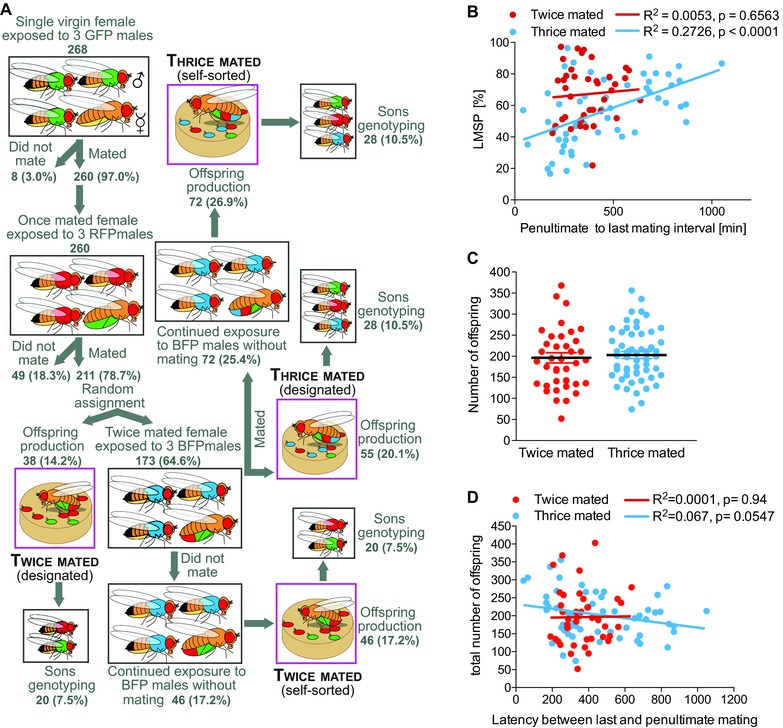
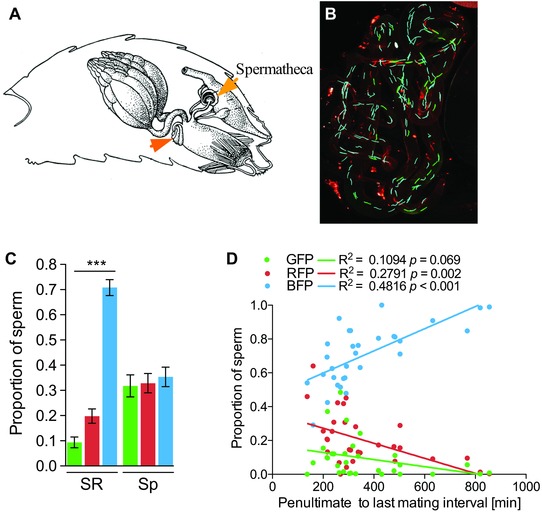
Following multiple matings, sperm from different males compete for fertilization within the female reproductive tract. In many species, this competition results in an unequal sharing of paternity that favors the most recent mate, termed last male sperm precedence (LMSP). Much of our understanding of LMSP comes from studies in that focus on twice-mated females with standardized latencies between successive matings. Despite accumulating evidence indicating that females often mate with more than two males and exhibit variation in the latency between matings, the consequences of mating rate on LMSP are poorly understood. Here, we developed a paradigm utilizing in which females remated at various time intervals with either two or three transgenic males that produce fluorescent sperm (green, red, or blue). This genetic manipulation enables paternity assessment of offspring and male-specific sperm fate examination in female reproductive tracts. We found that remating latency had no relationship with LMSP in females that mated with two males. However, LMSP was significantly reduced in thrice-mated females with short remating intervals; coinciding with reduced last-male sperm storage. Thus, female remating rate influences the relative share of paternity, the overall clutch paternity diversity, and ultimately the acquisition of indirect genetic benefits to potentially maximize female reproductive success.
在多次交配后,来自不同雄性的精子会在雌性生殖道内竞争受精。在许多物种中,这种竞争导致父权的不平等分配,有利于最后交配的雄性,即所谓的最后雄配优先(LMSP)。我们对LMSP的大部分理解来自于那些专注于连续交配间隔标准化的两次交配雌性的研究。尽管越来越多的证据表明雌性通常会与两个以上的雄性交配,并且交配间隔存在差异,但交配率对LMSP的影响却知之甚少。在这里,我们开发了一种模式,利用转基因雄性,雌性可以在不同的时间间隔与两个或三个产生荧光精子(绿色、红色或蓝色)的转基因雄性再次交配。这种基因操作能够对后代进行父权评估,并在雌性生殖道中检查特定雄性的精子命运。我们发现,在与两个雄性交配的雌性中,再次交配间隔与LMSP没有关系。然而,在再次交配间隔短的三次交配雌性中,LMSP显著降低;这与最后雄配精子储存量减少相吻合。因此,雌性再次交配率会影响父权的相对份额、整个窝卵的父权多样性,并最终影响间接遗传益处的获得,从而有可能使雌性生殖成功率最大化。