Department of Electrical and Computer Engineering, Seoul National University, room 908 Bldg. 301, 1 Gwanak-ro, Gwanak-gu, Seoul, 08826, Korea.
Department of Brain and Cognitive Sciences, Seoul National University College of Natural Sciences, Seoul, Korea.
BMC Geriatr. 2018 Oct 3;18(1):234. doi: 10.1186/s12877-018-0915-z.
The conventional scores of the neuropsychological batteries are not fully optimized for diagnosing dementia despite their variety and abundance of information. To achieve low-cost high-accuracy diagnose performance for dementia using a neuropsychological battery, a novel framework is proposed using the response profiles of 2666 cognitively normal elderly individuals and 435 dementia patients who have participated in the Korean Longitudinal Study on Cognitive Aging and Dementia (KLOSCAD).
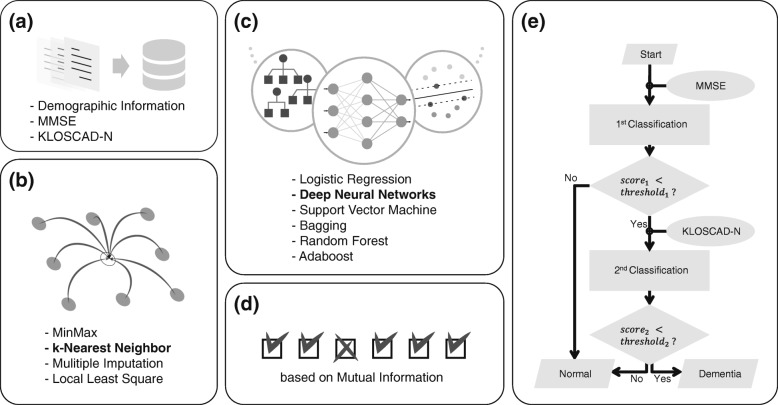
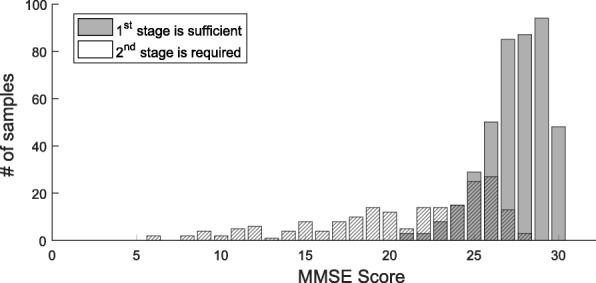
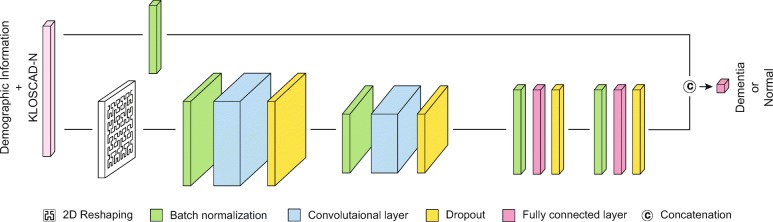
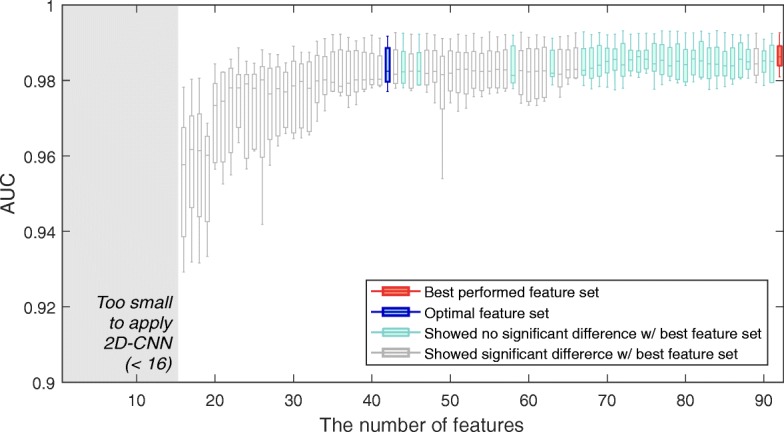
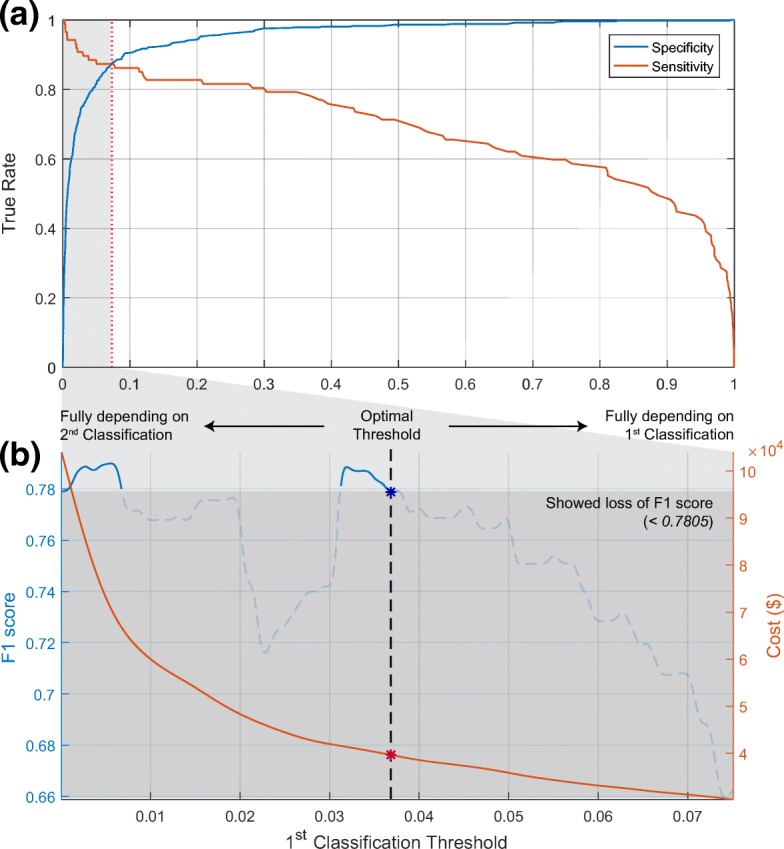
The key idea of the proposed framework is to propose a cost-effective and precise two-stage classification procedure that employed Mini Mental Status Examination (MMSE) as a screening test and the KLOSCAD Neuropsychological Assessment Battery as a diagnostic test using deep learning. In addition, an evaluation procedure of redundant variables is introduced to prevent performance degradation. A missing data imputation method is also presented to increase the robustness by recovering information loss. The proposed deep neural networks (DNNs) architecture for the classification is validated through rigorous evaluation in comparison with various classifiers.
The k-nearest-neighbor imputation has been induced according to the proposed framework, and the proposed DNNs for two stage classification show the best accuracy compared to the other classifiers. Also, 49 redundant variables were removed, which improved diagnostic performance and suggested the potential of simplifying the assessment. Using this two-stage framework, we could get 8.06% higher diagnostic accuracy of dementia than MMSE alone and 64.13% less cost than KLOSCAD-N alone.
The proposed framework could be applied to general dementia early detection programs to improve robustness, preciseness, and cost-effectiveness.
尽管神经心理学测试的种类繁多且信息量丰富,但它们的常规评分并不能完全优化用于诊断痴呆症。为了使用神经心理学测试实现低成本、高精度的痴呆症诊断性能,我们提出了一种新的框架,该框架使用了参加韩国认知衰老和痴呆症纵向研究(KLOSCAD)的 2666 名认知正常的老年人和 435 名痴呆症患者的反应特征。
该框架的关键思想是提出一种具有成本效益且精确的两阶段分类程序,该程序使用简易精神状态检查(MMSE)作为筛选测试,使用深度学习的 KLOSCAD 神经心理学评估电池作为诊断测试。此外,引入了冗余变量的评估过程,以防止性能下降。还提出了一种缺失数据插补方法,通过恢复信息丢失来提高稳健性。通过与各种分类器的严格评估比较,验证了用于分类的所提出的深度神经网络(DNN)架构。
根据所提出的框架进行了 K-最近邻插补,与其他分类器相比,所提出的用于两阶段分类的 DNN 显示出最佳的准确性。此外,还去除了 49 个冗余变量,这提高了诊断性能并表明了简化评估的潜力。使用此两阶段框架,我们可以获得比 MMSE 单独使用高 8.06%的痴呆症诊断准确性,比 KLOSCAD-N 单独使用低 64.13%的成本。
所提出的框架可应用于一般的痴呆症早期检测计划,以提高稳健性、精确性和成本效益。