Institute of Functional and Applied Anatomy, Hannover Medical School, Hannover, Germany.
Department of Nuclear Medicine, Hannover Medical School, Hannover, Germany.
PLoS One. 2018 Oct 4;13(10):e0205247. doi: 10.1371/journal.pone.0205247. eCollection 2018.
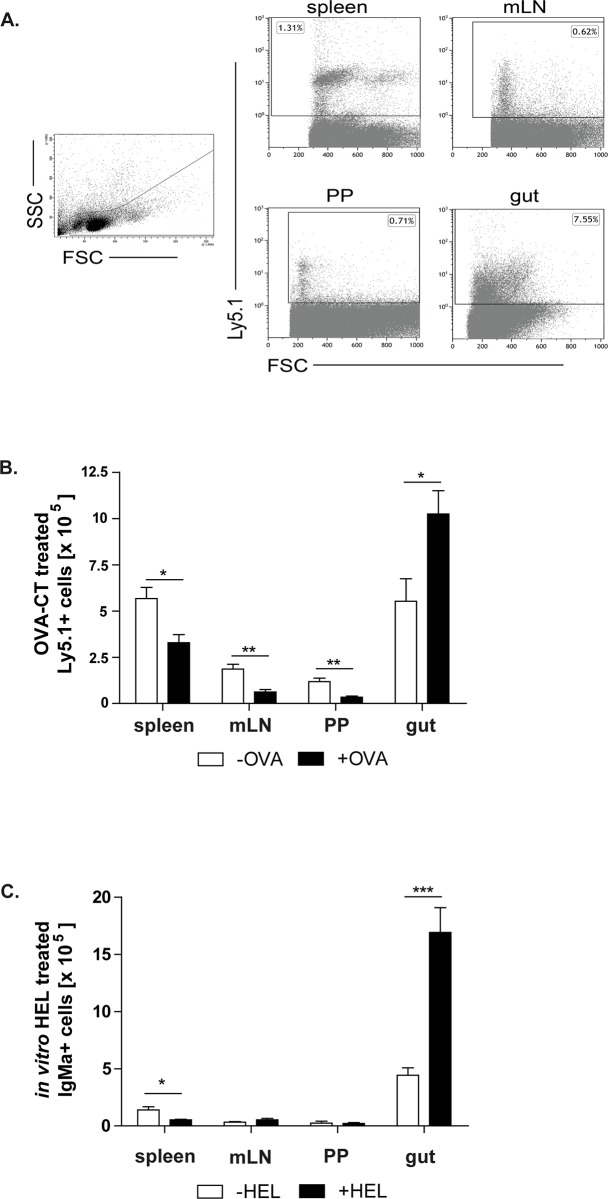
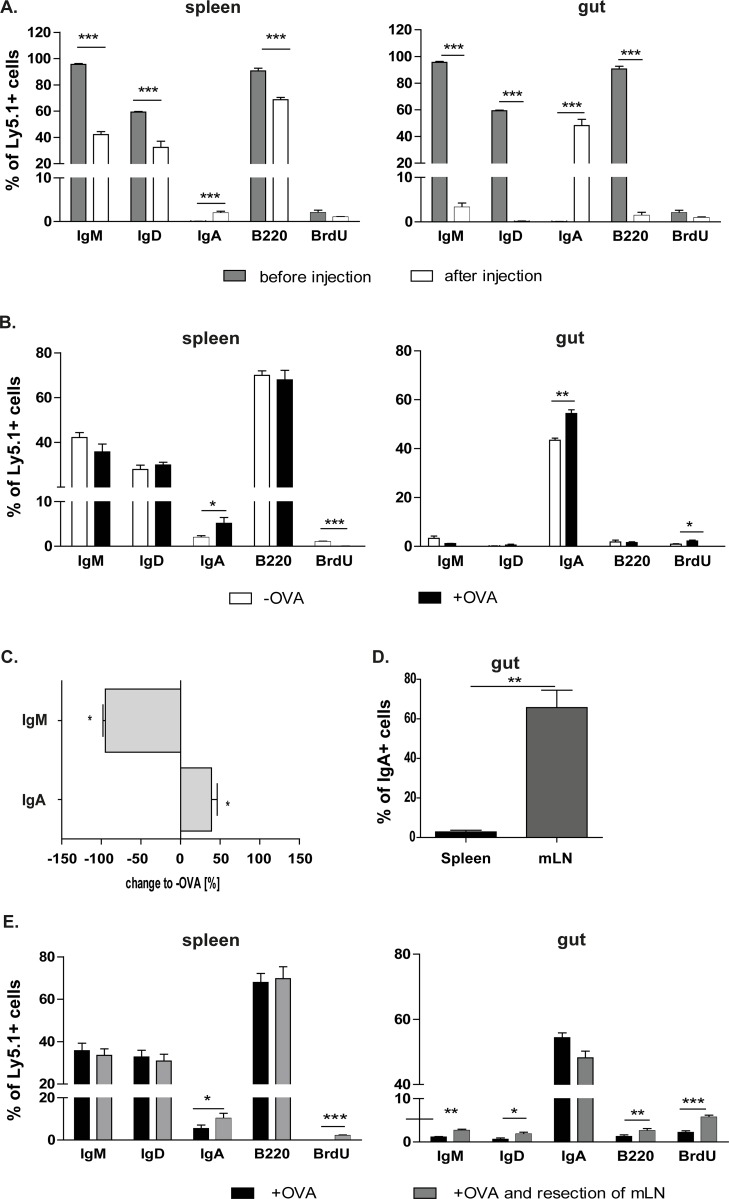
The role of the spleen in the induction of an immune response to orally administered antigens is still under discussion. Although it is well known that after oral antigen administration specific germinal centres are not only formed in the Peyers patches (PP) and the mesenteric lymph nodes (mLN) but also in the spleen, there is still a lack of functional data showing a direct involvement of splenic B cells in an IgA immune response in the gut. In addition, after removal of mLN a high level of IgA+ B cells was observed in the gut. Therefore, in this study we analysed the role of the spleen in the induction of IgA+ B cells in the gut after mice were orally challenged with antigens. Here we have shown that antigen specific splenic IgM+ B cells after in vitro antigen stimulation as well as oral immunisation of donor mice were able to migrate into the gut of recipient mice, where they predominantly switch to IgA+ plasma cells. Furthermore, stimulation of recipient mice by orally administered antigens enhanced the migration of the splenic B cells into the gut as well as their switch to IgA+ plasma cells. Removal of the mLN led to a higher activation level of the splenic B cells. Altogether, our results imply that splenic IgM+ B cells migrate in the intestinal lamina propria, where they differentiate into IgA+ plasma cells and subsequently proliferate. In conclusion, we demonstrated that the spleen plays a major role in the gut immune response serving as a reservoir of immune cells that migrate to the site of antigen entrance.
脾脏在诱导口服抗原产生免疫应答中的作用仍存在争议。虽然众所周知,口服抗原给药后,特异性生发中心不仅在派尔氏斑(PP)和肠系膜淋巴结(mLN)中形成,而且在脾脏中也形成,但仍缺乏功能数据表明脾脏 B 细胞直接参与肠道中的 IgA 免疫应答。此外,在去除 mLN 后,在肠道中观察到高水平的 IgA+B 细胞。因此,在这项研究中,我们分析了脾脏在口服抗原挑战后诱导肠道中 IgA+B 细胞中的作用。在这里,我们已经表明,抗原特异性脾脏 IgM+B 细胞在体外抗原刺激后以及供体小鼠的口服免疫后,能够迁移到受体小鼠的肠道中,在那里它们主要转化为 IgA+浆细胞。此外,通过口服给予抗原刺激受体小鼠增强了脾脏 B 细胞向肠道的迁移以及它们向 IgA+浆细胞的转化。去除 mLN 导致脾脏 B 细胞的激活水平升高。总之,我们的结果表明,脾脏中的 IgM+B 细胞迁移到肠固有层中,在那里它们分化为 IgA+浆细胞并随后增殖。总之,我们证明脾脏在肠道免疫反应中起着重要作用,作为迁移到抗原进入部位的免疫细胞的储库。