Department of Epidemiology, Johns Hopkins Bloomberg School of Public Health, Baltimore, Maryland, USA.
Social and Cardiovascular Epidemiology Research Group, Universidad de Alcalá, Madrid, Spain.
BMJ Open. 2018 Oct 4;8(9):e021143. doi: 10.1136/bmjopen-2017-021143.
To study the association between neighbourhood socioeconomic status and diabetes prevalence, incidence, and control in the entire population of northeastern Madrid, Spain.
Electronic health records of the primary-care system in four districts of Madrid (Spain).
269 942 people aged 40 or older, followed from 2013 to 2014.
Neighbourhoodsocioeconomic status (NSES), measured using a composite index of seven indicators from four domains of education, wealth, occupation and living conditions.
Diagnosis of diabetes based on ICPC-2 codes and glycated haemoglobin (HbA1c %).
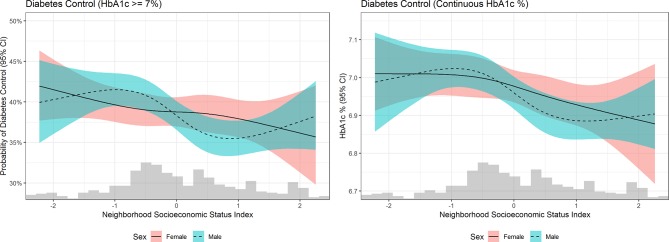
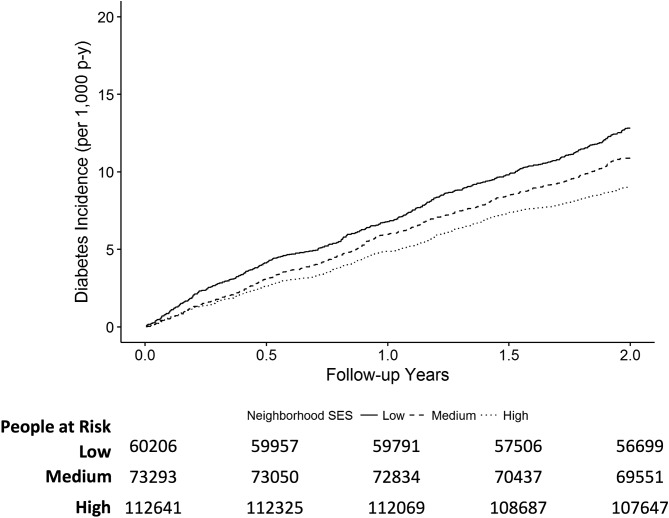
In regression analyses adjusted by age and sex and compared with individuals living in low NSES neighbourhoods, men living in medium and high NSES neighbourhoods had 10% (95% CI: 6% to 15%) and 29% (95% CI: 25% to 32%) lower prevalence of diabetes, while women had 27% (95% CI: 23% to 30%) and 50% (95% CI: 47% to 52%) lower prevalence of diabetes. Moreover, the hazard of diabetes in men living in medium and high NSES neighbourhoods was 13% (95% CI: 1% to 23%) and 20% (95% CI: 9% to 29%) lower, while the hazard of diabetes in women living in medium and high NSES neighbourhoods was 17% (95% CI: 3% to 29%) and 31% (95% CI: 20% to 41%) lower. Individuals living in medium and high SES neighbourhoods had 8% (95% CI: 2% to 15%) and 15% (95% CI: 9% to 21%) lower prevalence of lack of diabetes control, and a decrease in average HbA1c % of 0.05 (95% CI: 0.01 to 0.10) and 0.11 (95% CI: 0.06 to 0.15).
Diabetes prevalence, incidence and lack of control increased with decreasing NSES in a southern European city. Future studies should provide mechanistic insights and targets for intervention to address this health inequity.
研究西班牙马德里东北部全部人群的邻里社会经济地位与糖尿病患病率、发病率和控制之间的关系。
马德里四个区初级保健系统的电子健康记录。
2013 年至 2014 年间,年龄在 40 岁或以上的 269942 人。
邻里社会经济地位(NSES),使用来自教育、财富、职业和生活条件四个领域的七个指标的综合指数进行衡量。
根据国际疾病分类临床修订版第二版(ICPC-2)代码和糖化血红蛋白(HbA1c%)诊断糖尿病。
在按年龄和性别调整的回归分析中,与居住在低 NSES 邻里的个体相比,居住在中高 NSES 邻里的男性糖尿病患病率分别降低 10%(95%置信区间:6%至 15%)和 29%(95%置信区间:25%至 32%),而女性则分别降低 27%(95%置信区间:23%至 30%)和 50%(95%置信区间:47%至 52%)。此外,居住在中高 NSES 邻里的男性发生糖尿病的风险分别降低 13%(95%置信区间:1%至 23%)和 20%(95%置信区间:9%至 29%),而居住在中高 NSES 邻里的女性发生糖尿病的风险分别降低 17%(95%置信区间:3%至 29%)和 31%(95%置信区间:20%至 41%)。居住在中高 SES 邻里的人群糖尿病控制不良的比例分别降低 8%(95%置信区间:2%至 15%)和 15%(95%置信区间:9%至 21%),平均 HbA1c%分别降低 0.05(95%置信区间:0.01 至 0.10)和 0.11(95%置信区间:0.06 至 0.15)。
在一个南欧城市,随着邻里社会经济地位的下降,糖尿病的患病率、发病率和控制不良的情况增加。未来的研究应该提供机制上的见解和干预目标,以解决这种健康不平等现象。