Chang Christopher
New Mexico VA Health Care System, Division of Gastroenterology and Hepatology, Albuquerque, NM, USA,
Department of Internal Medicine, University of New Mexico School of Medicine, Albuquerque, NM, USA,
Clin Exp Gastroenterol. 2018 Sep 24;11:335-345. doi: 10.2147/CEG.S167031. eCollection 2018.
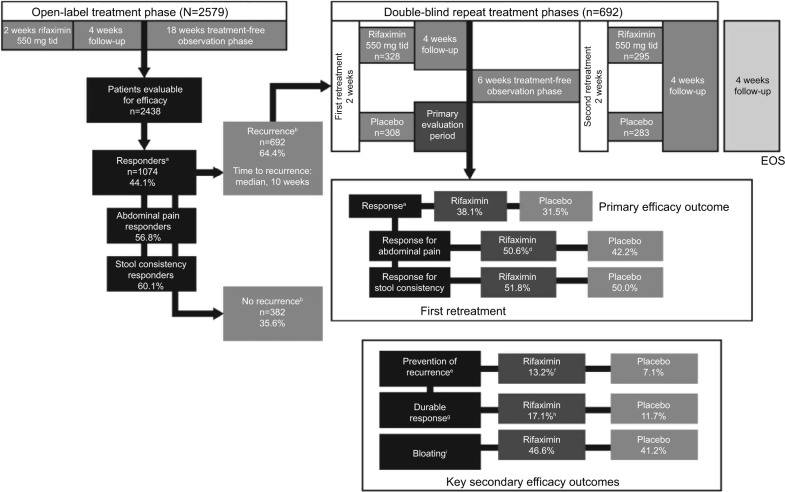
Irritable bowel syndrome (IBS) is a common gastrointestinal (GI) disorder characterized by abdominal pain that occurs with defecation or alterations in bowel habits. Further classification is based on the predominant bowel habit: constipation-predominant IBS, diarrhea-predominant IBS (IBS-D), or mixed IBS. The pathogenesis of IBS is unclear and is considered multifactorial in nature. GI dysbiosis, thought to play a role in IBS pathophysiology, has been observed in patients with IBS. Alterations in the gut microbiota are observed in patients with small intestinal bacterial overgrowth, and overgrowth may occur in a subset of patients with IBS. The management of IBS includes therapies targeting the putative factors involved in the pathogenesis of the condition. However, many of these interventions (eg, eluxadoline and alosetron) require long-term, daily administration and have important safety considerations. Agents thought to modulate the gut microbiota (eg, antibiotics and probiotics) have shown potential benefits in clinical studies. However, conventional antibiotics (eg, neomycin) are associated with several adverse events and/or the risk of bacterial antibiotic resistance, and probiotics lack uniformity in composition and consistency of response in patients. Rifaximin, a nonsystemic antibiotic administered as a 2-week course of therapy, has been shown to be safe and efficacious for the treatment of IBS-D. Rifaximin exhibits a favorable benefit-to-harm ratio when compared with daily therapies for IBS-D (eg, alosetron and tricyclic antidepressants), and rifaximin was not associated with the emergence of bacterial antibiotic resistance. Thus, short-course therapy with rifaximin is an appropriate treatment option for IBS-D.
肠易激综合征(IBS)是一种常见的胃肠道(GI)疾病,其特征为排便时出现腹痛或排便习惯改变。进一步的分类基于主要的排便习惯:以便秘为主的IBS、以腹泻为主的IBS(IBS-D)或混合型IBS。IBS的发病机制尚不清楚,被认为具有多因素性质。肠道菌群失调被认为在IBS的病理生理学中起作用,在IBS患者中已观察到这种情况。在小肠细菌过度生长的患者中观察到肠道微生物群的改变,并且在一部分IBS患者中可能会发生过度生长。IBS的管理包括针对该疾病发病机制中假定因素的治疗。然而,许多这些干预措施(例如,eluxadoline和alosetron)需要长期每日给药,并且有重要的安全考虑因素。被认为可调节肠道微生物群的药物(例如,抗生素和益生菌)在临床研究中已显示出潜在益处。然而,传统抗生素(例如,新霉素)与多种不良事件和/或细菌抗生素耐药性风险相关,并且益生菌在患者中的成分缺乏一致性以及反应缺乏一致性。利福昔明是一种非全身性抗生素,作为为期2周的疗程给药,已被证明对治疗IBS-D安全有效。与IBS-D的每日疗法(例如,alosetron和三环类抗抑郁药)相比,利福昔明具有良好的利弊比,并且利福昔明与细菌抗生素耐药性的出现无关。因此,利福昔明短疗程治疗是IBS-D的一种合适治疗选择。