Department of Biochemistry and Molecular Biology, College of Medicine, Medical University of South Carolina, Charleston, SC, United States of America.
Stony Brook University School of Medicine, Stony Brook, NY, United States of America.
PLoS One. 2018 Oct 5;13(10):e0205077. doi: 10.1371/journal.pone.0205077. eCollection 2018.
Human papillomavirus (HPV) infected oropharyngeal squamous cell carcinoma (OPSCC) patients have a better prognosis compared to HPV(-) counterparts. However, a subset of HPV(+) patients with a smoking history fail to respond to the standard of care treatments such as radiation and chemotherapy. To understand the underlying mechanism driving HPV(+) OPSCC patient resistance to treatment and recurrence, we sought to identify and characterize the differentially expressed miRNAs and their target genes in HPV(+) smokers and non-smokers.
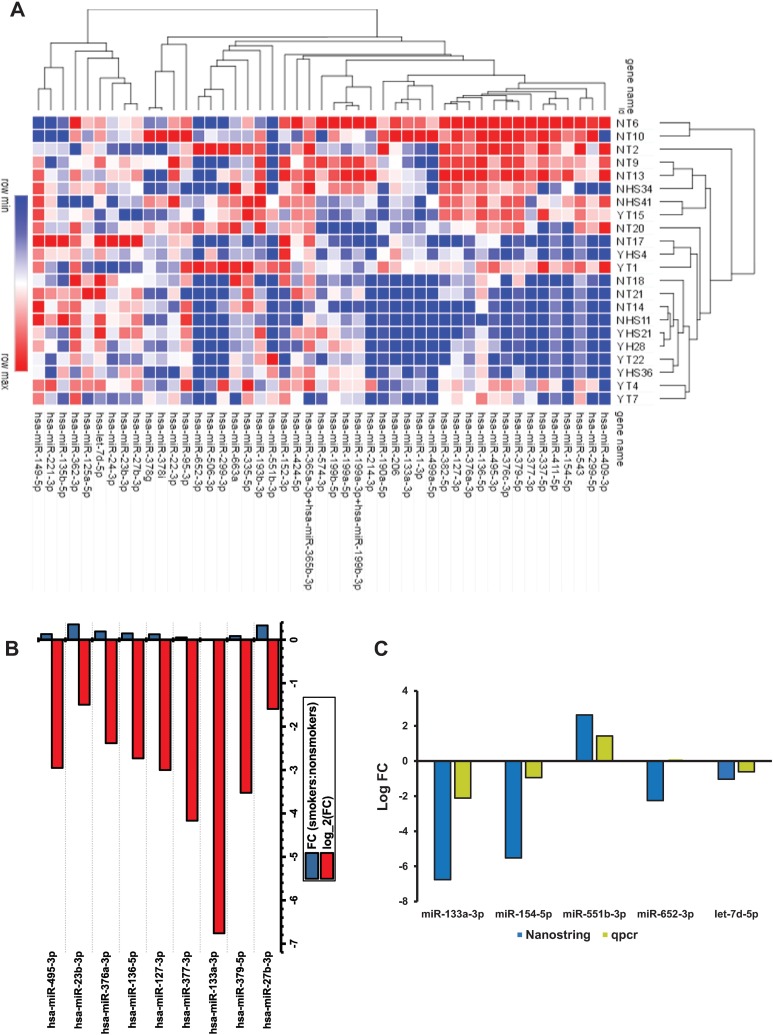
MicroRNA expression analysis was performed using Nanostring in tumor tissues isolated from a prospective cohort of HPV(+) smoking (n = 9) and HPV(+) (n = 13) non-smoking OPSCC patients. Identified miRNAs of interest were further validated using qRT-PCR in cigarette smoke extract (CSE) treated HPV(+) and E6/E7 overexpressing HPV(-) cells.
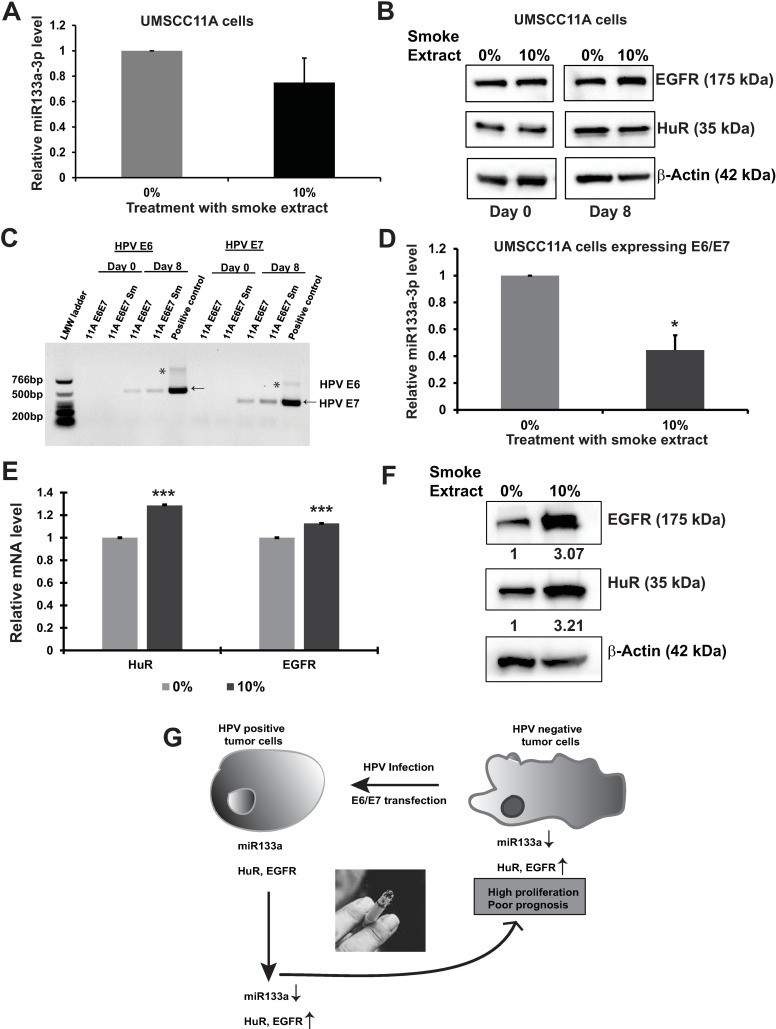
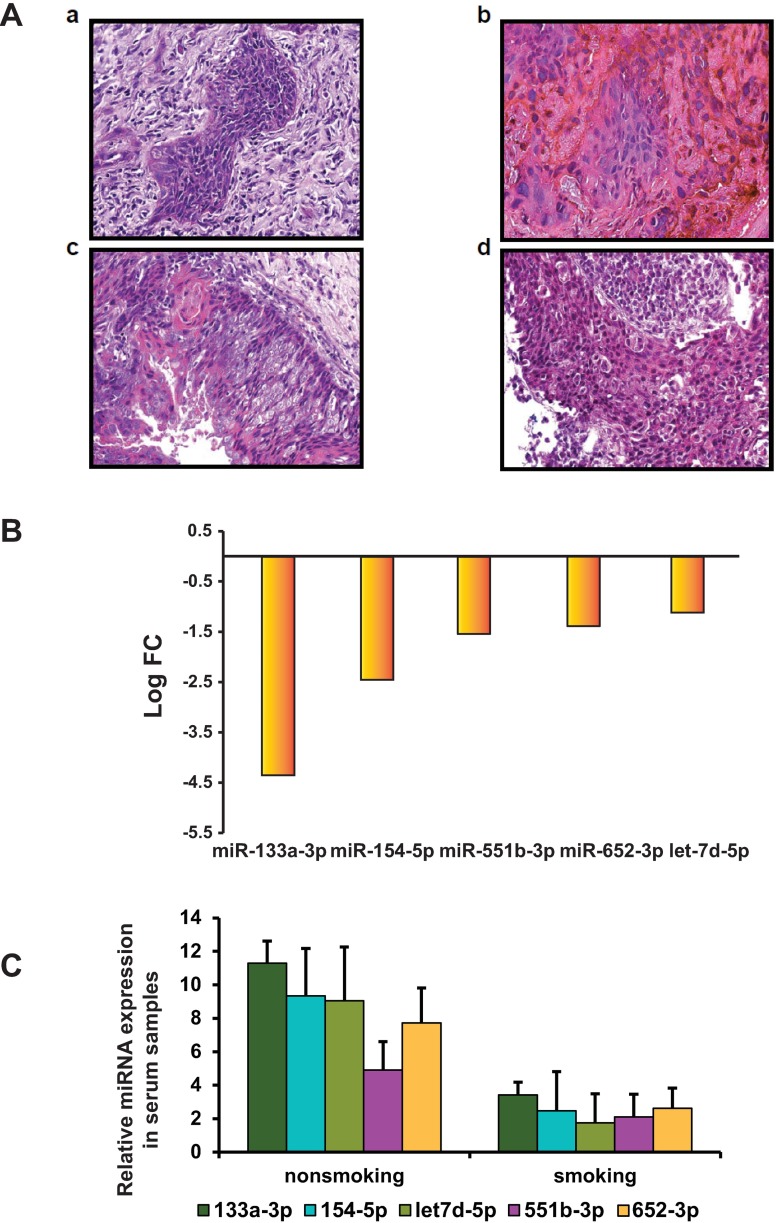
In comparison to OPSCC HPV(+) non-smokers, 38 miRNAs were significantly altered in the HPV(+) smoker patients cohort and out of that 9 were downregulated. Altered miRNA expression was also detected in the serum and metastatic lymph nodes of HPV(+) smokers versus non-smokers. Expression of miR-133a-3p was significantly downregulated in OPSCC smokers, HPV(+) cells and E6/E7 overexpressing HPV(-) cells treated with CSE. Reduction of miR-133a-3p induced the upregulation of miR-133a-3p target mRNAs EGFR and HuR.
Our results indicate that miR-133a-3p is a target of smoking-induced changes in HPV(+) patients and alters the expression of EGFR and HuR which may promote HPV associated oropharyngeal cancer. Therefore, future treatment strategies for HPV(+) OPSCC smokers should focus on EGFR inhibition and the development of selective therapies to target HuR.
与 HPV(-) 患者相比,人乳头瘤病毒(HPV)感染的口咽鳞状细胞癌(OPSCC)患者预后更好。然而,一部分有吸烟史的 HPV(+) 患者对标准治疗(如放疗和化疗)没有反应。为了了解 HPV(+) OPSCC 患者对治疗和复发产生耐药性的潜在机制,我们试图鉴定和描述 HPV(+) 吸烟者和非吸烟者中差异表达的 miRNA 及其靶基因。
使用 Nanostring 在来自 HPV(+) 吸烟(n = 9)和 HPV(+) (n = 13)非吸烟 OPSCC 患者的肿瘤组织中进行 miRNA 表达分析。使用 qRT-PCR 进一步验证感兴趣的 miRNA 在香烟烟雾提取物(CSE)处理的 HPV(+) 和 E6/E7 过表达的 HPV(-) 细胞中。
与 OPSCC HPV(+) 非吸烟者相比,HPV(+) 吸烟者患者队列中有 38 个 miRNA 显著改变,其中 9 个下调。在 HPV(+) 吸烟者与非吸烟者的血清和转移性淋巴结中也检测到 miRNA 表达改变。与非吸烟者相比,HPV(+) 细胞和 CSE 处理的 E6/E7 过表达的 HPV(-) 细胞中 miR-133a-3p 的表达显著下调。miR-133a-3p 的减少诱导 miR-133a-3p 靶基因 EGFR 和 HuR 的上调。
我们的结果表明,miR-133a-3p 是 HPV(+) 患者吸烟诱导变化的靶标,并改变 EGFR 和 HuR 的表达,这可能促进 HPV 相关的口咽癌。因此,HPV(+) OPSCC 吸烟者的未来治疗策略应侧重于 EGFR 抑制和开发针对 HuR 的选择性治疗方法。