Yin Caiyong, Li Kai, Yu Yanfang, Huang Huijie, Yu Youjia, Wang Zhongqun, Yan Jinchuan, Pu Yan, Li Zheng, Li Ding, Chen Peng, Chen Feng
Department of Forensic Medicine, Nanjing Medical University, Nanjing, Jiangsu, 211166, People's Republic of China.
MOE Key Laboratory of Contemporary Anthropology, Department of Anthropology and Human Genetics, School of Life Sciences, Fudan University, Shanghai, 200438, People's Republic of China.
BMC Pulm Med. 2018 Oct 5;18(1):158. doi: 10.1186/s12890-018-0719-0.
Pulmonary hypertension (PH) is a rare disease characterized by proliferation and occlusion of small pulmonary arterioles, which has been associated with a high mortality rate. The pathogenesis of PH is complex and incompletely understood, which includes both genetic and environmental factors that alter vascular structure and function.
Thus we aimed to reveal the potential genetic etiology of PH by targeting 143 tag SNPs of 14 candidate genes. Totally 208 individuals from Chinese Han population were enrolled in the present study, including 109 non-idiopathic PH patients and 99 healthy controls.
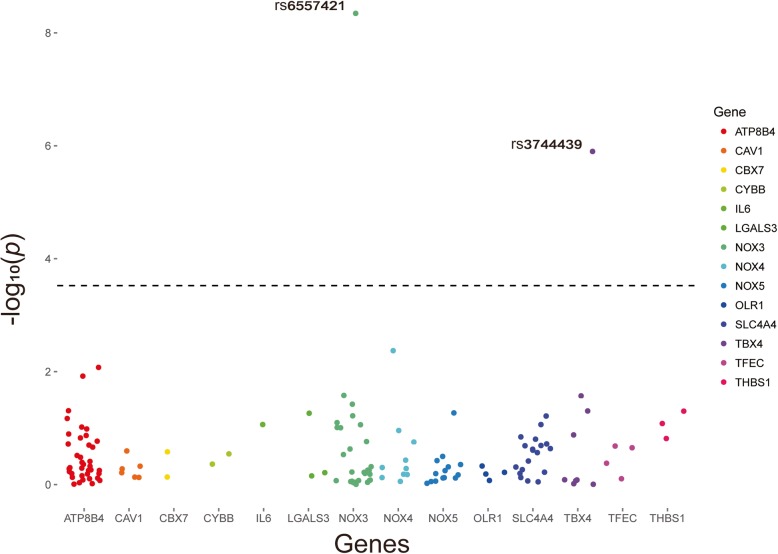
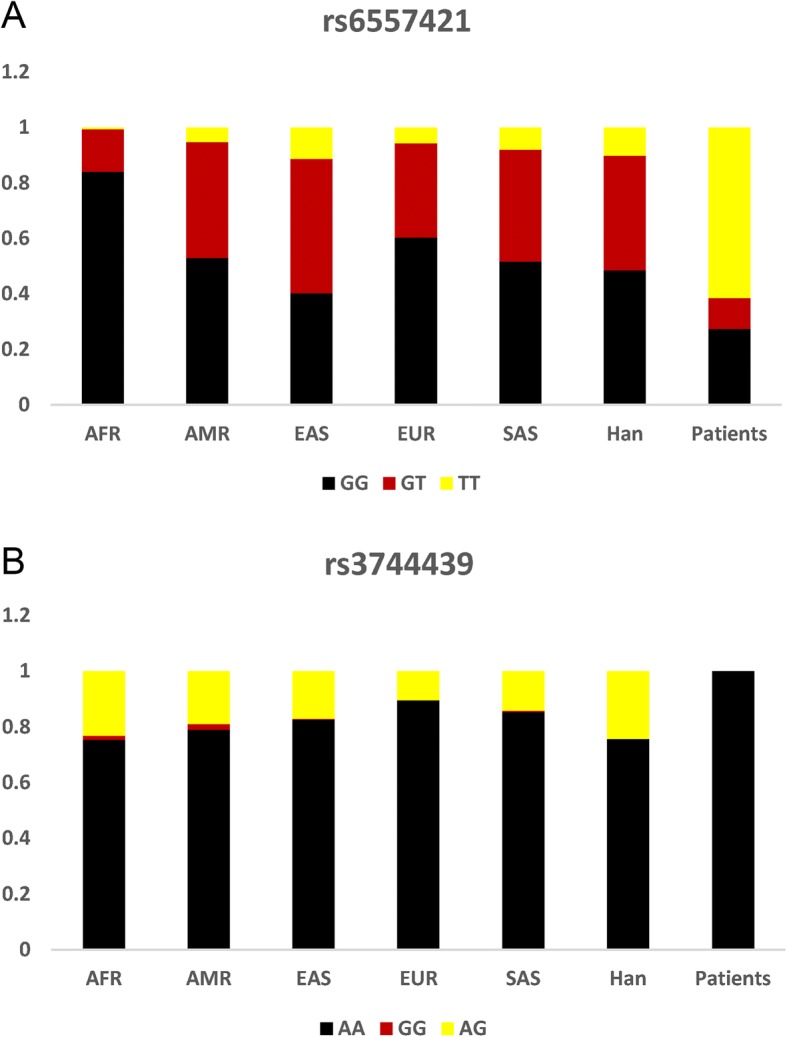
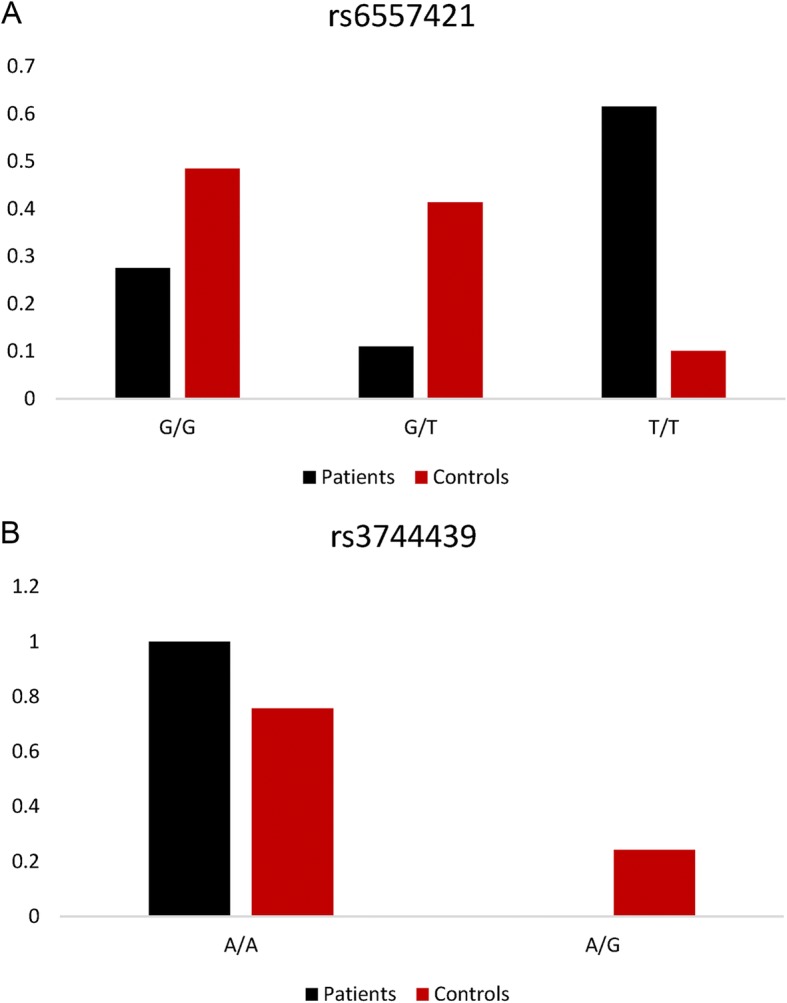
The data revealed that 2 SNPs were associated with PH overall susceptibility at p < 3×10 after Bonferroni correction. The top hit was rs6557421 (p = 4.5×10), located within Nox3 gene on chromosome 6. Another SNP rs3744439 located in Tbx4 gene, also showed evidence of association with PH susceptibility (p = 1.2×10). The distribution of genotype frequencies of rs6557421 and rs3744439 have dramatic differences between PH patients and controls. Individuals with rs6557421 TT genotype had a 10.72-fold/14.20-fold increased risk to develop PH when compared with GG or GG/GT carriers in codominant or recessive model, respectively (TT versus GG: 95%CI = 4.79-24.00; TT versus GG/GT: 95%CI = 6.65-30.33). As for rs3744439, AG genotype only occurred in healthy controls but has not been observed in PH patients. We further validated the result by using 26 different populations from five regions around the globe, including African (AFR), American (AMR), East Asian (EAS), European (EUR), and South Asian (SAS). In consistent with the present case-control study's results, significantly different genotype frequencies of the observed SNPs existed between PH patients and healthy individuals from all over the world.
The results suggested that rs6557421 variant in Nox3 and rs3744439 variant in Tbx4 might have potential effect on individual susceptibility to pulmonary hypertension, which could lead to therapeutic or diagnosis approaches in PH.
肺动脉高压(PH)是一种罕见疾病,其特征为肺小动脉的增殖和闭塞,与高死亡率相关。PH的发病机制复杂且尚未完全明确,包括改变血管结构和功能的遗传及环境因素。
因此,我们旨在通过靶向14个候选基因的143个标签单核苷酸多态性(tag SNPs)来揭示PH的潜在遗传病因。本研究共纳入了208名中国汉族个体,包括109例非特发性PH患者和99名健康对照。
数据显示,经过Bonferroni校正后,有2个单核苷酸多态性(SNPs)与PH的总体易感性相关,p值小于3×10。最显著的是rs6557421(p = 4.5×10),位于6号染色体上的Nox3基因内。另一个位于Tbx4基因的SNP rs3744439也显示出与PH易感性相关的证据(p = 1.2×10)。rs6557421和rs3744439的基因型频率分布在PH患者和对照之间存在显著差异。与共显性或隐性模型中的GG或GG/GT携带者相比,rs6557421 TT基因型个体患PH的风险分别增加了10.72倍/14.20倍(TT与GG相比:95%置信区间 = 4.79 - 24.00;TT与GG/GT相比:95%置信区间 = 6.65 - 30.33)。至于rs3744439,AG基因型仅在健康对照中出现,而在PH患者中未观察到。我们通过使用来自全球五个地区的26个不同人群进一步验证了结果,包括非洲(AFR)、美洲(AMR)、东亚(EAS)、欧洲(EUR)和南亚(SAS)。与本病例对照研究结果一致,在全球范围内的PH患者和健康个体之间,观察到的SNPs基因型频率存在显著差异。
结果表明,Nox3中的rs6557421变异和Tbx4中的rs3744439变异可能对个体患肺动脉高压的易感性有潜在影响,这可能为PH的治疗或诊断方法提供依据。