National Immunization Program, Chinese Center for Disease Control and Prevention, Beijing, PRC.
National Center for Immunization and Respiratory Diseases, Centers for Disease Control and Prevention, Atlanta, GA, USA.
Int J Epidemiol. 2019 Aug 1;48(4):1240-1251. doi: 10.1093/ije/dyz058.
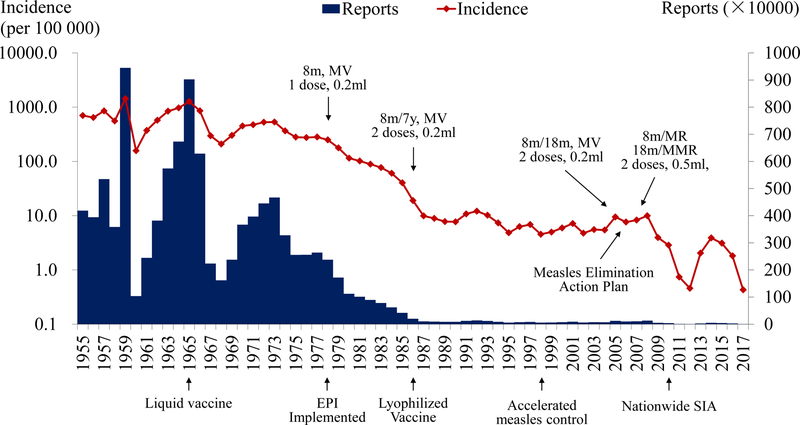
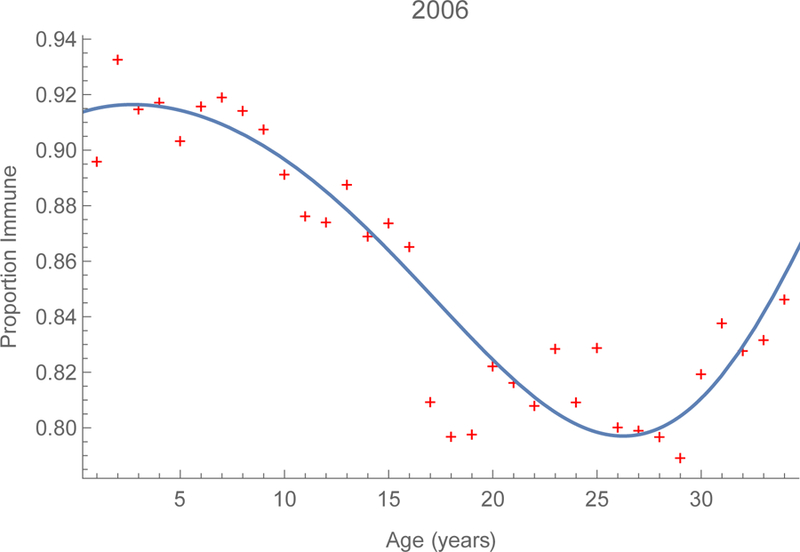
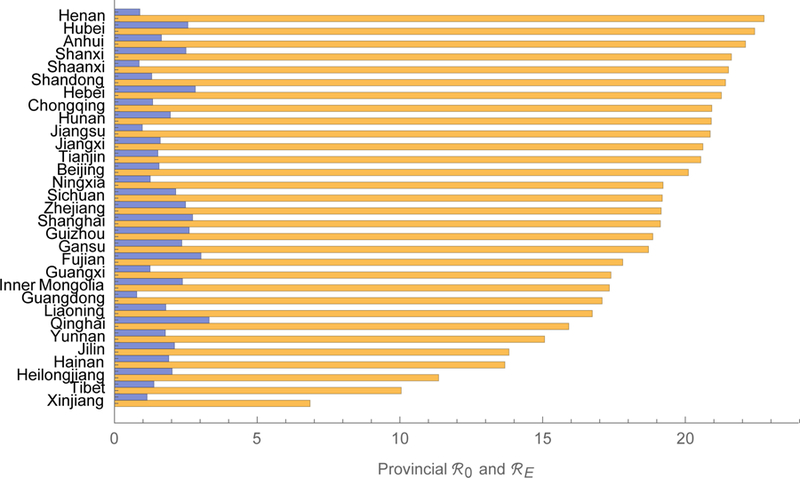
Measles is among the most highly infectious human diseases. By virtue of increasingly effective childhood vaccination, together with targeted supplemental immunization activities (SIAs), health authorities in the People's Republic of China have reduced measles' reproduction number from about 18 to 2.3. Despite substantial residual susceptibility among young adults, more in some locales than others, sustained routine childhood immunization likely would eliminate measles eventually. To support global eradication efforts, as well as expedite morbidity and mortality reductions in China, we evaluated alternative SIAs via mechanistic mathematical modelling.
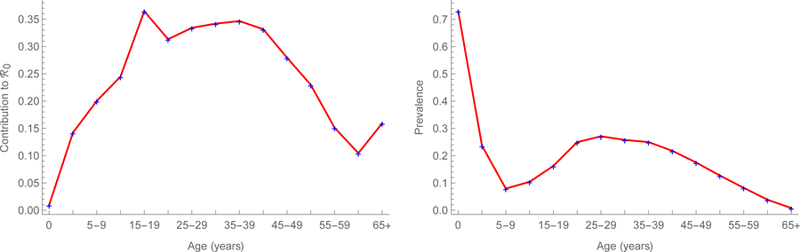
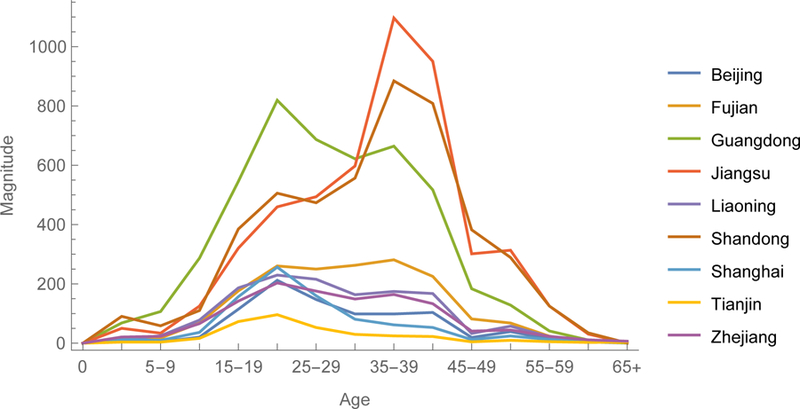
Our model Chinese population is stratified by immune status (susceptible to measles infection; infected, but not yet infectious; infectious; and recovered or immunized), age (0, 1-4, 5-9, …, 65+ years) and location (31 provinces). Contacts between sub-populations are either empirical or a mixture of preferential and proportionate with respect to age and decline exponentially with distance between locations at age-dependent rates. We estimated initial conditions and most parameters from recent cross-sectional serological surveys, disease surveillance and demographic observations. Then we calculated the reproduction numbers and gradient of the effective number with respect to age- and location-specific immunization rates. We corroborated these analytical results by simulating adolescent and young adult SIAs using a version of our model in which the age-specific contact rates vary seasonally.
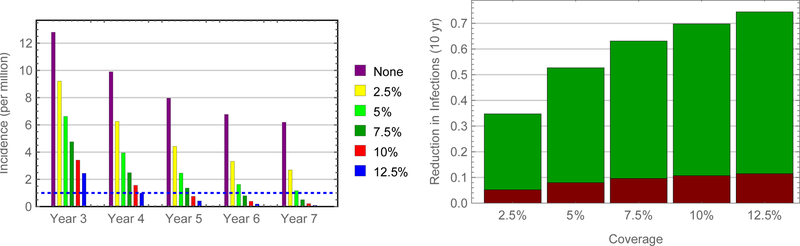
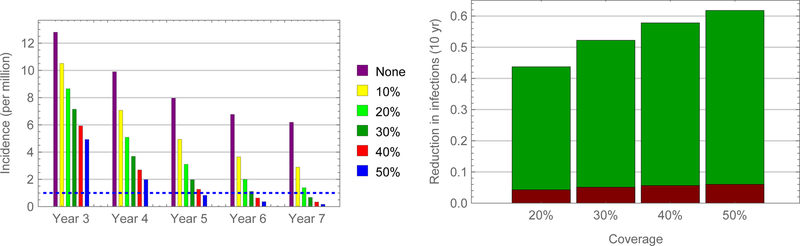
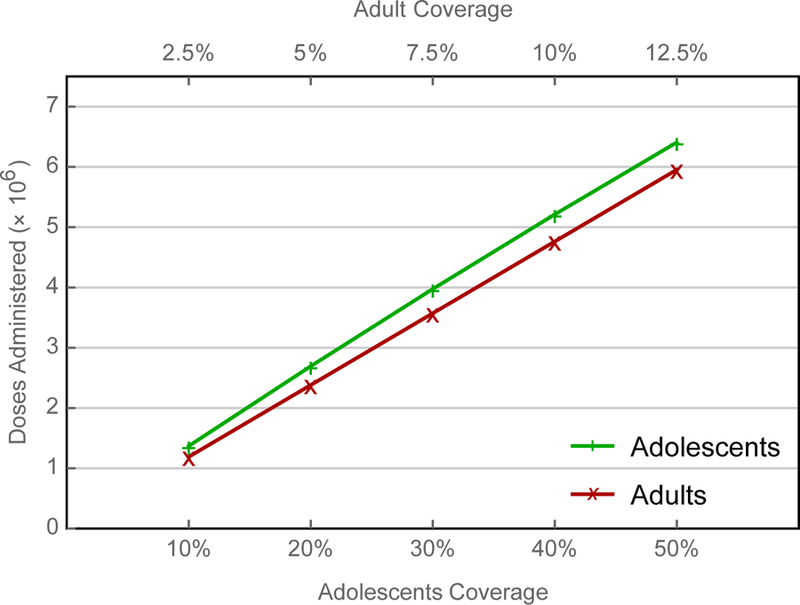
Whereas the gradient indicates that vaccinating young adults generally is the optimal strategy, simulations indicate that a catch-up campaign among susceptible adolescent schoolchildren would accelerate elimination, with timing dependent on uptake.
These results are largely due to indirect effects (i.e. fewer infections than immunized people might otherwise cause), which meta-population models with realistic mixing are uniquely capable of reproducing accurately.
麻疹是最具高度传染性的人类疾病之一。由于儿童疫苗接种的效果日益显著,再加上有针对性的补充免疫活动(SIAs),中华人民共和国的卫生当局已将麻疹的繁殖数从约 18 降至 2.3。尽管年轻人(某些地方比其他地方更多)仍存在大量残余易感性,但持续的常规儿童免疫接种最终可能会消除麻疹。为了支持全球根除工作,并加快中国的发病率和死亡率降低,我们通过基于机制的数学模型评估了替代的 SIA。
我们的模型中国人口按免疫状态(易受麻疹感染;感染但尚未具有传染性;具有传染性;已康复或已免疫)、年龄(0、1-4、5-9、…、65+岁)和地点(31 个省)分层。亚人群之间的接触要么是经验性的,要么是年龄相关的优先和比例混合,与地点之间的距离呈指数下降,且下降速度取决于年龄。我们从最近的横断面血清学调查、疾病监测和人口统计数据中估计初始条件和大多数参数。然后,我们计算了与年龄和地点特异性免疫率相关的繁殖数和有效数量的梯度。我们通过使用我们的模型的一个版本模拟青少年和年轻成人 SIA 来验证这些分析结果,其中特定年龄的接触率随季节而变化。
尽管梯度表明接种年轻人通常是最佳策略,但模拟表明,在易感青少年学生中进行追赶运动将加速消除,具体取决于接种率。
这些结果主要是由于间接效应(即免疫接种者感染的人数可能比未免疫接种者少)所致,而具有现实混合的元人群模型是唯一能够准确重现的。