Institute of Pathology, University of Bern, Murtenstrasse 31, 3008 Bern, Switzerland.
Graduate School for Cellular and Biomedical Sciences, University of Bern, Freiestr. 1, 3012 Bern, Switzerland.
Int J Mol Sci. 2018 Oct 8;19(10):3069. doi: 10.3390/ijms19103069.
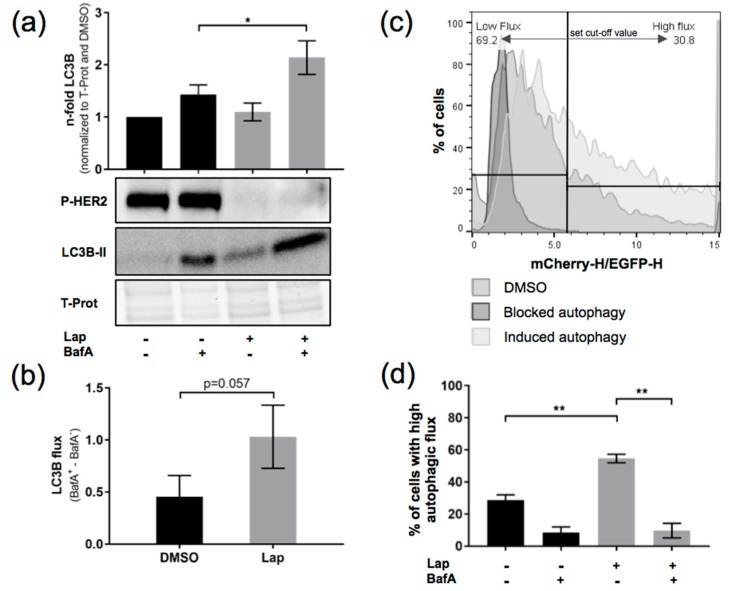
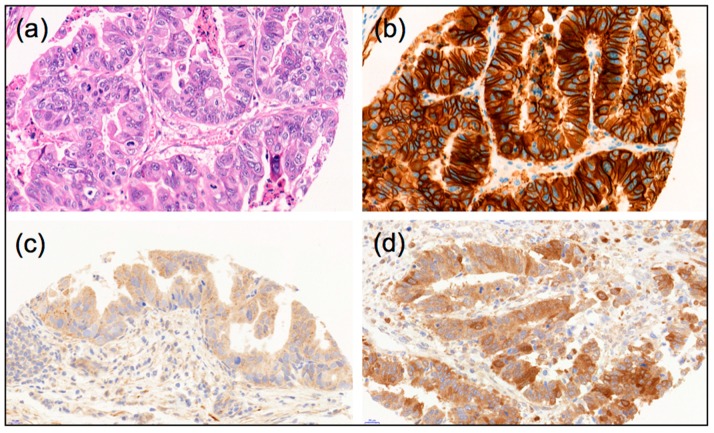
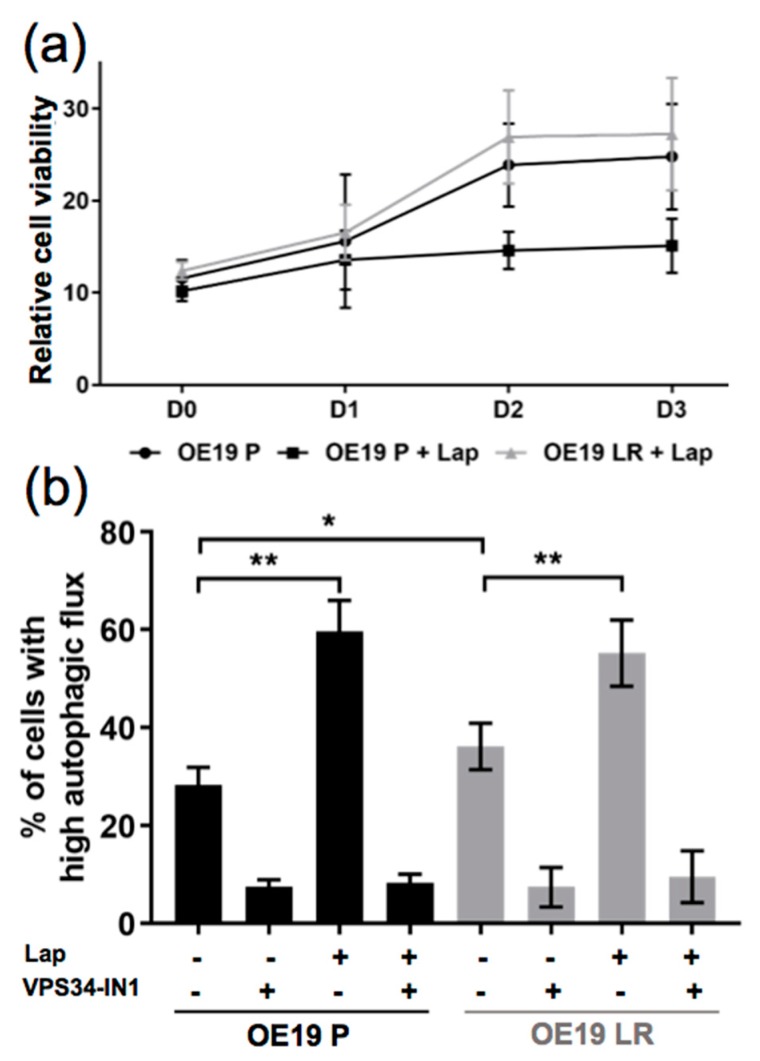
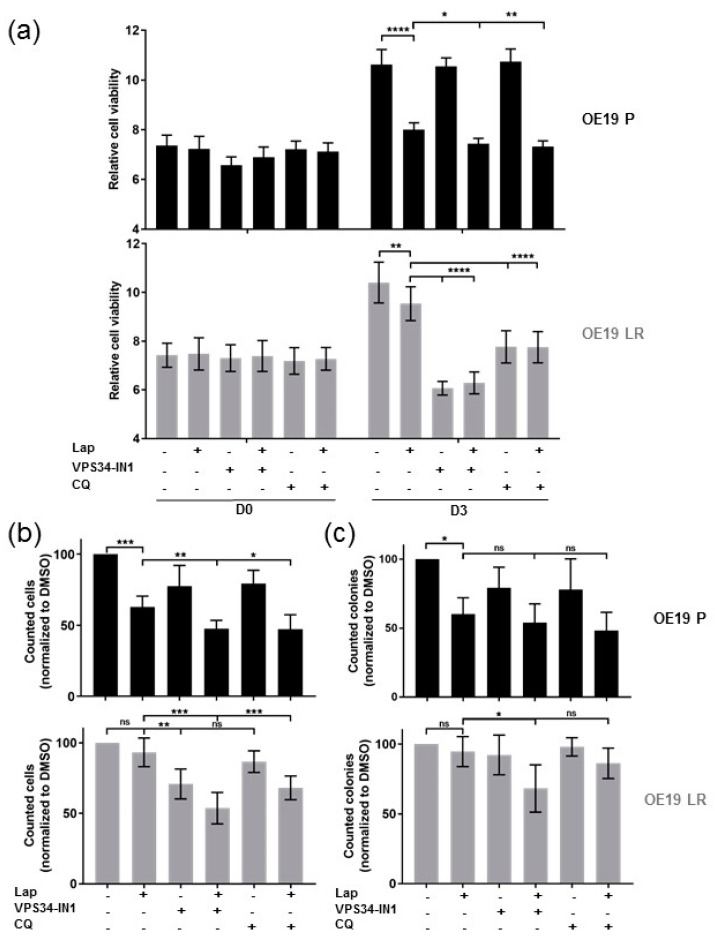
Esophageal adenocarcinoma (EAC) is a highly lethal cancer type with an overall poor survival rate. Twenty to thirty percent of EAC overexpress the human epidermal growth factor receptor 2 (Her2), a transmembrane receptor tyrosine kinase promoting cell growth and proliferation. Patients with Her2 overexpressing breast and gastroesophageal cancer may benefit from Her2 inhibitors. Therapy resistance, however, is well documented. Since autophagy, a lysosome-dependent catabolic process, is implicated in cancer resistance mechanisms, we tested whether autophagy modulation influences Her2 inhibitor sensitivity in EAC. Her2-positive OE19 EAC cells showed an induction in autophagic flux upon treatment with the small molecule Her2 inhibitor Lapatinib. Newly generated Lapatinib-resistant OE19 (OE19 LR) cells showed increased basal autophagic flux compared to parental OE19 (OE19 P) cells. Based on these results, we tested if combining Lapatinib with autophagy inhibitors might be beneficial. OE19 P showed significantly reduced cell viability upon double treatment, while OE19 LR were already sensitive to autophagy inhibition alone. Additionally, Her2 status and autophagy marker expression (LC3B and p62) were investigated in a treatment-naïve EAC patient cohort ( = 112) using immunohistochemistry. Here, no significant correlation between Her2 status and expression of LC3B and p62 was found. Our data show that resistance to Her2-directed therapy is associated with a higher basal autophagy level, which is not per se associated with Her2 status. Therefore, we propose that autophagy may contribute to acquired resistance to Her2-targeted therapy in EAC, and that combining Her2 and autophagy inhibition might be beneficial for EAC patients.
食管腺癌 (EAC) 是一种高度致命的癌症类型,整体存活率较低。20%至 30%的 EAC 过表达人类表皮生长因子受体 2 (Her2),这是一种促进细胞生长和增殖的跨膜受体酪氨酸激酶。过表达 Her2 的乳腺癌和胃食管癌患者可能受益于 Her2 抑制剂。然而,治疗耐药性已有充分记录。由于自噬是一种溶酶体依赖性分解代谢过程,与癌症耐药机制有关,我们测试了自噬调节是否会影响 EAC 中 Her2 抑制剂的敏感性。用小分子 Her2 抑制剂拉帕替尼处理 Her2 阳性的 OE19 EAC 细胞后,观察到自噬通量的诱导。与亲本 OE19 (OE19 P) 细胞相比,新产生的拉帕替尼耐药 OE19 (OE19 LR) 细胞显示出增加的基础自噬通量。基于这些结果,我们测试了联合使用拉帕替尼和自噬抑制剂是否有益。OE19 P 经双重处理后细胞活力明显降低,而 OE19 LR 单独对自噬抑制已敏感。此外,还使用免疫组织化学法在未经治疗的 EAC 患者队列(n=112)中检测了 Her2 状态和自噬标志物表达(LC3B 和 p62)。结果发现,Her2 状态与 LC3B 和 p62 的表达之间没有显著相关性。我们的数据表明,对 Her2 定向治疗的耐药性与较高的基础自噬水平相关,而自噬水平本身与 Her2 状态无关。因此,我们提出自噬可能有助于 EAC 中获得性抗 Her2 靶向治疗的耐药性,并且联合使用 Her2 和自噬抑制可能对 EAC 患者有益。