Chair of Forestry Economics and Forest Planning, University of Freiburg, Tennenbacher Str. 4 (2. OG), D-79106, Freiburg, Germany.
Sci Rep. 2018 Oct 8;8(1):14964. doi: 10.1038/s41598-018-33389-9.
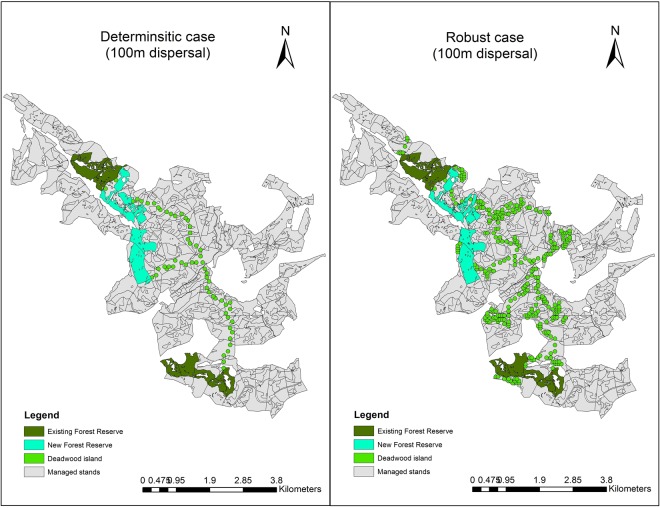
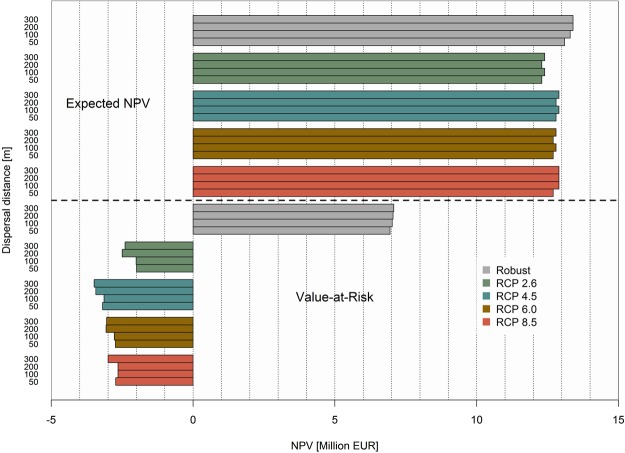
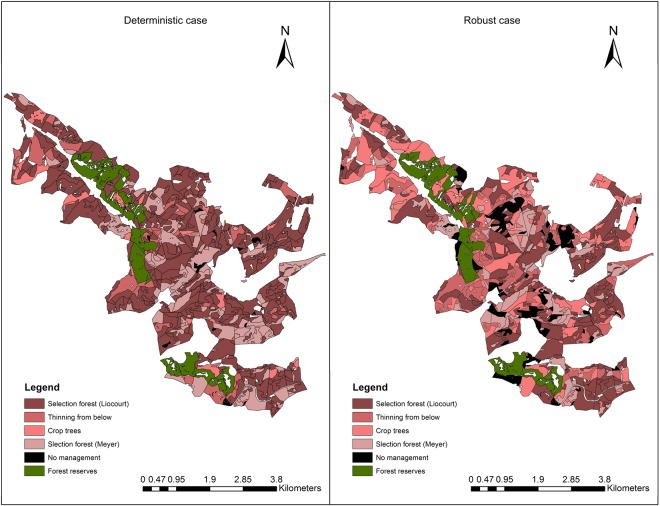
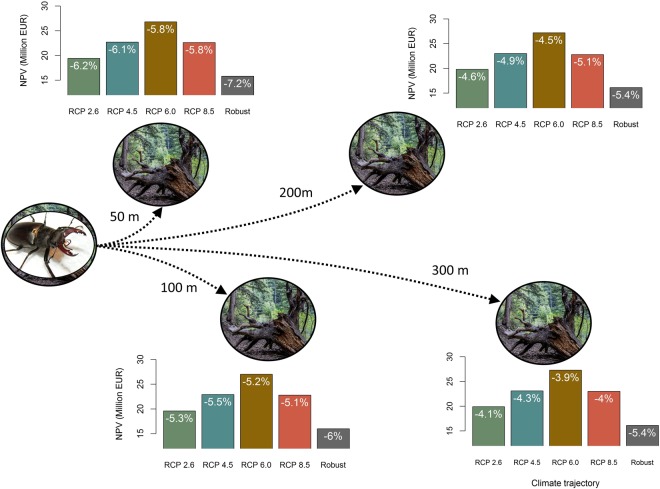
In Europe, intensive forest management has severely compromised the habitat of forest insects, especially saproxylic beetles, due to the removal of deadwood and veteran trees. The loss of insect diversity may disrupt ecosystem functioning and affect the provision of important ecosystem goods and services in the future. Here we propose a novel approach for the implementation of conservation policies, by optimally allocating forest reserves and deadwood islands under multiple sources of uncertainty and minimizing economic risk. We use the saproxylic beetle Lucanus cervus as umbrella species, requiring that deadwood islands were spaced within its dispersal capacity. We show that current management and conservation practices are increasingly inefficient under changing environmental conditions and that the consideration of uncertainty requires a major expansion of conservation areas. Moreover, our results indicate that a strong diversification of management regimes, with a focus on selection forest systems, is required to reduce economic risk of forest management. We conclude that the integration of uncertainty into conservation planning may reduce the trade-off between production and conservation objectives in forest landscapes and is key to increase the efficiency of forest management in the future.
在欧洲,由于清除枯木和老树,集约化森林管理严重破坏了森林昆虫的栖息地,尤其是腐木甲虫。昆虫多样性的丧失可能会扰乱生态系统功能,并影响未来提供重要生态系统产品和服务的能力。在这里,我们提出了一种新的保护政策实施方法,通过在多种不确定性来源下优化分配森林保护区和枯木岛,并将经济风险最小化。我们使用需要在其扩散能力范围内设置枯木岛的鞘翅目甲虫欧洲野牛 Lucanus cervus 作为伞物种。我们表明,在不断变化的环境条件下,当前的管理和保护实践效率越来越低,并且不确定性的考虑需要大规模扩大保护区。此外,我们的结果表明,需要对管理体制进行多样化,重点是选择森林系统,以降低森林管理的经济风险。我们得出的结论是,将不确定性纳入保护规划中可能会减少森林景观中生产和保护目标之间的权衡,是提高未来森林管理效率的关键。