Storch Ilse, Penner Johannes, Asbeck Thomas, Basile Marco, Bauhus Jürgen, Braunisch Veronika, Dormann Carsten F, Frey Julian, Gärtner Stefanie, Hanewinkel Marc, Koch Barbara, Klein Alexandra-Maria, Kuss Thomas, Pregernig Michael, Pyttel Patrick, Reif Albert, Scherer-Lorenzen Michael, Segelbacher Gernot, Schraml Ulrich, Staab Michael, Winkel Georg, Yousefpour Rasoul
Chair of Wildlife Ecology and Management Faculty of Environment and Natural Resources University of Freiburg Freiburg Germany.
Chair of Silviculture Faculty of Environment and Natural Resources University of Freiburg Freiburg Germany.
Ecol Evol. 2020 Jan 14;10(3):1489-1509. doi: 10.1002/ece3.6003. eCollection 2020 Feb.
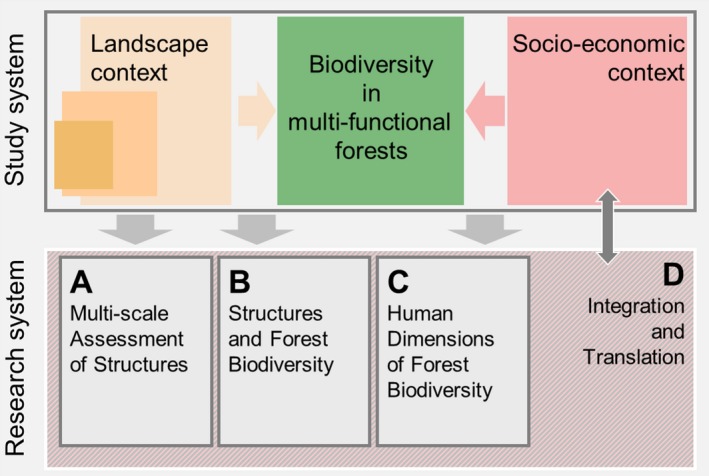
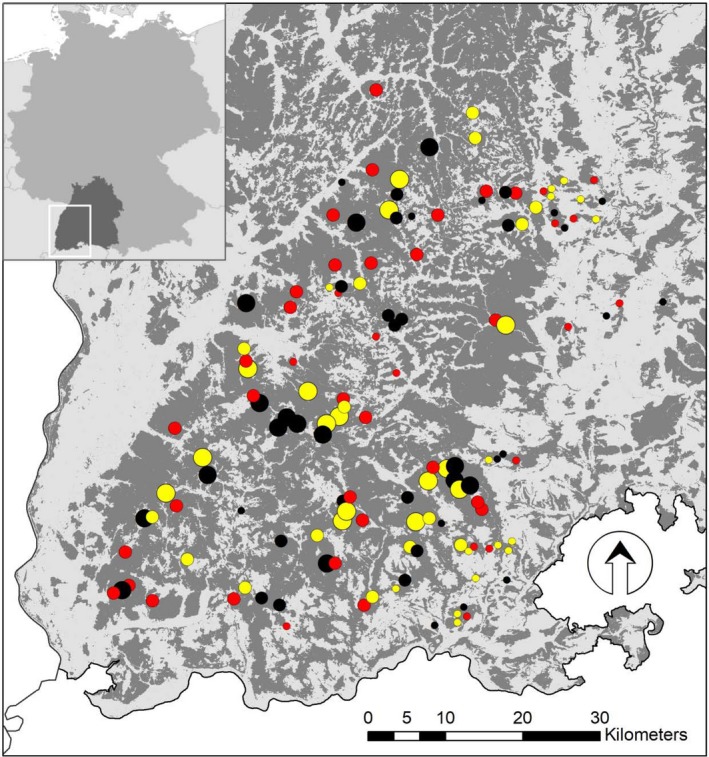
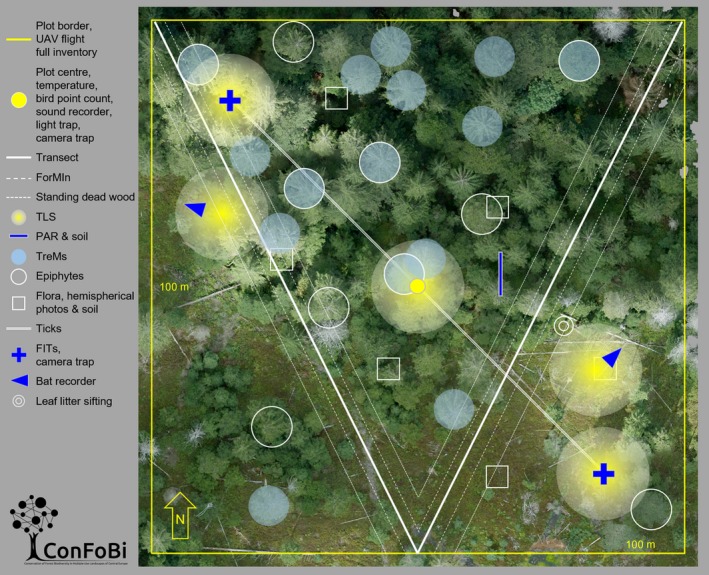
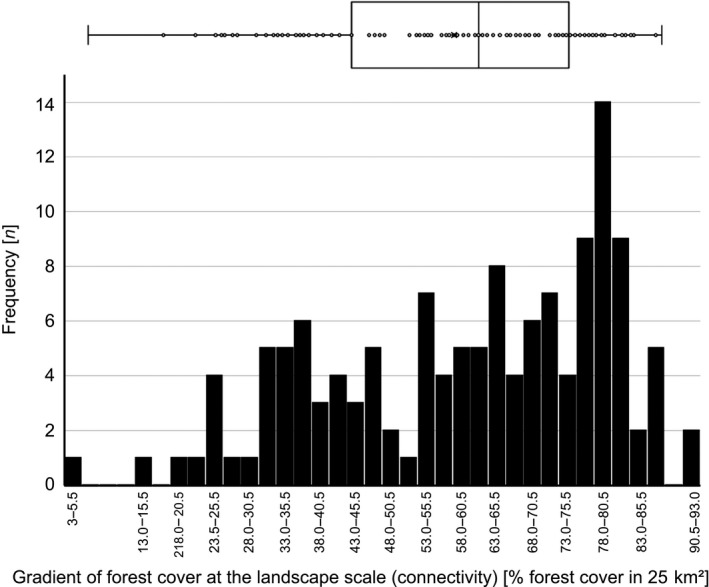
Retention forestry, which retains a portion of the original stand at the time of harvesting to maintain continuity of structural and compositional diversity, has been originally developed to mitigate the impacts of clear-cutting. Retention of habitat trees and deadwood has since become common practice also in continuous-cover forests of Central Europe. While the use of retention in these forests is plausible, the evidence base for its application is lacking, trade-offs have not been quantified, it is not clear what support it receives from forest owners and other stakeholders and how it is best integrated into forest management practices. The Research Training Group ConFoBi (Conservation of Forest Biodiversity in Multiple-use Landscapes of Central Europe) focusses on the effectiveness of retention forestry, combining ecological studies on forest biodiversity with social and economic studies of biodiversity conservation across multiple spatial scales. The aim of ConFoBi is to assess whether and how structural retention measures are appropriate for the conservation of forest biodiversity in uneven-aged and selectively harvested continuous-cover forests of temperate Europe. The study design is based on a pool of 135 plots (1 ha) distributed along gradients of forest connectivity and structure. The main objectives are (a) to investigate the effects of structural elements and landscape context on multiple taxa, including different trophic and functional groups, to evaluate the effectiveness of retention practices for biodiversity conservation; (b) to analyze how forest biodiversity conservation is perceived and practiced, and what costs and benefits it creates; and (c) to identify how biodiversity conservation can be effectively integrated in multi-functional forest management. ConFoBi will quantify retention levels required across the landscape, as well as the socio-economic prerequisites for their implementation by forest owners and managers. ConFoBi's research results will provide an evidence base for integrating biodiversity conservation into forest management in temperate forests.
保留式林业在采伐时保留一部分原始林分,以维持结构和组成多样性的连续性,其最初是为了减轻皆伐的影响而发展起来的。此后,在中欧的连续覆盖林中,保留栖息地树木和枯木也已成为常见做法。虽然在这些森林中采用保留式林业似乎有道理,但缺乏其应用的证据基础,权衡尚未量化,不清楚它得到森林所有者和其他利益相关者的何种支持,以及如何最好地融入森林经营实践。研究培训小组ConFoBi(中欧多用途景观中的森林生物多样性保护)专注于保留式林业的有效性,将森林生物多样性的生态学研究与跨多个空间尺度的生物多样性保护的社会和经济研究相结合。ConFoBi的目标是评估在欧洲温带地区的异龄和选择性采伐的连续覆盖林中,结构保留措施是否以及如何适用于森林生物多样性保护。研究设计基于135个样地(1公顷)的样本,这些样地沿着森林连通性和结构梯度分布。主要目标是:(a)调查结构要素和景观背景对多个分类群(包括不同营养级和功能群)的影响,以评估保留措施对生物多样性保护的有效性;(b)分析森林生物多样性保护是如何被认知和实践的,以及它产生了哪些成本和效益;(c)确定如何将生物多样性保护有效地融入多功能森林经营中。ConFoBi将量化整个景观所需的保留水平,以及森林所有者和管理者实施这些措施的社会经济前提条件。ConFoBi的研究结果将为将生物多样性保护纳入温带森林的森林经营提供证据基础。