Davies Benjamin Marshall, Munro Colin Fraser, Kotter Mark Rn
Academic Neurosurgery Unit, Department of Clinical Neurosciences, University of Cambridge, Cambridge, United Kingdom.
School of Clinical Medicine, University of Cambridge, Cambridge, United Kingdom.
J Med Internet Res. 2019 Jan 11;21(1):e10868. doi: 10.2196/10868.
Degenerative cervical myelopathy (DCM) is a common debilitating condition resulting from degeneration of the cervical spine. While decompressive surgery can halt disease progression, existing spinal cord damage is often permanent, leaving patients with lifelong disability. Early surgery improves the likelihood of recovery, yet the average time from the onset of symptoms to correct diagnosis is over 2 years. The majority of delays occur initially, before and within primary care, mainly due to a lack of recognition. Symptom checkers are widely used by patients before medical consultation and can be useful for preliminary triage and diagnosis. Lack of recognition of DCM by symptom checkers may contribute to the delay in diagnosis.
The aims of this study were to investigate whether Web-based symptom checkers were able to recognize relevant symptoms of DCM, to characterize the DCM differential they returned , and to evaluate the diagnostic performance of recognized DCM symptoms.
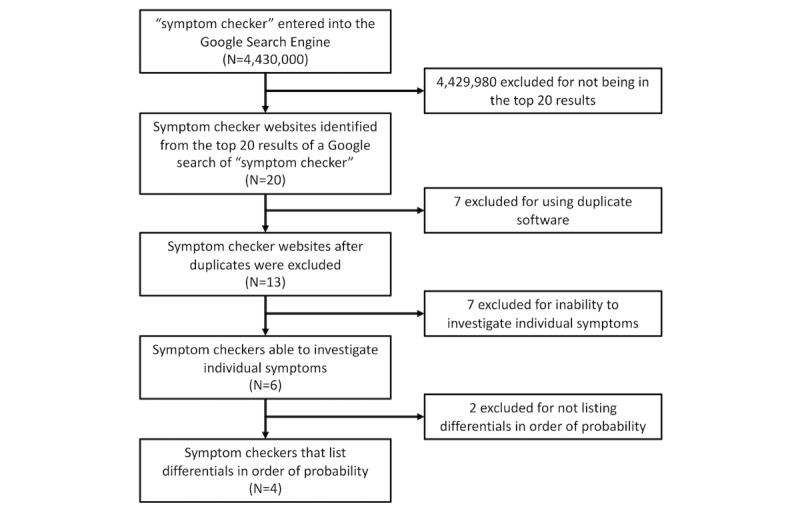
We pooled classical DCM symptoms from leading review articles. These symptoms were entered into the algorithms used by the top 20 symptom checker websites (N=4; Google Search). The most widely cited symptom checker, WebMD, was used to characterize the differential diagnosis for DCM symptoms.
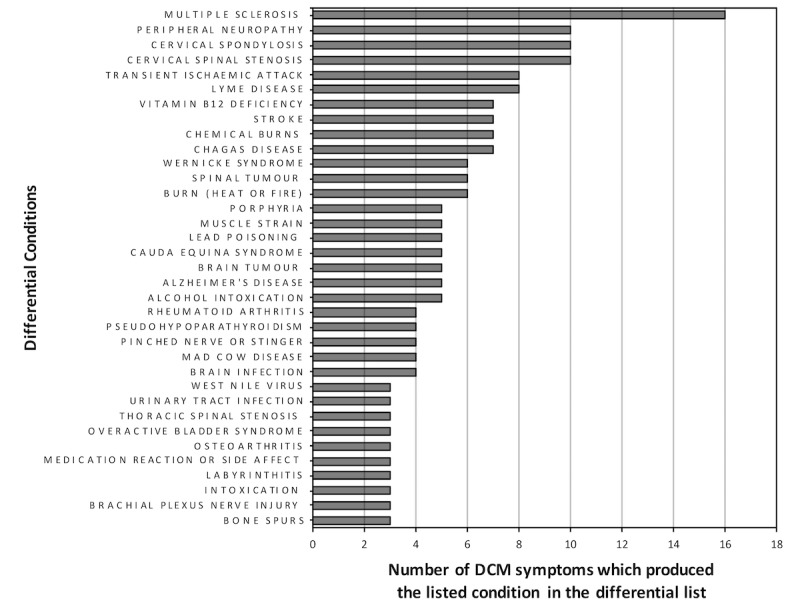
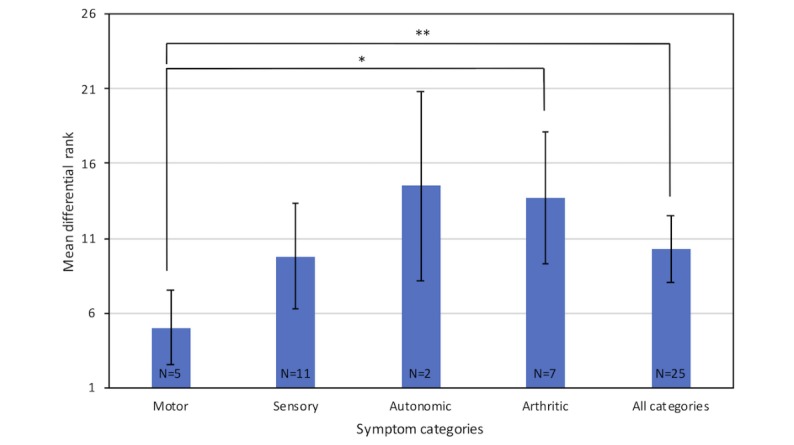
A total of 31 classical DCM symptoms were identified, of which 45% (14/31) listed DCM as a differential and 10% (3/31) placed DCM in the top third of the differential. The mean differential rank for motor symptoms was significantly better than that for arthritic symptoms (P=.01) and the average differential rank for all symptoms (P=.048). The symptom checker WebMD performed best at recognizing DCM, placing the condition nearer to the top of the differential list (mean rank of 5.6) than either Healthline (rank of 12.9, P=.02) or Healthtools.AARP (rank of 15.5, P=.001). On WebMD, only one combination of symptoms resulted in DCM as the primary differential: neck, shoulder, and arm pain with hand weakness. Moreover, 151 differential diagnoses for DCM symptoms were recorded on WebMD. Multiple sclerosis and peripheral neuropathy were the most common differentials, shortlisted for 52% (16/31) and 32% (10/31) of the DCM symptoms, respectively.
DCM symptoms are poorly identified by Web-based symptom checkers, which leads to a large differential of many other common conditions. While a diagnosis becomes more likely as the number of symptoms increases, this represents more advanced disease and will not support much-needed earlier diagnosis. Symptom checkers remain an attractive concept with potential. Further research is required to support their optimization.
退行性颈椎脊髓病(DCM)是一种因颈椎退变导致的常见致残性疾病。虽然减压手术可以阻止疾病进展,但现有的脊髓损伤往往是永久性的,会使患者终身残疾。早期手术可提高恢复的可能性,然而从症状出现到正确诊断的平均时间超过2年。大多数延误最初发生在初级保健之前及期间,主要原因是缺乏识别。患者在就医前广泛使用症状检查工具,这些工具可用于初步分诊和诊断。症状检查工具对DCM的识别不足可能导致诊断延误。
本研究旨在调查基于网络的症状检查工具是否能够识别DCM的相关症状,描述其返回的DCM鉴别诊断情况,并评估已识别的DCM症状的诊断性能。
我们汇总了主要综述文章中的经典DCM症状。将这些症状输入前20个症状检查网站(N = 4;谷歌搜索)所使用的算法中。使用引用最广泛的症状检查工具WebMD来描述DCM症状的鉴别诊断。
共识别出31种经典DCM症状,其中45%(14/31)将DCM列为鉴别诊断,10%(3/31)将DCM列为鉴别诊断的前三位。运动症状的平均鉴别排名显著优于关节炎症状(P = 0.01)以及所有症状的平均鉴别排名(P = 0.048)。症状检查工具WebMD在识别DCM方面表现最佳,将该疾病置于鉴别列表的更靠前位置(平均排名5.6),优于Healthline(排名12.9,P = 0.02)或Healthtools.AARP(排名15.5,P = 0.001)。在WebMD上,只有一种症状组合导致DCM成为主要鉴别诊断:颈部、肩部和手臂疼痛伴手部无力。此外,WebMD上记录了151种DCM症状的鉴别诊断。多发性硬化症和周围神经病变是最常见的鉴别诊断,分别在31种DCM症状中的52%(16/31)和32%(10/31)中被列为候选。
基于网络的症状检查工具对DCM症状的识别较差,这导致了许多其他常见疾病的大量鉴别诊断。虽然随着症状数量的增加诊断的可能性会增大,但这代表疾病已处于更晚期,无法支持急需的早期诊断。症状检查工具仍然是一个有潜力的吸引人的概念。需要进一步研究以支持其优化。