Department of Cell Biology, Microbiology and Molecular Biology, School of Natural Sciences and Mathematics, College of Arts and Sciences, University of South Florida, Tampa, FL 33620, USA.
Int J Mol Sci. 2018 Oct 7;19(10):3052. doi: 10.3390/ijms19103052.
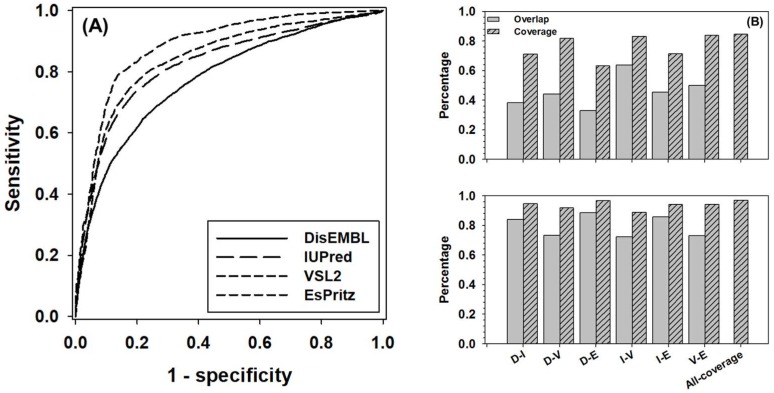
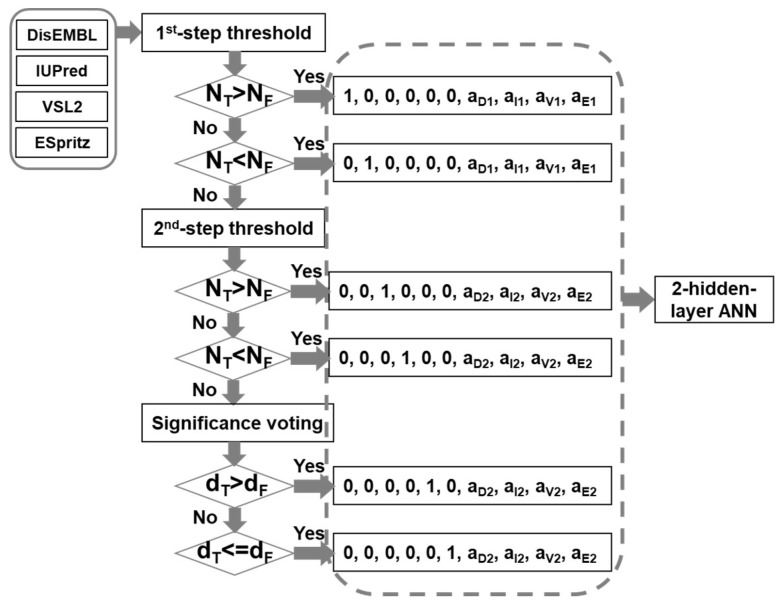
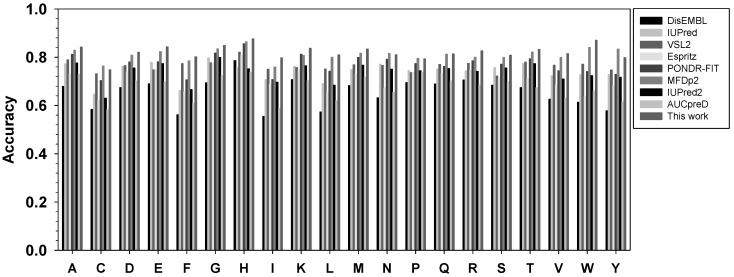
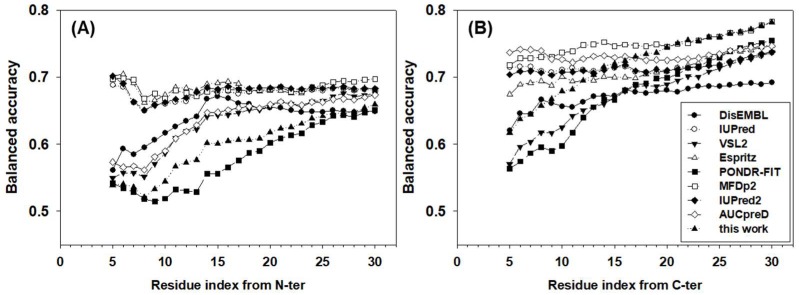
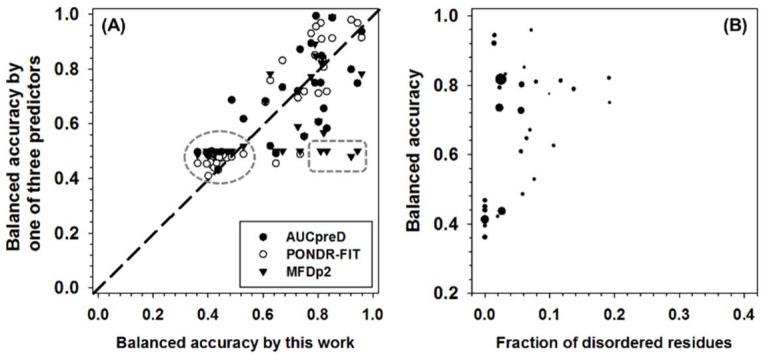
Using computational techniques to identify intrinsically disordered residues is practical and effective in biological studies. Therefore, designing novel high-accuracy strategies is always preferable when existing strategies have a lot of room for improvement. Among many possibilities, a meta-strategy that integrates the results of multiple individual predictors has been broadly used to improve the overall performance of predictors. Nonetheless, a simple and direct integration of individual predictors may not effectively improve the performance. In this project, dual-threshold two-step significance voting and neural networks were used to integrate the predictive results of four individual predictors, including: DisEMBL, IUPred, VSL2, and ESpritz. The new meta-strategy has improved the prediction performance of intrinsically disordered residues significantly, compared to all four individual predictors and another four recently-designed predictors. The improvement was validated using five-fold cross-validation and in independent test datasets.
利用计算技术来识别固有无序残基在生物研究中是切实可行且有效的。因此,当现有的策略有很大的改进空间时,设计新颖的高精度策略总是更好的选择。在许多可能性中,一种整合多个个体预测器结果的元策略已被广泛用于提高预测器的整体性能。然而,个体预测器的简单直接整合可能无法有效地提高性能。在这个项目中,双阈值两步显著性投票和神经网络被用于整合四个个体预测器的预测结果,包括:DisEMBL、IUPred、VSL2 和 Espritz。与所有四个个体预测器以及另外四个最近设计的预测器相比,新的元策略显著提高了固有无序残基的预测性能。该改进通过五重交叉验证和独立测试数据集得到了验证。