Leadership Sinai Centre for Diabetes, Mount Sinai Hospital, 60 Murray Street, Suite-L5-039, Mailbox-21, Toronto, ON, M5T3L9, Canada.
Division of Endocrinology, University of Toronto, Toronto, ON, Canada.
Cardiovasc Diabetol. 2018 Oct 9;17(1):133. doi: 10.1186/s12933-018-0776-y.
Gestational diabetes (GDM) and milder gestational impaired glucose tolerance (GIGT) identify women at risk of developing type 2 diabetes and cardiovascular disease later in life. Accordingly, the postpartum years after gestational dysglycemia can provide insight into early events in the natural history of these disorders. We thus sought to prospectively evaluate the relationship between gestational glucose tolerance and emerging cardiometabolic biomarkers [adiponectin, chemerin, retinol-binding protein-4 (RBP-4), C-reactive protein (CRP), plasminogen activator inhibitor-1 (PAI-1)] at both 1- and 3-years postpartum in a cohort reflecting the full spectrum of gestational dysglycemia (from normal to GIGT to GDM).
Three-hundred-and-thirty-nine women completed a glucose challenge test (GCT) and oral glucose tolerance test (OGTT) in pregnancy, which identified 4 gestational glucose tolerance groups: GDM (n = 105); GIGT (n = 59); abnormal GCT with normal OGTT (n = 99); and normal GCT with normal OGTT (n = 76). At 1- and 3-years postpartum, the women underwent repeat OGTT with measurement of biomarkers (adiponectin/chemerin/RBP-4/CRP/PAI-1).
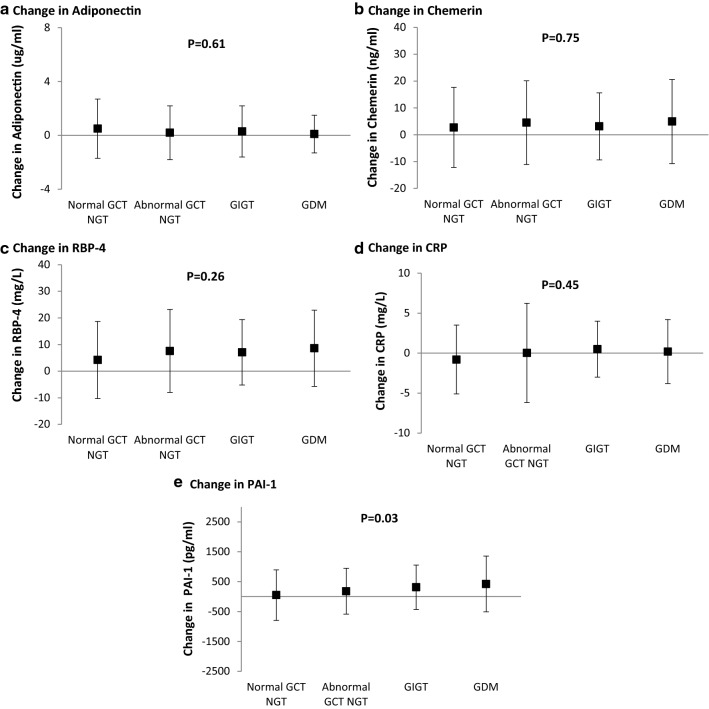
Serum adiponectin was lower in women with GDM and GIGT at both 1-year and 3-years (both P ≤ 0.002), whereas chemerin, RBP-4, CRP and PAI-1 showed no differences across the 4 groups. Importantly, the change in PAI-1 between 1- and 3-years progressively increased from the normal GCT group to the abnormal GCT group to GIGT to GDM (P = 0.03). Indeed, both GDM (t = 2.98, P = 0.003) and GIGT (t = 2.14, P = 0.03) independently predicted an increase in PAI-1 from 1- to 3-years postpartum.
Hypoadiponectinemia and rising PAI-1 over time are early features of the cardiometabolic biomarker profile of women with recent gestational dysglycemia.
妊娠期糖尿病(GDM)和较轻的妊娠期糖耐量受损(GIGT)可识别出以后生活中易患 2 型糖尿病和心血管疾病的女性。因此,妊娠后血糖异常的产后数年可深入了解这些疾病自然史中的早期事件。因此,我们前瞻性地评估了在反映妊娠后血糖异常(从正常到 GIGT 到 GDM)全貌的队列中,产后 1 年和 3 年时,与妊娠葡萄糖耐量相关的新生代谢生物标志物(脂联素、趋化素、视黄醇结合蛋白 4(RBP-4)、C 反应蛋白(CRP)、纤溶酶原激活物抑制剂 1(PAI-1))的关系。
339 名女性在妊娠期间完成了葡萄糖挑战试验(GCT)和口服葡萄糖耐量试验(OGTT),这些试验确定了 4 种妊娠葡萄糖耐量组:GDM(n=105);GIGT(n=59);异常 GCT 但正常 OGTT(n=99);正常 GCT 但正常 OGTT(n=76)。在产后 1 年和 3 年时,这些女性再次进行 OGTT 并测量生物标志物(脂联素/趋化素/RBP-4/CRP/PAI-1)。
GDM 和 GIGT 女性在产后 1 年和 3 年时血清脂联素水平均较低(均 P≤0.002),而趋化素、RBP-4、CRP 和 PAI-1在 4 组间无差异。重要的是,PAI-1 在 1 年至 3 年之间的变化从正常 GCT 组到异常 GCT 组到 GIGT 到 GDM 逐渐增加(P=0.03)。事实上,GDM(t=2.98,P=0.003)和 GIGT(t=2.14,P=0.03)均可独立预测产后 1 年至 3 年期间 PAI-1 的增加。
低脂联素血症和 PAI-1 随时间的升高是近期妊娠后血糖异常女性代谢生物标志物谱的早期特征。