Renal, Vascular and Diabetes Laboratory, Instituto de Investigaciones Sanitarias-Fundación Jiménez Díaz, Universidad Autónoma de Madrid, Av. Reyes Católicos 2, 28040, Madrid, Spain.
Department of Pharmacology, School of Medicine, Universidad Autónoma de Madrid, Madrid, Spain.
Cardiovasc Diabetol. 2019 Oct 30;18(1):140. doi: 10.1186/s12933-019-0935-9.
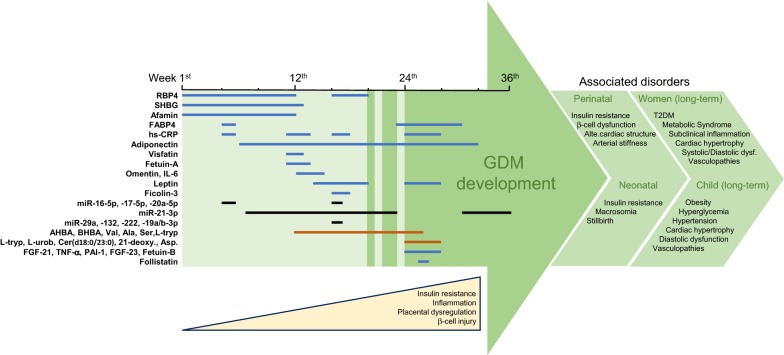
Gestational diabetes mellitus (GDM) is defined as the presence of high blood glucose levels with the onset, or detected for the first time during pregnancy, as a result of increased insulin resistance. GDM may be induced by dysregulation of pancreatic β-cell function and/or by alteration of secreted gestational hormones and peptides related with glucose homeostasis. It may affect one out of five pregnancies, leading to perinatal morbidity and adverse neonatal outcomes, and high risk of chronic metabolic and cardiovascular injuries in both mother and offspring. Currently, GDM diagnosis is based on evaluation of glucose homeostasis at late stages of pregnancy, but increased age and body-weight, and familiar or previous occurrence of GDM, may conditionate this criteria. In addition, an earlier and more specific detection of GDM with associated metabolic and cardiovascular risk could improve GDM development and outcomes. In this sense, 1st-2nd trimester-released biomarkers found in maternal plasma including adipose tissue-derived factors such as adiponectin, visfatin, omentin-1, fatty acid-binding protein-4 and retinol binding-protein-4 have shown correlations with GDM development. Moreover, placenta-related factors such as sex hormone-binding globulin, afamin, fetuin-A, fibroblast growth factors-21/23, ficolin-3 and follistatin, or specific micro-RNAs may participate in GDM progression and be useful for its recognition. Finally, urine-excreted metabolites such as those related with serotonin system, non-polar amino-acids and ketone bodies, may complete a predictive or early-diagnostic panel of biomarkers for GDM.
妊娠期糖尿病(GDM)是指在怀孕期间出现胰岛素抵抗导致的血糖升高,或在怀孕期间首次发现的高血糖。GDM 可能是由于胰腺β细胞功能失调和/或与葡萄糖稳态相关的分泌妊娠激素和肽的改变引起的。它可能影响五分之一的妊娠,导致围产期发病率和不良新生儿结局,并使母亲和后代都面临高风险的慢性代谢和心血管损伤。目前,GDM 的诊断基于对妊娠晚期葡萄糖稳态的评估,但年龄和体重的增加,以及 GDM 的家族史或既往史,可能会影响这一标准。此外,通过更早和更特异性地检测与代谢和心血管风险相关的 GDM,可以改善 GDM 的发展和结局。在这方面,母体血浆中释放的 1 期和 2 期生物标志物,包括脂肪组织来源的因子,如脂联素、内脂素、网膜素-1、脂肪酸结合蛋白-4 和视黄醇结合蛋白-4,与 GDM 的发展有关。此外,胎盘相关因子,如性激素结合球蛋白、甲胎蛋白、胎球蛋白-A、成纤维细胞生长因子-21/23、ficolin-3 和卵泡抑素,或特定的 micro-RNAs,可能参与 GDM 的进展,并有助于其识别。最后,尿液中排泄的代谢物,如与 5-羟色胺系统、非极性氨基酸和酮体相关的代谢物,可能构成 GDM 的预测或早期诊断生物标志物的综合指标。