National Centre for Biological Sciences, TIFR, Bangalore 560065.
National Centre for Biological Sciences, TIFR, Bangalore 560065
J Neurosci. 2018 Nov 21;38(47):10202-10219. doi: 10.1523/JNEUROSCI.1163-18.2018. Epub 2018 Oct 9.
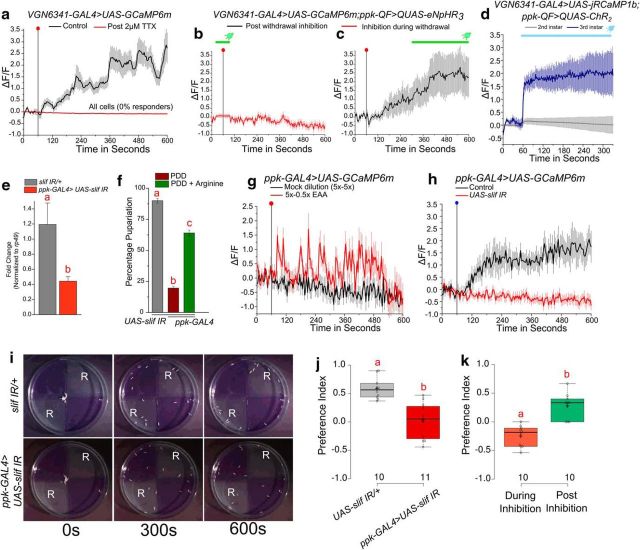
Organisms need to coordinate growth with development, particularly in the context of nutrient availability. Thus, multiple ways have evolved to survive extrinsic nutrient deprivation during development. In , growth occurs during larval development. Larvae are thus critically dependent on nutritional inputs; but after critical weight, they pupariate even when starved. How nutrient availability is coupled to the internal metabolic state for the decision to pupariate needs better understanding. We had earlier identified glutamatergic interneurons in the ventral ganglion that regulate pupariation on a protein-deficient diet. Here we report that third instar larvae (either sex) sense arginine to evaluate their nutrient environment using an amino acid transporter Slimfast. The glutamatergic interneurons integrate external protein availability with internal metabolic state through neuropeptide signals. IP-mediated calcium release and store-operated calcium entry are essential in these glutamatergic neurons for such integration and alter neuronal function by reducing the expression of multiple ion channels. Coordinating growth with development, in the context of nutrient availability is a challenge for all organisms in nature. After attainment of "critical weight," insect larvae can pupariate, even in the absence of nutrition. Mechanism(s) that stimulate appropriate cellular responses and allow normal development on a nutritionally deficient diet remain to be understood. Here, we demonstrate that nutritional deprivation, in postcritical weight larvae, is sensed by special sensory neurons through an amino acid transporter that detects loss of environmental arginine. This information is integrated by glutamatergic interneurons with the internal metabolic state through neuropeptide signals. These glutamatergic interneurons require calcium-signaling-regulated expression of a host of neuronal channels to generate complex calcium signals essential for pupariation on a protein-deficient diet.
生物需要协调生长和发育,尤其是在营养物质可利用的情况下。因此,多种方式已经进化出来以在发育过程中应对外在的营养物质剥夺。在昆虫中,生长发生在幼虫发育过程中。因此,幼虫严重依赖营养物质输入;但在关键体重之后,即使饥饿它们也会化蛹。更好地理解营养物质可用性如何与内部代谢状态相关联,以做出化蛹的决定,这一点仍需要深入了解。我们之前已经确定了腹神经节中的谷氨酸能中间神经元,它们在蛋白质缺乏的饮食中调节化蛹。在这里,我们报告第三龄幼虫(无论性别)通过使用氨基酸转运蛋白 Slimfast 感知精氨酸,以评估其营养环境。谷氨酸能中间神经元通过神经肽信号将外部蛋白质可用性与内部代谢状态整合在一起。IP 介导的钙释放和储存操纵的钙内流对于这些谷氨酸能神经元中的这种整合是必不可少的,并通过减少多种离子通道的表达来改变神经元功能。在营养物质可利用的情况下协调生长和发育是自然界中所有生物面临的挑战。达到“关键体重”后,昆虫幼虫即使没有营养也可以化蛹。刺激适当的细胞反应并允许在营养缺乏的饮食中正常发育的机制仍有待理解。在这里,我们证明了在关键体重后的幼虫中,营养物质剥夺通过一种氨基酸转运体被特殊感觉神经元感知,该转运体检测到环境中精氨酸的丧失。通过神经肽信号,这些谷氨酸能中间神经元将信息与内部代谢状态整合在一起。这些谷氨酸能中间神经元需要钙信号调节表达大量神经元通道,以产生在蛋白质缺乏的饮食中化蛹所必需的复杂钙信号。