Cancer Bioinformatics, Cancer Centre at Guy's Hospital, King's College London, London, United Kingdom.
Breast Cancer Now Research Unit, Cancer Centre at Guy's Hospital, King's College London, London, United Kingdom.
Mol Cancer Ther. 2019 Jan;18(1):204-212. doi: 10.1158/1535-7163.MCT-18-0243. Epub 2018 Oct 10.
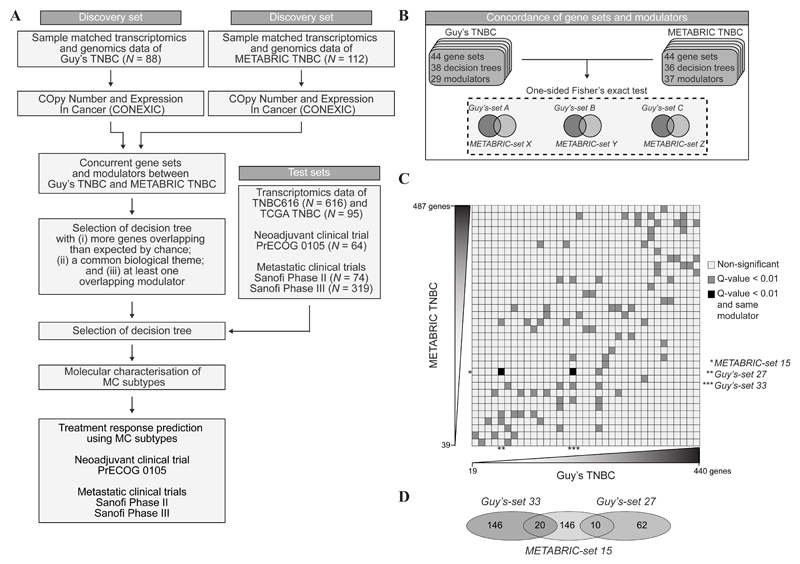
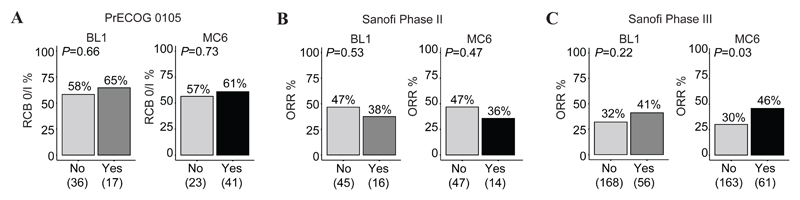
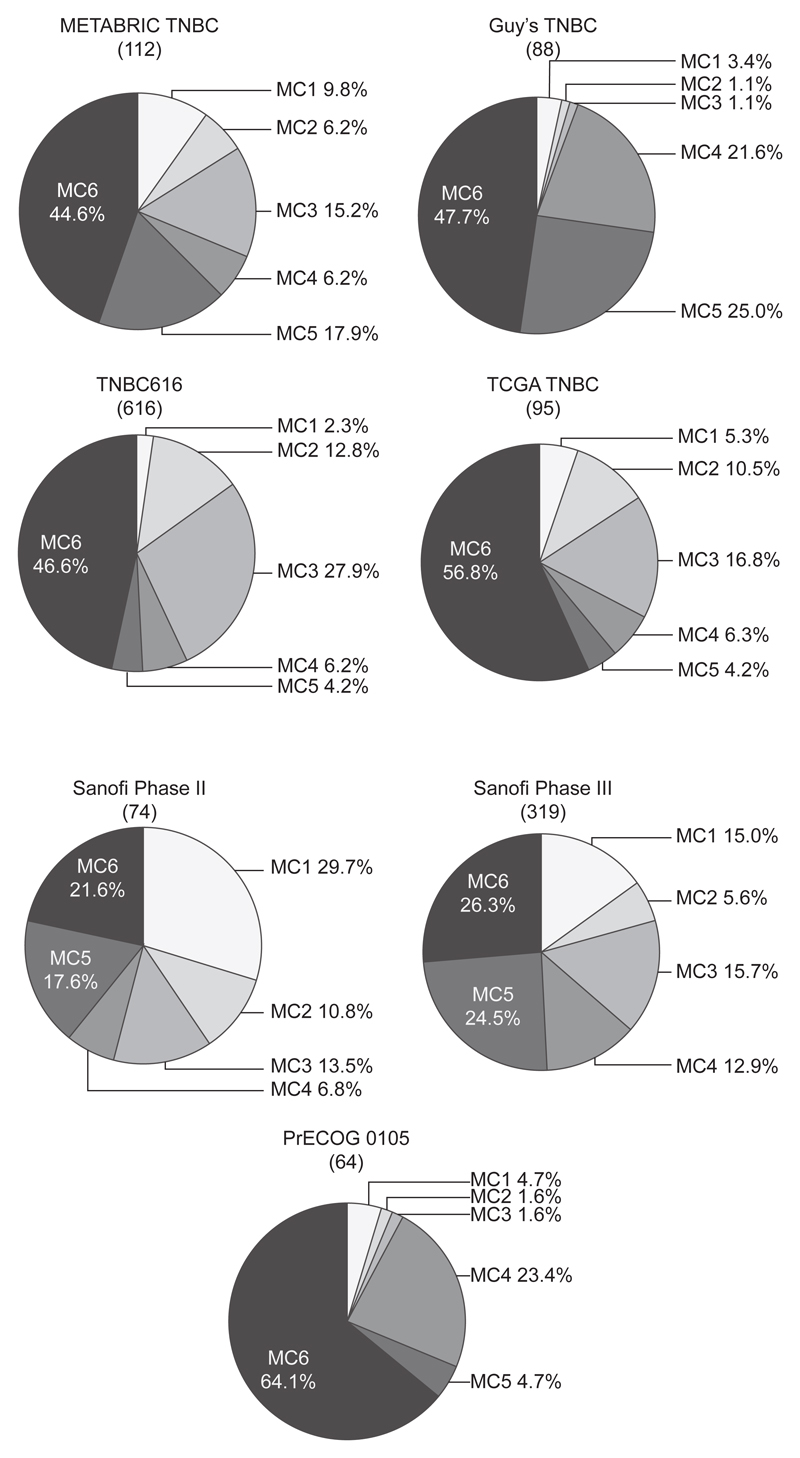
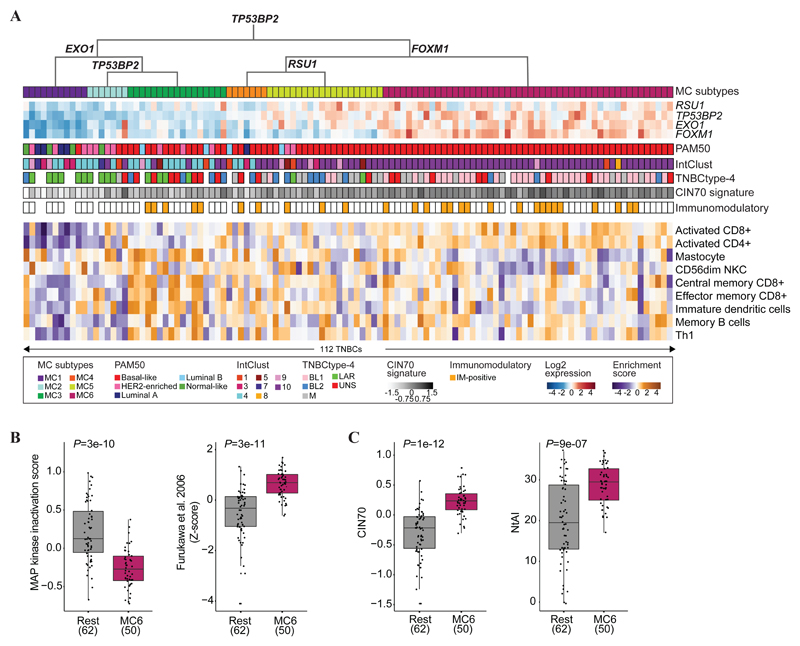
The molecular complexity of triple-negative breast cancers (TNBCs) provides a challenge for patient management. We set out to characterize this heterogeneous disease by combining transcriptomics and genomics data, with the aim of revealing convergent pathway dependencies with the potential for treatment intervention. A Bayesian algorithm was used to integrate molecular profiles in two TNBC cohorts, followed by validation using five independent cohorts ( = 1,168), including three clinical trials. A four-gene decision tree signature was identified, which robustly classified TNBCs into six subtypes. All four genes in the signature (, and ) are associated with either genomic instability, malignant growth, or treatment response. One of the six subtypes, MC6, encompassed the largest proportion of tumors (∼50%) in early diagnosed TNBCs. In TNBC patients with metastatic disease, the MC6 proportion was reduced to 25%, and was independently associated with a higher response rate to platinum-based chemotherapy. In TNBC cell line data, platinum sensitivity was recapitulated, and a sensitivity to the inhibition of the phosphatase PPM1D was revealed. Molecularly, MC6-TNBCs displayed high levels of telomeric allelic imbalances, enrichment of CD4 and CD8 immune signatures, and reduced expression of genes negatively regulating the MAPK signaling pathway. These observations suggest that our integrative classification approach may identify TNBC patients with discernible and theoretically pharmacologically tractable features that merit further studies in prospective trials.
三阴性乳腺癌(TNBC)的分子复杂性为患者管理带来了挑战。我们通过整合转录组学和基因组学数据来对这种异质性疾病进行特征描述,旨在揭示具有治疗干预潜力的趋同途径依赖性。采用贝叶斯算法整合了两个 TNBC 队列的分子谱,随后使用五个独立的队列(= 1,168)进行验证,其中包括三个临床试验。确定了一个由四个基因组成的决策树特征,该特征能够将 TNBC 稳健地分为六个亚型。特征中的四个基因(、和)均与基因组不稳定性、恶性生长或治疗反应相关。四个基因组成的特征之一,MC6,涵盖了早期诊断的 TNBC 中最大比例的肿瘤(约 50%)。在转移性疾病的 TNBC 患者中,MC6 的比例降低至 25%,且与对铂类化疗更高的反应率独立相关。在 TNBC 细胞系数据中,重现了对铂类的敏感性,并且揭示了对磷酸酶 PPM1D 抑制的敏感性。从分子水平上看,MC6-TNBC 显示出端粒等位基因失衡水平较高、CD4 和 CD8 免疫特征富集以及负调节 MAPK 信号通路的基因表达减少。这些观察结果表明,我们的综合分类方法可能能够识别出具有可识别的、理论上具有可操作性的特征的 TNBC 患者,这些特征值得在前瞻性试验中进一步研究。