Fraunhofer MEVIS, Am Fallturm 1, Bremen, Germany.
Department of Internal Medicine 1, University Hospital Frankfurt, Goethe University, Theodor-Stern-Kai 7, Frankfurt (Main), Germany.
PLoS Comput Biol. 2018 Oct 11;14(10):e1006141. doi: 10.1371/journal.pcbi.1006141. eCollection 2018 Oct.
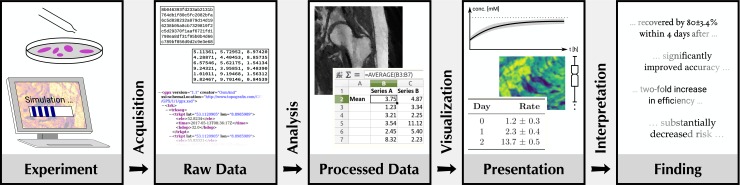
Most studies in the life sciences and other disciplines involve generating and analyzing numerical data of some type as the foundation for scientific findings. Working with numerical data involves multiple challenges. These include reproducible data acquisition, appropriate data storage, computationally correct data analysis, appropriate reporting and presentation of the results, and suitable data interpretation. Finding and correcting mistakes when analyzing and interpreting data can be frustrating and time-consuming. Presenting or publishing incorrect results is embarrassing but not uncommon. Particular sources of errors are inappropriate use of statistical methods and incorrect interpretation of data by software. To detect mistakes as early as possible, one should frequently check intermediate and final results for plausibility. Clearly documenting how quantities and results were obtained facilitates correcting mistakes. Properly understanding data is indispensable for reaching well-founded conclusions from experimental results. Units are needed to make sense of numbers, and uncertainty should be estimated to know how meaningful results are. Descriptive statistics and significance testing are useful tools for interpreting numerical results if applied correctly. However, blindly trusting in computed numbers can also be misleading, so it is worth thinking about how data should be summarized quantitatively to properly answer the question at hand. Finally, a suitable form of presentation is needed so that the data can properly support the interpretation and findings. By additionally sharing the relevant data, others can access, understand, and ultimately make use of the results. These quick tips are intended to provide guidelines for correctly interpreting, efficiently analyzing, and presenting numerical data in a useful way.
大多数生命科学和其他学科的研究都涉及生成和分析某种类型的数值数据,作为科学发现的基础。处理数值数据涉及多个挑战。这些挑战包括可重现的数据采集、适当的数据存储、计算上正确的数据分析、适当的结果报告和呈现,以及合适的数据解释。在分析和解释数据时发现和纠正错误可能会令人沮丧且耗时。呈现或发布不正确的结果是尴尬的,但并不罕见。错误的特别来源是统计方法的不当使用和软件对数据的不正确解释。为了尽早发现错误,应该经常检查中间和最终结果的合理性。清晰地记录数量和结果的获取方式有助于纠正错误。正确理解数据对于从实验结果得出有充分根据的结论是必不可少的。需要使用单位来理解数字,并且应该估计不确定性以了解结果的意义。如果正确应用,描述性统计和显著性检验是解释数值结果的有用工具。然而,盲目信任计算出的数字也可能会产生误导,因此值得思考如何对数据进行定量总结,以正确回答当前的问题。最后,需要一个合适的呈现形式,以便数据能够正确支持解释和发现。通过额外共享相关数据,其他人可以访问、理解并最终利用这些结果。这些快速提示旨在为正确解释、高效分析和以有用的方式呈现数值数据提供指导。