Instituto de Ciências da Atividade Física e Esportes, Universidade Cruzeiro do Sul, São Paulo, SP, Brazil.
Universidade Paulista, São Paulo, SP, Brazil.
PLoS One. 2018 Oct 11;13(10):e0205338. doi: 10.1371/journal.pone.0205338. eCollection 2018.
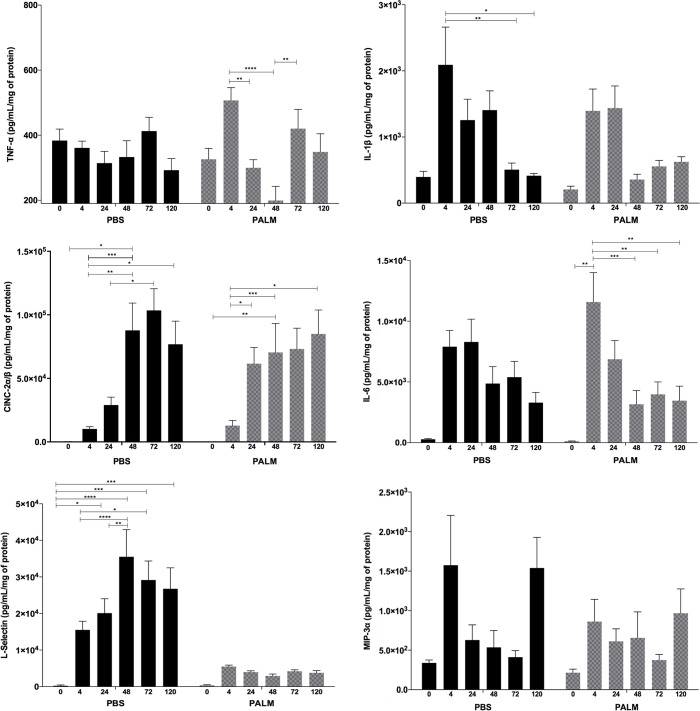
This study investigated the effects of palmitoleic acid on different phases of the healing process. Macroscopic analyses were performed on wounds in rats with or without palmitoleic acid treatment, and the results showed that palmitoleic acid directly hastened wound closure. The topical treatment of wounds with palmitoleic acid resulted in smaller wounds than those observed in the control group. The anti-inflammatory activity of palmitoleic acid may be responsible for healing, especially in the stages of granulation tissue formation and remodelling. Palmitoleic acid modified TNF-α, IL-1β, IL-6, CINC-2α/β, MIP-3α and VEGF-α profiles at the wound site 24, 48, 120, 216 and 288 hours post-wounding. Assays assessing neutrophil migration and exudate formation in sterile inflammatory air pouches revealed that palmitoleic acid had potent anti-inflammatory activity, inhibiting the LPS-induced release of TNF-α (73.14%, p≤0.05), IL-1β (66.19%, p≤0.001), IL-6 (75.19%, p≤0.001), MIP-3α (70.38%, p≤0.05), and l-selectin (16%, p≤0.05). Palmitoleic acid also inhibited LPS-stimulated neutrophil migration. We concluded that palmitoleic acid accelerates wound healing via an anti-inflammatory effect.
本研究探讨了棕榈油酸对愈合过程不同阶段的影响。对有或没有棕榈油酸处理的大鼠伤口进行了宏观分析,结果表明棕榈油酸直接加速了伤口闭合。局部用棕榈油酸处理伤口导致的伤口比对照组小。棕榈油酸的抗炎活性可能是愈合的原因,特别是在肉芽组织形成和重塑阶段。棕榈油酸在伤后 24、48、120、216 和 288 小时改变了 TNF-α、IL-1β、IL-6、CINC-2α/β、MIP-3α 和 VEGF-α 在伤口部位的表达谱。评估中性粒细胞迁移和无菌性炎症气囊中渗出物形成的实验表明,棕榈油酸具有很强的抗炎活性,抑制 LPS 诱导的 TNF-α 释放(73.14%,p≤0.05)、IL-1β(66.19%,p≤0.001)、IL-6(75.19%,p≤0.001)、MIP-3α(70.38%,p≤0.05)和 l-选择素(16%,p≤0.05)。棕榈油酸还抑制了 LPS 刺激的中性粒细胞迁移。我们得出结论,棕榈油酸通过抗炎作用加速伤口愈合。