Vande Perre Pierre, Toledano Daniel, Corsini Carole, Escriba Elsa, Laporte Marine, Bertet Helena, Yauy Kevin, Toledano Alain, Galibert Virginie, Baudry Karen, Clotet Lucie, Million Elodie, Picot Marie-Christine, Geneviève David, Pujol Pascal
Department of Cancer Genetics, Montpellier University Hospital (CHRU), Montpellier, France.
Université Toulouse III Paul Sabatier, Toulouse, France.
Mol Genet Genomic Med. 2018 Nov;6(6):957-965. doi: 10.1002/mgg3.464. Epub 2018 Oct 11.
General practitioners (GPs) have an increasing role in referring patients with putative mutation in BRCA1/2 genes for genetics consultation and for long-term follow-up of mutation carriers.
We compared the expectations of the GPs' role according to BRCA1/2 mutation carriers and to GPs themselves.
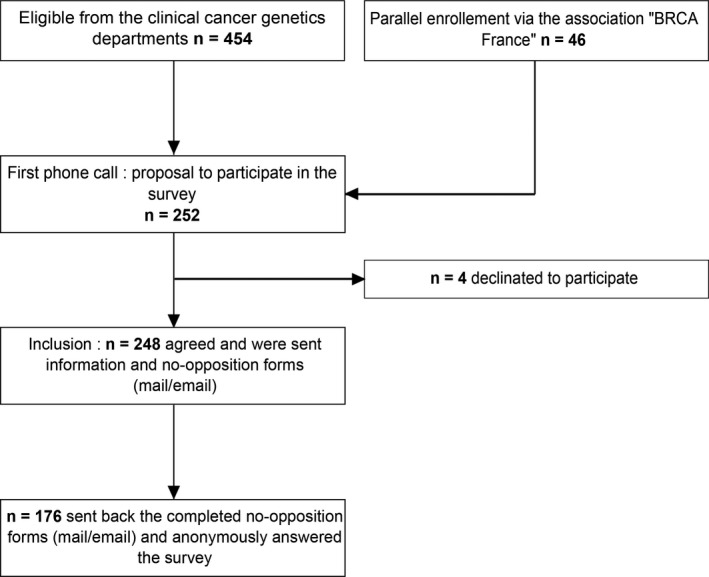
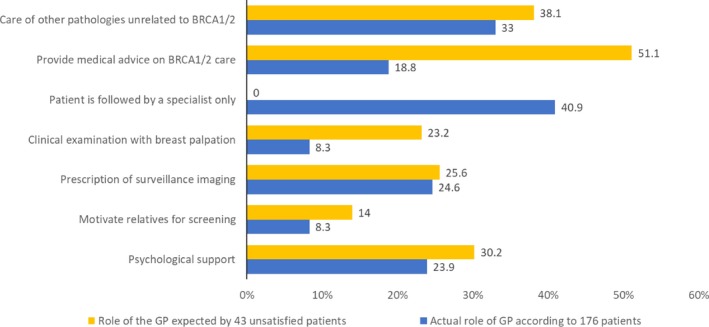
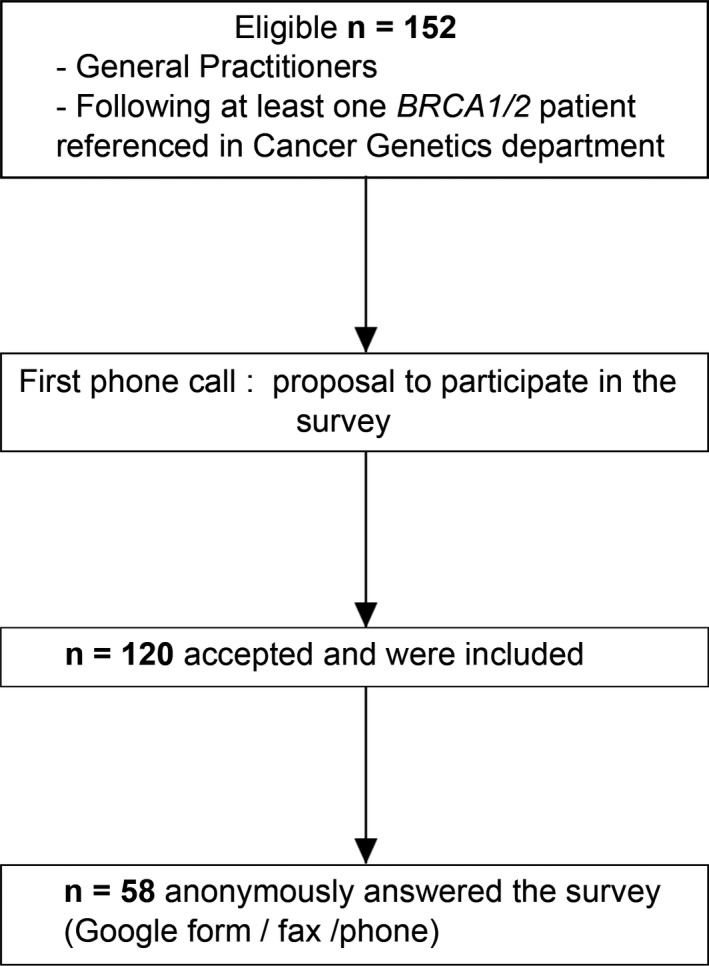
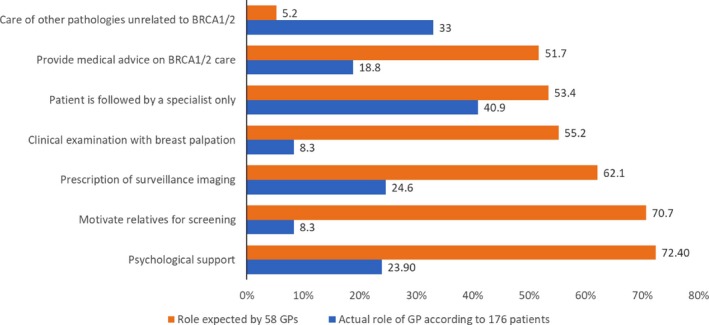
Overall, 38% (58/152) of eligible GPs and 70% (176/252) of eligible patients were surveyed. Although 81% of GPs collected the family history, only 24% considered that they know criteria indicating genetics consultation and 39% sufficient knowledge of BRCA1/2 guidelines to answer patients' questions. Twelve% of GPs were aware of the French national guidelines. Among unsatisfied patients, 40% felt that their GP was able to answer (moderately, sufficiently, or completely) specific questions about BRCA1/2 care as compared with 81% in satisfied patients. Only 33% of GPs reported being informed directly by the geneticist about the patients' results. GPs' main expectations for their role in BRCA1/2 carrier care were psychological support and informing relatives about screening (72% and 71%, respectively), which contrasts with the perceptions of patients, who mainly requested medical advice for BRCA1/2-related care (51%).
There is an important need for GP training and enhancing interactions between GPs and geneticists to improve the GP's role in BRCA1/2 screening and management.
全科医生(GP)在将疑似携带BRCA1/2基因突变的患者转诊至遗传学咨询门诊以及对突变携带者进行长期随访方面发挥着越来越重要的作用。
我们比较了BRCA1/2突变携带者和全科医生自身对全科医生角色的期望。
总体而言,对152名符合条件的全科医生中的38%(58名)以及252名符合条件的患者中的70%(176名)进行了调查。尽管81%的全科医生收集了家族病史,但只有24%的全科医生认为他们了解遗传学咨询的指征,39%的全科医生对BRCA1/2指南有足够的了解以回答患者的问题。12%的全科医生知晓法国国家指南。在不满意的患者中,40%认为他们的全科医生能够(部分、充分或完全)回答关于BRCA1/2治疗的具体问题,而在满意的患者中这一比例为81%。只有33%的全科医生报告直接从遗传学家那里得知了患者的检测结果。全科医生对其在BRCA1/2携带者护理中角色的主要期望是心理支持以及告知亲属进行筛查(分别为72%和71%),这与患者的看法形成对比,患者主要寻求关于BRCA1/2相关护理的医疗建议(51%)。
迫切需要对全科医生进行培训,并加强全科医生与遗传学家之间的互动,以改善全科医生在BRCA1/2筛查和管理中的作用。