Department of Anorectal Surgery, The First Affiliated Hospital of Zhengzhou University, Zhengzhou, 450052, Henan, China.
Department of Plastic Surgery, The First Affiliated Hospital of Zhengzhou University, Zhengzhou, 450052, Henan, China.
Mol Cancer. 2018 Oct 11;17(1):147. doi: 10.1186/s12943-018-0897-7.
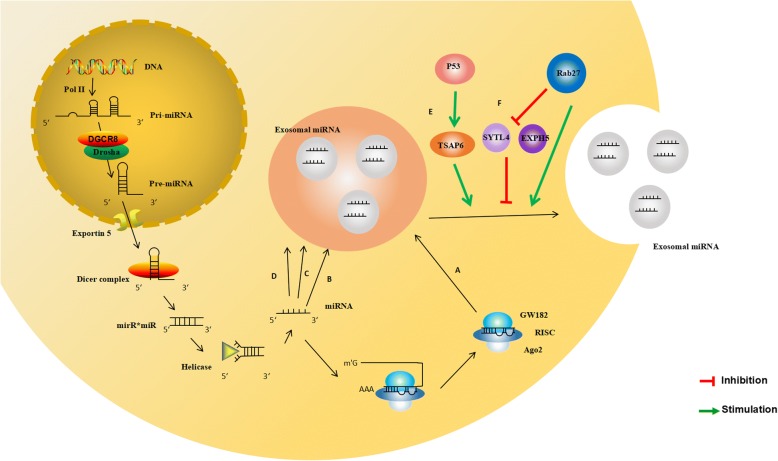
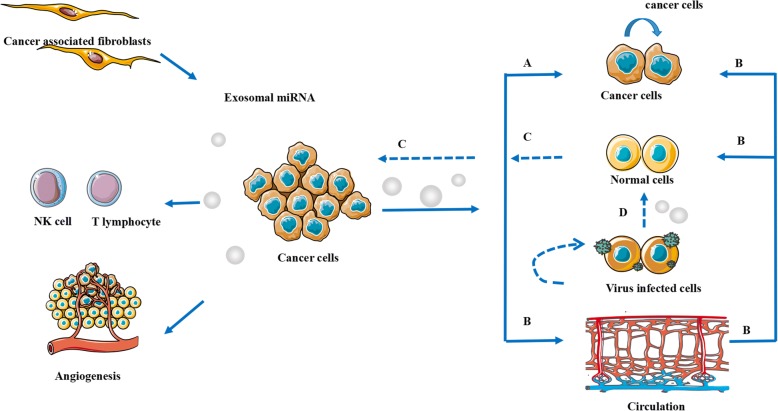
Exosomes, extracellular vesicles with diameters ranging from 30 to 150 nm, are widely present in various body fluids. Recently, microRNAs (miRNAs) have been identified in exosomes, the biogenesis, release, and uptake of which may involve the endosomal sorting complex required for transport (ESCRT complex) and relevant proteins. After release, exosomes are taken up by neighboring or distant cells, and the miRNAs contained within modulate such processes as interfering with tumor immunity and the microenvironment, possibly facilitating tumor growth, invasion, metastasis, angiogenesis and drug resistance. Therefore, exosomal miRNAs have a significant function in regulating cancer progression. Here, we briefly review recent findings regarding tumor-derived exosomes, including RNA sorting and delivering mechanism. We then describe the intercommunication occurring between different cells via exosomal miRNAs in tumor microenvironmnt, with impacts on tumor proliferation, vascularization, metastasis and other biological characteristics. Finally, we highlight the potential role of these molecules as biomarkers in cancer diagnosis and prognosis and tumor resistance to therapeutics.
外泌体是直径为 30 至 150nm 的细胞外囊泡,广泛存在于各种体液中。最近,在外泌体中发现了 microRNAs(miRNAs),其生物发生、释放和摄取可能涉及必需的内体分选复合物运输(ESCRT 复合物)和相关蛋白。释放后,外泌体被邻近或远处的细胞摄取,其中包含的 miRNAs 调节肿瘤免疫和微环境等过程,可能促进肿瘤生长、侵袭、转移、血管生成和耐药性。因此,外泌体 miRNAs 在调节癌症进展方面具有重要功能。在这里,我们简要回顾了肿瘤衍生的外泌体的最新发现,包括 RNA 分选和递药机制。然后,我们描述了肿瘤微环境中不同细胞之间通过外泌体 miRNAs 进行的相互交流,这些交流对肿瘤的增殖、血管生成、转移和其他生物学特性产生影响。最后,我们强调了这些分子作为癌症诊断和预后以及肿瘤对治疗耐药性的生物标志物的潜在作用。