Martha S. Pitzer Center for Women, Children, and Youth, College of Nursing, The Ohio State University, 1585 Neil Avenue, Columbus, OH, USA.
Martha S. Pitzer Center for Women, Children, and Youth, College of Nursing, The Ohio State University, 1585 Neil Avenue, Columbus, OH, USA.
Soc Sci Med. 2018 Nov;216:114-123. doi: 10.1016/j.socscimed.2018.08.010. Epub 2018 Oct 9.
Psychological stress-induced cortisol elevations appear to contribute to preterm birth. Yet, some studies suggest that the biological ramifications of racial discrimination-associated stress are unique and may involve development of decreased glucocorticoid sensitivity despite normalized cortisol levels.
In this study, we examined the effects of racial discrimination on maternal cortisol output, leukocyte glucocorticoid sensitivity, and the degree of correspondence between cortisol levels and birth timing in an African American cohort.
A generally healthy prospective cohort was enrolled at 28-32 weeks gestation (n = 91). The Experiences of Discrimination scale was administered, whole blood collected, and plasma cortisol levels, cytokine levels, and leukocyte counts quantified for examination of patterns of endogenous feedback.
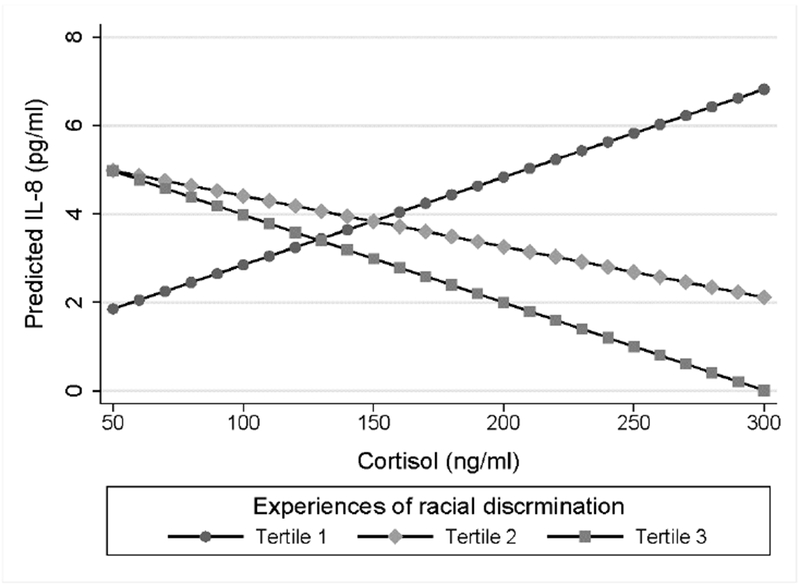
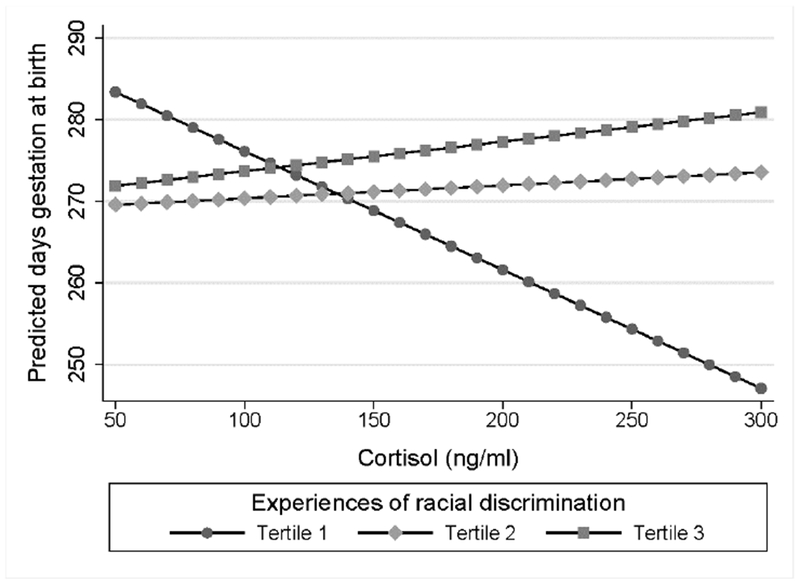
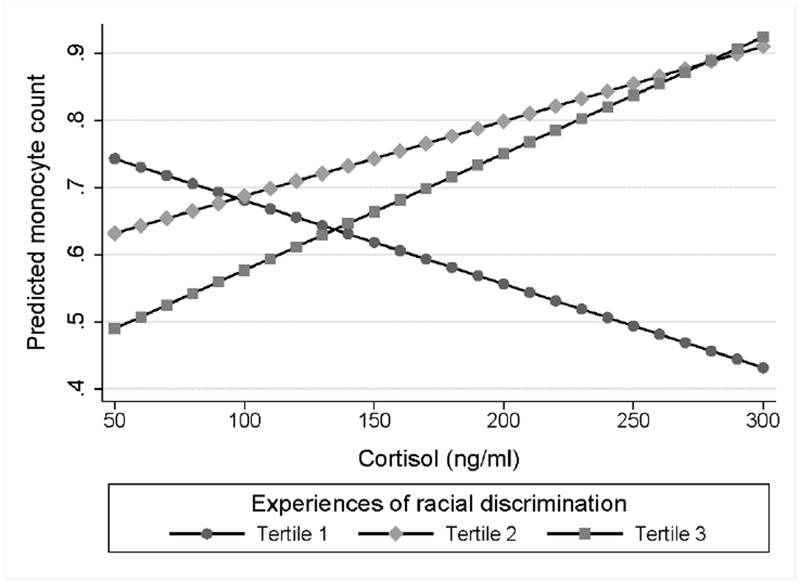
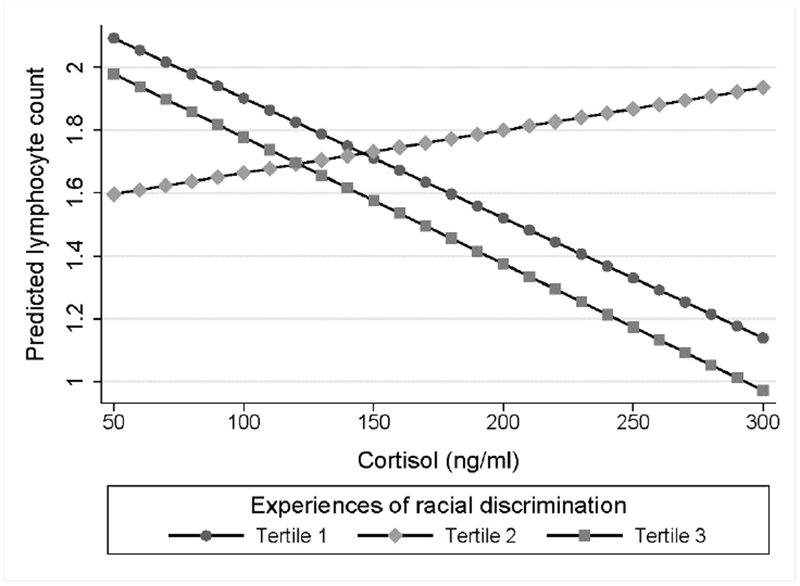
Racial discrimination in the mid-tertile was associated with greater maternal cortisol levels than the bottom tertile among women reporting internalizing responses (b* = 0.68, p = 0.001). Decreased leukocyte glucocorticoid sensitivity was witnessed at greater frequencies of experiences of racial discrimination, as evidenced by decreased correspondence between maternal cortisol levels and plasma IL-8 levels, monocyte counts, and lymphocyte counts (p values ≤ 0.043). The association between maternal cortisol levels and birth timing differed by discrimination tertile (p values ≤ 0.005), with greater cortisol levels predictive of earlier birth among women without (b* = -0.59, p < 0.001) but not with racial discrimination (ps ≥ 0.497).
We provide novel evidence of decreased glucocorticoid sensitivity at increasing frequency of exposure to racial discrimination. Our findings suggest that the biology of preterm birth may depend upon racial discriminatory exposures, favoring pathways dependent upon glucocorticoid-induced increases in leukocyte tissue surveillance versus glucocorticoid resistance-associated inflammatory aberrations at increasing levels of exposure. Precision approaches to prenatal care are sorely needed to combat preterm birth, particularly among African American women, with efforts dependent upon further research examining the pathways contributing to the syndrome dependent upon the totality of an individual's exposures.
心理应激引起的皮质醇升高似乎与早产有关。然而,一些研究表明,与种族歧视相关的应激的生物学后果是独特的,尽管皮质醇水平正常,但可能涉及糖皮质激素敏感性降低。
在这项研究中,我们检查了种族歧视对非裔美国人群母体皮质醇分泌、白细胞糖皮质激素敏感性以及皮质醇水平与分娩时间之间一致性程度的影响。
在 28-32 孕周时,一般健康的前瞻性队列被纳入研究(n=91)。进行了歧视经历量表评估,采集全血,并检测血浆皮质醇水平、细胞因子水平和白细胞计数,以检查内源性反馈模式。
在报告有内化反应的女性中,中等水平的种族歧视与最底层种族歧视的女性相比,皮质醇水平更高(b*=0.68,p=0.001)。经历更多种族歧视的女性白细胞糖皮质激素敏感性降低,表现为母体皮质醇水平与血浆白细胞介素 8 水平、单核细胞计数和淋巴细胞计数之间的一致性降低(p 值≤0.043)。母体皮质醇水平与分娩时间的关联因歧视三分位数而异(p 值≤0.005),在没有种族歧视的女性中,皮质醇水平越高,分娩时间越早(b*=-0.59,p<0.001),但在有种族歧视的女性中则不然(p 值≥0.497)。
我们提供了新的证据,证明在暴露于种族歧视的频率增加时,糖皮质激素敏感性降低。我们的研究结果表明,早产的生物学机制可能取决于种族歧视的暴露,有利于依赖于糖皮质激素诱导的白细胞组织监视增加的途径,而不是在暴露水平增加时,与糖皮质激素抵抗相关的炎症异常。迫切需要采用精确的产前护理方法来对抗早产,特别是在非裔美国女性中,需要进一步研究检查依赖于个体暴露的总和的、导致该综合征的途径。