Social Determinants of Obesity and Cardiovascular Risk Laboratory, National Heart, Lung, and Blood Institute (T.M.P.-W., Y.B., F.O.B., A.S.B., C.T.M., M.A.P., K.A.P.), National Institutes of Health, Bethesda, MD.
Intramural Research Program, National Institute on Minority Health and Health Disparities (T.M.P.-W.), National Institutes of Health, Bethesda, MD.
Circ Res. 2022 Mar 4;130(5):782-799. doi: 10.1161/CIRCRESAHA.121.319811. Epub 2022 Mar 3.
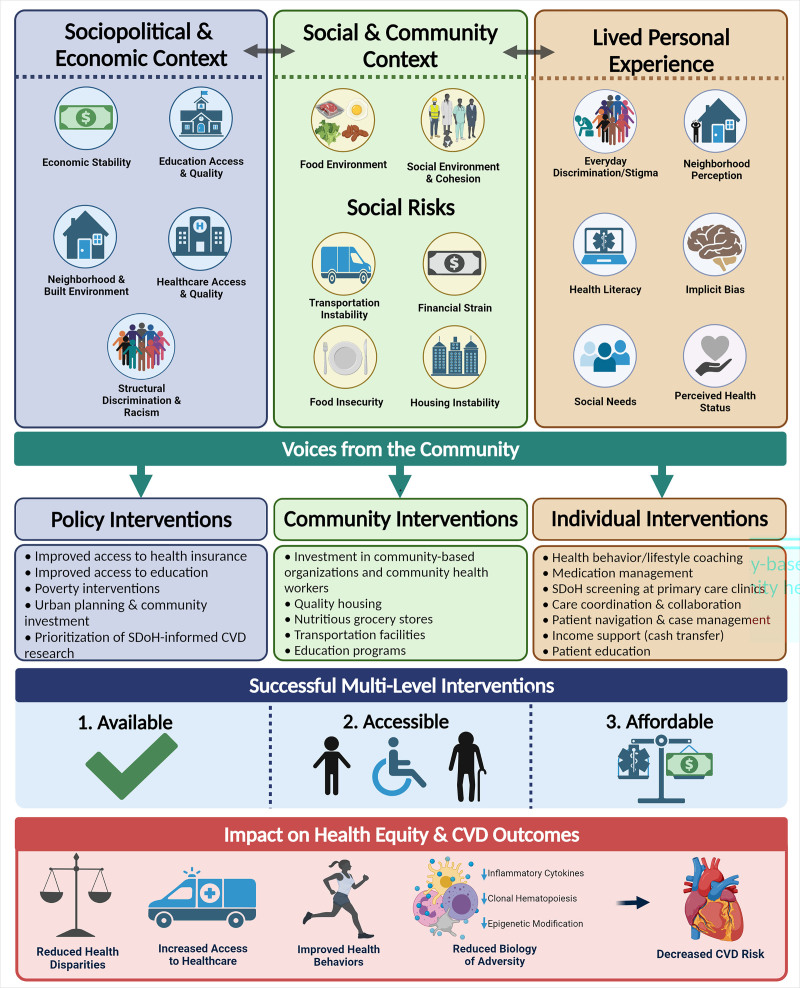
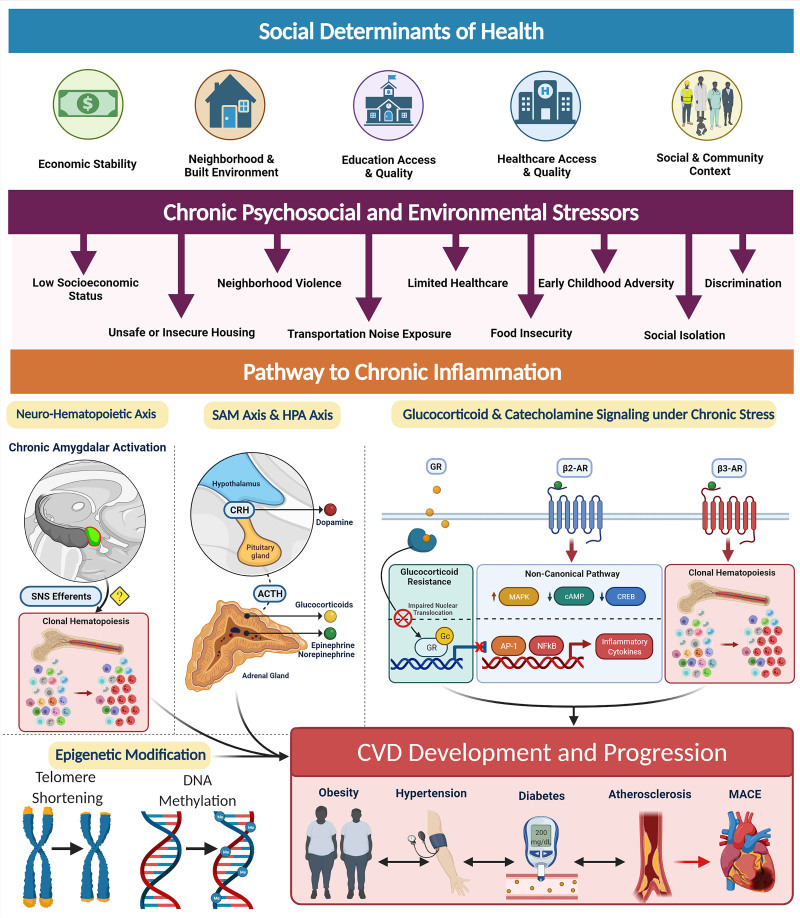
Social determinants of health (SDoH), which encompass the economic, social, environmental, and psychosocial factors that influence health, play a significant role in the development of cardiovascular disease (CVD) risk factors as well as CVD morbidity and mortality. The COVID-19 pandemic and the current social justice movement sparked by the death of George Floyd have laid bare long-existing health inequities in our society driven by SDoH. Despite a recent focus on these structural drivers of health disparities, the impact of SDoH on cardiovascular health and CVD outcomes remains understudied and incompletely understood. To further investigate the mechanisms connecting SDoH and CVD, and ultimately design targeted and effective interventions, it is important to foster interdisciplinary efforts that incorporate translational, epidemiological, and clinical research in examining SDoH-CVD relationships. This review aims to facilitate research coordination and intervention development by providing an evidence-based framework for SDoH rooted in the lived experiences of marginalized populations. Our framework highlights critical structural/socioeconomic, environmental, and psychosocial factors most strongly associated with CVD and explores several of the underlying biologic mechanisms connecting SDoH to CVD pathogenesis, including excess stress hormones, inflammation, immune cell function, and cellular aging. We present landmark studies and recent findings about SDoH in our framework, with careful consideration of the constructs and measures utilized. Finally, we provide a roadmap for future SDoH research focused on individual, clinical, and policy approaches directed towards developing multilevel community-engaged interventions to promote cardiovascular health.
社会决定因素(SDoH)涵盖了影响健康的经济、社会、环境和心理社会因素,在心血管疾病(CVD)风险因素以及 CVD 发病率和死亡率的发展中起着重要作用。COVID-19 大流行和乔治·弗洛伊德(George Floyd)之死引发的当前社会正义运动,暴露了我们社会中由 SDoH 驱动的长期存在的健康不平等现象。尽管最近关注了这些健康差异的结构性驱动因素,但 SDoH 对心血管健康和 CVD 结局的影响仍未得到充分研究和理解。为了进一步研究 SDoH 与 CVD 之间的联系机制,并最终设计有针对性和有效的干预措施,重要的是要促进跨学科的努力,将转化、流行病学和临床研究纳入 SDoH-CVD 关系的研究中。本综述旨在通过为基于边缘化人群生活经验的 SDoH 提供循证框架,促进研究协调和干预措施的制定。我们的框架强调了与 CVD 最密切相关的关键结构性/社会经济、环境和心理社会因素,并探讨了将 SDoH 与 CVD 发病机制联系起来的几种潜在生物学机制,包括应激激素过多、炎症、免疫细胞功能和细胞衰老。我们介绍了我们框架中的 SDoH 标志性研究和最新发现,并仔细考虑了所使用的结构和措施。最后,我们为未来的 SDoH 研究提供了路线图,重点关注针对个体、临床和政策方法的研究,以开发多层次的社区参与干预措施,促进心血管健康。