Määttä O L Merita, Laurila Henna P, Holopainen Saila, Lilja-Maula Liisa, Melamies Marika, Viitanen Sanna J, Johnson L R, Koho Ninna, Neuvonen Mikko, Niemi Mikko, Rajamäki Minna M
Department of Equine and Small Animal Medicine, Faculty of Veterinary Medicine, University of Helsinki, Finland.
Department of Medicine and Epidemiology, Faculty of Veterinary Medicine, University of California, Davis, California.
J Vet Intern Med. 2018 Nov;32(6):2074-2081. doi: 10.1111/jvim.15321. Epub 2018 Oct 12.
Gastroesophageal reflux and microaspiration (MA) of gastric juice are associated with various human respiratory diseases but not in dogs.
To detect the presence of bile acids in bronchoalveolar lavage fluid (BALF) of dogs with various respiratory diseases.
Twenty-seven West Highland White Terriers (WHWTs) with canine idiopathic pulmonary fibrosis (CIPF), 11 dogs with bacterial pneumonia (BP), 13 with chronic bronchitis (CB), 9 with eosinophilic bronchopneumopathy (EBP), 19 with laryngeal dysfunction (LD), 8 Irish Wolfhounds (IWHs) with previous BPs, 13 healthy WHWTs, all privately owned dogs, and 6 healthy research colony Beagles METHODS: Prospective cross-sectional observational study with convenience sampling of dogs. Bile acids were measured by mass spectrometry in BALF samples. Total bile acid (TBA) concentration was calculated as a sum of 17 different bile acids.
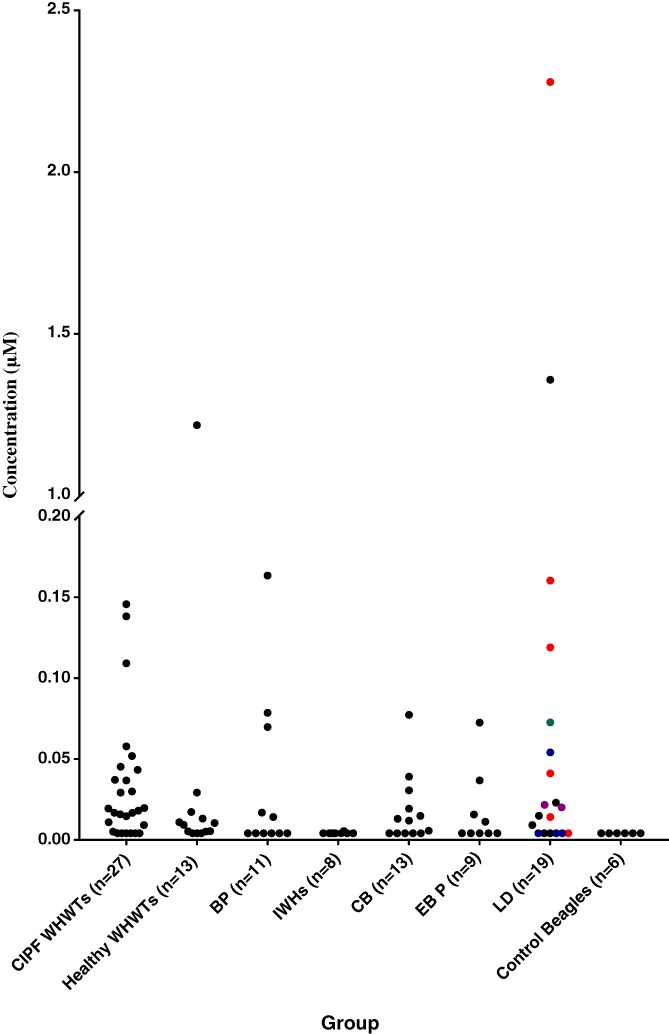
Concentrations of TBA were above the limit of quantification in 78% of CIPF, 45% of BP, 62% of CB, 44% of EBP, 68% of LD, and 13% of IWH dogs. In healthy dogs, bile acids were detected less commonly in Beagles (0/6) than in healthy WHWTs (10/13). Concentrations of TBA were significantly higher in CIPF (median 0.013 μM, range not quantifiable [n.q.]-0.14 μM, P < .001), healthy WHWTs (0.0052 μM, n.q.-1.2 μM, P = .003), LD (0.010 μM, n.q.-2.3 μM, P = .015), and CB (0.0078 μM, n.q.-0.073 μM, P = .018) groups compared to Beagles (0 μM, n.q.).
These results suggest that MA occurs in various respiratory diseases of dogs and also in healthy WHWTs.
胃食管反流和胃液微误吸(MA)与多种人类呼吸系统疾病相关,但在犬类中并非如此。
检测患有各种呼吸系统疾病的犬支气管肺泡灌洗液(BALF)中胆汁酸的存在情况。
27只患有犬特发性肺纤维化(CIPF)的西高地白梗(WHWTs)、11只患有细菌性肺炎(BP)的犬、13只患有慢性支气管炎(CB)的犬、9只患有嗜酸性支气管肺炎(EBP)的犬、19只患有喉功能障碍(LD)的犬、8只曾患BP的爱尔兰猎狼犬(IWHs)、13只健康的WHWTs(均为私人所有的犬)以及6只健康的研究用比格犬。
采用方便抽样法对犬进行前瞻性横断面观察研究。通过质谱法测量BALF样本中的胆汁酸。总胆汁酸(TBA)浓度计算为17种不同胆汁酸的总和。
78%的CIPF犬、45%的BP犬、62%的CB犬、44%的EBP犬、68%的LD犬以及13%的IWH犬的TBA浓度高于定量限。在健康犬中,比格犬(0/6)检测到胆汁酸的情况比健康的WHWTs(10/13)少。与比格犬(0 μM,未定量)相比,CIPF组(中位数0.013 μM,范围不可定量[n.q.] - 0.14 μM,P <.001)、健康WHWTs组(0.0052 μM,n.q. - 1.2 μM)(P = 0.003)、LD组(0.010 μM,n.q. - 2.3 μM,P = 0.015)和CB组(0.0078 μM,n.q. - 0.073 μM,P = 0.018)的TBA浓度显著更高。
这些结果表明,MA发生在犬的各种呼吸系统疾病中,也发生在健康的WHWTs中。