van der Laan Danielle M, Elders Petra J M, Boons Christel C L M, Nijpels Giel, van Dijk Liset, Hugtenburg Jacqueline G
Department of Clinical Pharmacology and Pharmacy and the Amsterdam Public Health Research Institute, VU University Medical Center, Amsterdam, Netherlands.
Department of General Practice and Elderly Care Medicine and the Amsterdam Public Health Research Institute, VU University Medical Center, Amsterdam, Netherlands.
Front Pharmacol. 2018 Sep 26;9:1057. doi: 10.3389/fphar.2018.01057. eCollection 2018.
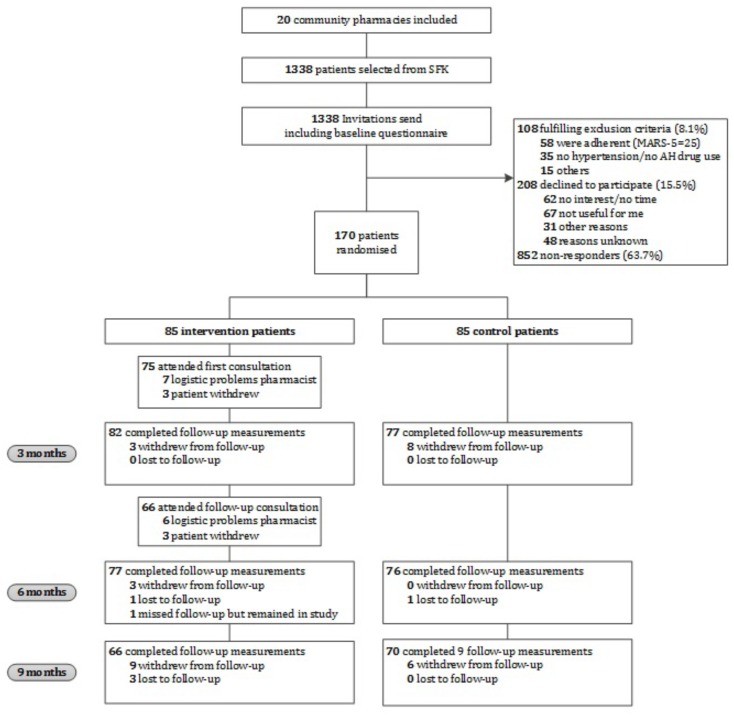
Non-adherence to medication is a complex health care problem. In spite of substantial efforts, up till now little progress has been made to effectively tackle the problem with adherence-enhancing interventions. The aim of this study was to investigate the effectiveness of a patient-tailored, pharmacist-led and theory-driven intervention program aimed to enhance self-reported adherence to antihypertensive medication. A parallel-group randomized controlled trial in 20 community pharmacies with nine months follow-up was conducted. Patients (45-75 years) using antihypertensive medication and considered non-adherent based on both pharmacy dispensing data and a self-report questionnaire were eligible to participate. The intervention program consisted of two consultations with the pharmacist to identify participants' barriers to adhere to medication and to counsel participants in overcoming these barriers. The primary outcome was self-reported medication adherence. Secondary outcomes were beliefs about medicines, illness perceptions, quality of life and blood pressure. Mixed-model and generalized estimating equation (GEE) analyses were used to assess overall effects of the intervention program and effects per time point. 170 patients were included. No significant differences between intervention and control groups were found in self-reported adherence, quality of life, illness perceptions, beliefs about medicines (concern scale), and blood pressure. After nine months, intervention participants had significantly stronger beliefs about the necessity of using their medicines as compared to control participants (mean difference 1.25 [95% CI: 0.27 to 2.24], = 0.012). We do not recommend to implement the intervention program in the current form for this study population. Future studies should focus on how to select eligible patient groups with appropriate measures in order to effectively target adherence-enhancing interventions. NTR5017 http://www.trialregister.nl/trialreg/admin/rctview.asp?TC=5017.
不遵医嘱服药是一个复杂的医疗保健问题。尽管付出了巨大努力,但迄今为止,在通过增强依从性的干预措施有效解决该问题方面进展甚微。本研究的目的是调查一项针对患者量身定制、由药剂师主导且基于理论的干预计划的有效性,该计划旨在提高自我报告的抗高血压药物依从性。在20家社区药房进行了一项平行组随机对照试验,并进行了9个月的随访。使用抗高血压药物且根据药房配药数据和自我报告问卷被认为不依从的患者(45 - 75岁)有资格参与。干预计划包括与药剂师进行两次咨询,以确定参与者坚持服药的障碍,并指导参与者克服这些障碍。主要结局是自我报告的药物依从性。次要结局包括对药物的信念、疾病认知、生活质量和血压。采用混合模型和广义估计方程(GEE)分析来评估干预计划的总体效果和每个时间点的效果。共纳入170名患者。在自我报告的依从性、生活质量、疾病认知、对药物的信念(关注量表)和血压方面,干预组和对照组之间未发现显著差异。9个月后,与对照组参与者相比,干预组参与者对服用药物必要性的信念明显更强(平均差异1.25 [95% CI:0.27至2.24], = 0.012)。我们不建议以当前形式对该研究人群实施干预计划。未来的研究应关注如何通过适当措施选择符合条件的患者群体,以便有效地针对增强依从性的干预措施。NTR5017 http://www.trialregister.nl/trialreg/admin/rctview.asp?TC=5017