Unit of Clinical Immunology, Allergy and Advanced Biotechnologies, Azienda Unità Sanitaria Locale-IRCCS di Reggio Emilia, Reggio Emilia, Italy.
Unit of Rheumatology, Azienda Unità Sanitaria Locale-IRCCS di Reggio Emilia, Reggio Emilia, Italy.
Front Immunol. 2018 Sep 25;9:2157. doi: 10.3389/fimmu.2018.02157. eCollection 2018.
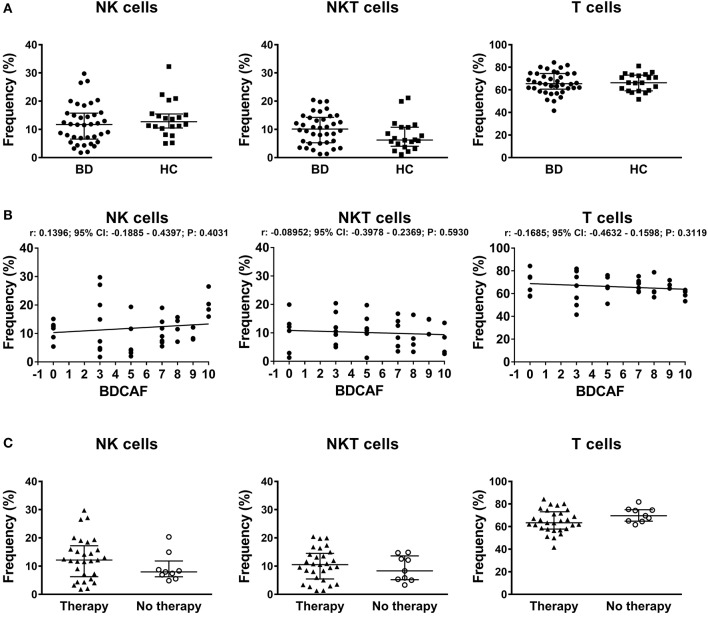
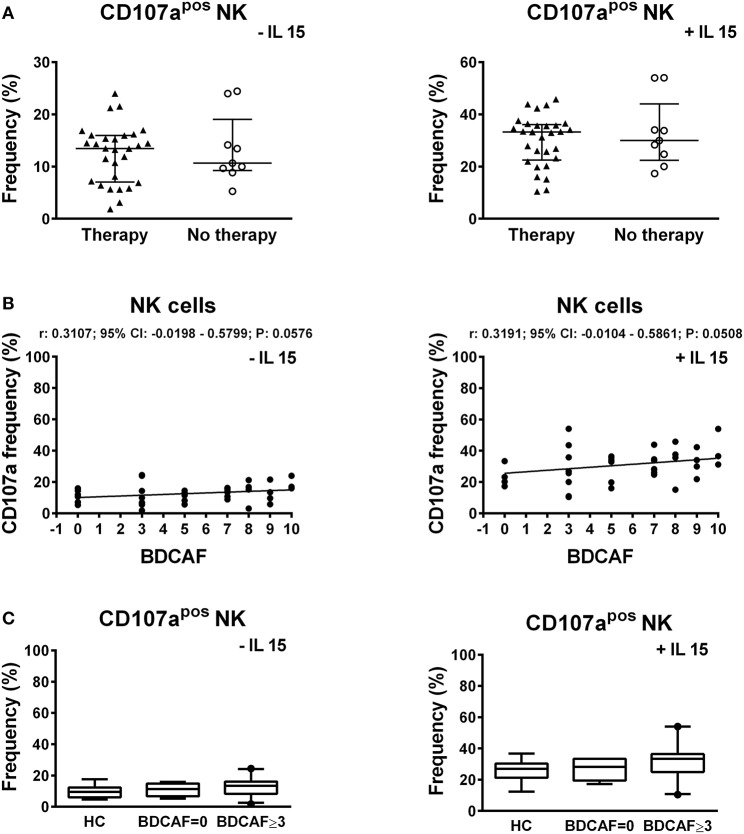
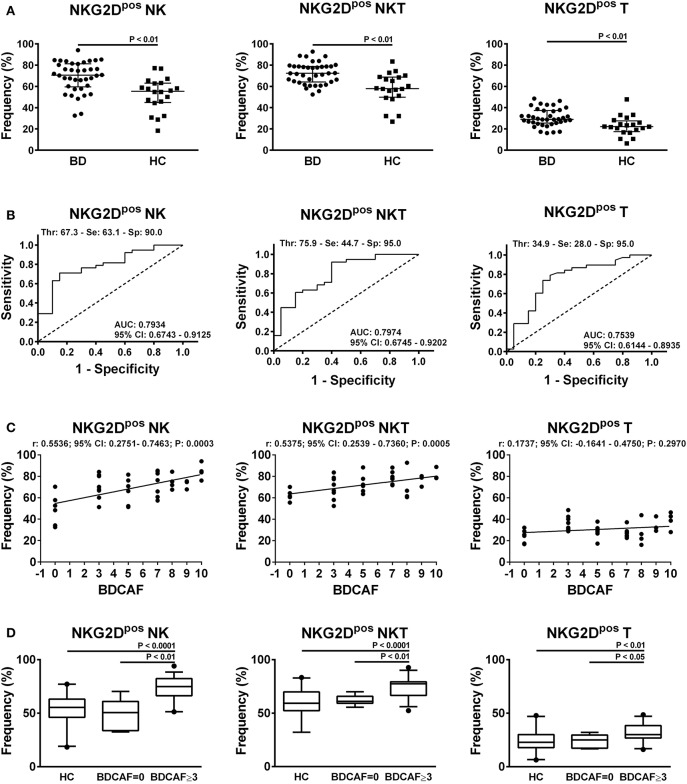
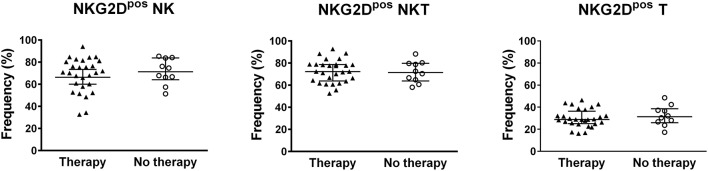
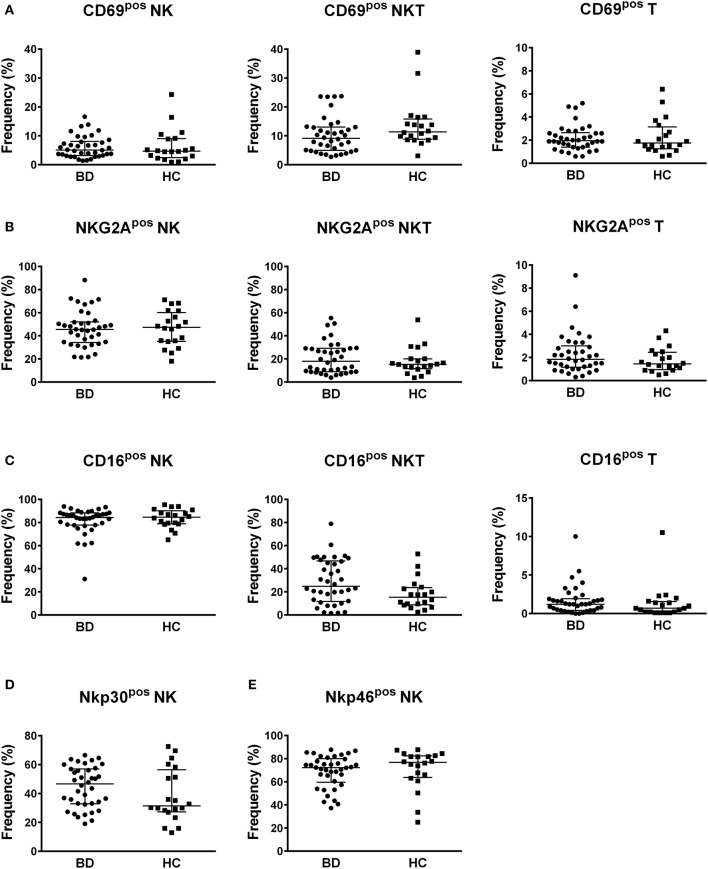
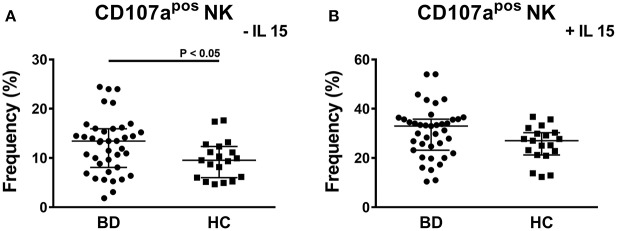
Behçet disease (BD) is an inflammatory systemic disease with a fluctuating course, which can affect the skin, eyes, central nervous system, musculoskeletal, gastrointestinal, and vascular systems. No laboratory tests are currently available for the diagnosis of BD and monitoring disease activity. Moreover there is a lack of knowledge on BD pathogenesis. This study focused on circulating Natural Killer (NK), NKT and T cells evaluated as CD3 CD56, CD3 CD56, and CD3 CD56. Peripheral blood mononuclear cells (PBMCs) were collected from 38 BD patients and 20 healthy controls (HC). The frequencies of NK, NKT, and T cells expressing CD16, CD69, NKG2D, Nkp30, Nkp46, and NKG2A were assessed by flow cytometry. Cytotoxic potential of NK cells was evaluated by flow cytometry as the percentage of cells expressing the degranulation marker CD107a after incubation with K562 cells. The levels of 27 cytokines were determined in plasma with a multiplex bead-based assay. Higher percentages of NK, NKT, and T cells expressing NKG2D were detected in PBMCs of BD patients than HC. ROC curve analysis showed that the evaluation of NKG2D NK, NKT, and T cell percentages discriminated between BD patients and HC. Moreover, there was a positive correlation between the BD Current Activity Form (BDCAF) scores and the frequencies of NKG2D NK and NKT cells. A higher frequency of NK cells expressing CD107a was induced in PBMCs from BD patients than HC after incubation with K562 cells. Concentrations of IL-5, IL-6, IL-10, IL-13, IP-10, and MIP-1β were higher in plasma of BD patients than HC. Monitoring the frequencies of NKG2D lymphocytes could help the clinicians in BD patients management. In addition, the increased expression of NKG2D in BD patients is likely involved in disease pathogenesis.
贝赫切特病(BD)是一种具有波动病程的炎症性全身性疾病,可影响皮肤、眼睛、中枢神经系统、肌肉骨骼、胃肠道和血管系统。目前尚无用于 BD 诊断和监测疾病活动的实验室检测方法。此外,人们对 BD 的发病机制知之甚少。本研究集中于循环自然杀伤(NK)、NKT 和 T 细胞,这些细胞被评估为 CD3 CD56、CD3 CD56 和 CD3 CD56。从 38 名 BD 患者和 20 名健康对照者(HC)中采集外周血单核细胞(PBMCs)。通过流式细胞术评估 NK、NKT 和 T 细胞表达 CD16、CD69、NKG2D、Nkp30、Nkp46 和 NKG2A 的频率。通过流式细胞术评估 NK 细胞的细胞毒性潜能,方法是在与 K562 细胞孵育后,评估表达脱颗粒标志物 CD107a 的细胞的百分比。使用基于多重珠的测定法在血浆中测定 27 种细胞因子的水平。与 HC 相比,BD 患者的 PBMCs 中检测到更高百分比的表达 NKG2D 的 NK、NKT 和 T 细胞。ROC 曲线分析表明,评估 NKG2D NK、NKT 和 T 细胞的百分比可区分 BD 患者和 HC。此外,BD 当前活动表(BDCAF)评分与 NKG2D NK 和 NKT 细胞的频率之间存在正相关。与 HC 相比,BD 患者 PBMCs 在与 K562 细胞孵育后诱导表达 CD107a 的 NK 细胞的频率更高。BD 患者血浆中的 IL-5、IL-6、IL-10、IL-13、IP-10 和 MIP-1β 浓度高于 HC。监测 NKG2D 淋巴细胞的频率可能有助于 BD 患者的临床医生进行管理。此外,BD 患者中 NKG2D 的表达增加可能与疾病发病机制有关。