Zhang Xinbo, Sessa William C, Fernández-Hernando Carlos
Vascular Biology and Therapeutics Program, Integrative Cell Signaling and Neurobiology of Metabolism Program, Department of Comparative Medicine and Department of Pathology, Yale University School of Medicine, New Haven, CT, United States.
Vascular Biology and Therapeutics Program, Department of Pharmacology, Yale University School of Medicine, New Haven, CT, United States.
Front Cardiovasc Med. 2018 Sep 25;5:130. doi: 10.3389/fcvm.2018.00130. eCollection 2018.
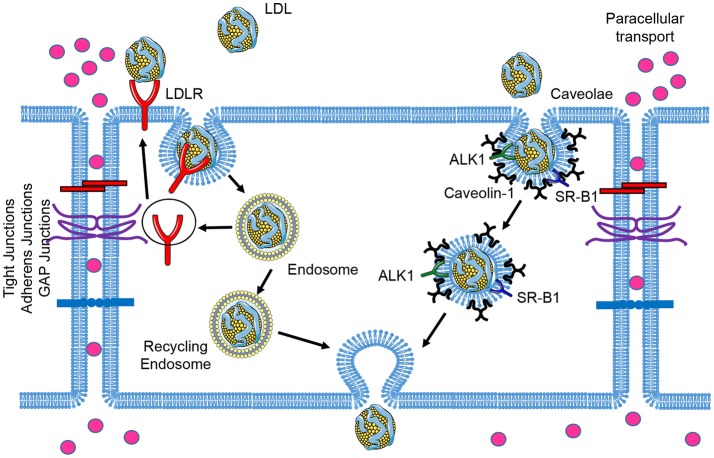
Seminal studies from Nikolai Anichckov identified the accumulation of cholesterol in the arteries as the initial event that lead to the formation of atherosclerotic plaques. Further studies by Gofman and colleagues demonstrated that high levels of circulating low-density lipoprotein cholesterol (LDL-C) was responsible for the accelerated atherosclerosis observed in humans. These findings were confirmed by numerous epidemiological studies which identified elevated LDL-C levels as a major risk factor for cardiovascular disease. LDL infiltrates in the arterial wall and interacts with the proteoglycan matrix promoting the retention and modification of LDL to a toxic form, which results in endothelial cell (EC) activation and vascular inflammation. Despite the relevance of LDL transport across the endothelium during atherogenesis, the molecular mechanism that control this process is still not fully understood. A number of studies have recently demonstrated that low density lipoprotein (LDL) transcytosis across the endothelium is dependent on the function of caveolae, scavenger receptor B1 (SR-B1), activin receptor-like kinase 1 (ALK1), and LDL receptor (LDLR), whereas high-density lipoproteins (HDL) and its major protein component apolipoprotein AI transcytose ECs through SR-B1, ATP-Binding cassette transporter A1 (ABCA1) and ABCG1. In this review article, we briefly summarize the function of the EC barrier in regulating lipoprotein transport, and its relevance during the progression of atherosclerosis. A better understanding of the mechanisms that mediate lipoprotein transcytosis across ECs will help to develop therapies targeting the early events of atherosclerosis and thus exert potential benefits for treating atherosclerotic vascular disease.
尼古拉·阿尼奇科夫的开创性研究发现,动脉中胆固醇的积累是导致动脉粥样硬化斑块形成的初始事件。戈夫曼及其同事的进一步研究表明,循环中高水平的低密度脂蛋白胆固醇(LDL-C)是导致人类动脉粥样硬化加速的原因。众多流行病学研究证实了这些发现,这些研究将LDL-C水平升高确定为心血管疾病的主要危险因素。LDL渗入动脉壁并与蛋白聚糖基质相互作用,促使LDL保留并转变为毒性形式,从而导致内皮细胞(EC)活化和血管炎症。尽管LDL在动脉粥样硬化形成过程中穿过内皮的运输具有相关性,但控制这一过程的分子机制仍未完全了解。最近的一些研究表明,低密度脂蛋白(LDL)通过内皮细胞的转胞吞作用依赖于小窝、清道夫受体B1(SR-B1)、激活素受体样激酶1(ALK1)和LDL受体(LDLR)的功能,而高密度脂蛋白(HDL)及其主要蛋白质成分载脂蛋白AI则通过SR-B1、ATP结合盒转运体A1(ABCA1)和ABCG1转胞吞进入内皮细胞。在这篇综述文章中,我们简要总结了内皮细胞屏障在调节脂蛋白运输中的功能及其在动脉粥样硬化进展过程中的相关性。更好地理解介导脂蛋白通过内皮细胞转胞吞的机制将有助于开发针对动脉粥样硬化早期事件的疗法,从而为治疗动脉粥样硬化性血管疾病带来潜在益处。