Haramaya University, College of Health and Medical Sciences, Harar, Ethiopia.
Haramaya University, College of Social Sciences and Humanities, Dire Dawa, Ethiopia.
PLoS One. 2018 Oct 15;13(10):e0204697. doi: 10.1371/journal.pone.0204697. eCollection 2018.
Pulmonary tuberculosis (TB) impairs respiratory physiology and functional ability, resulting in economic and social dependence upon others. Patients with tuberculosis especially multi drug resistant (MDR-TB) suffer from social isolation, stigma, lack of support and economic constraints. In Ethiopia, the trend of MDR TB is increasing and becoming a serious public health problem. However, little is known about patients except treatment outcomes, financial burden and psychological distress with serious deficiency of data on Health Related Quality of Life (HRQOL). Hence, the aim of this study was to assess HRQOL of MDR TB patients in comparison with drug sensitive pulmonary TB (DSTB) patients.
We included 100 cases of MDR and 300 controls with DSTB who were matched by sex. Data were collected using SF- 36v2 TM questionnaire and analysed with SPSS version 20. Independent t-test and conditional logistic regression analysis was done considering P-values of less than 0.05 statistically significant. Eight in-depth interviews were also conducted with both groups and represented with verbatim quotations and narrative texts.
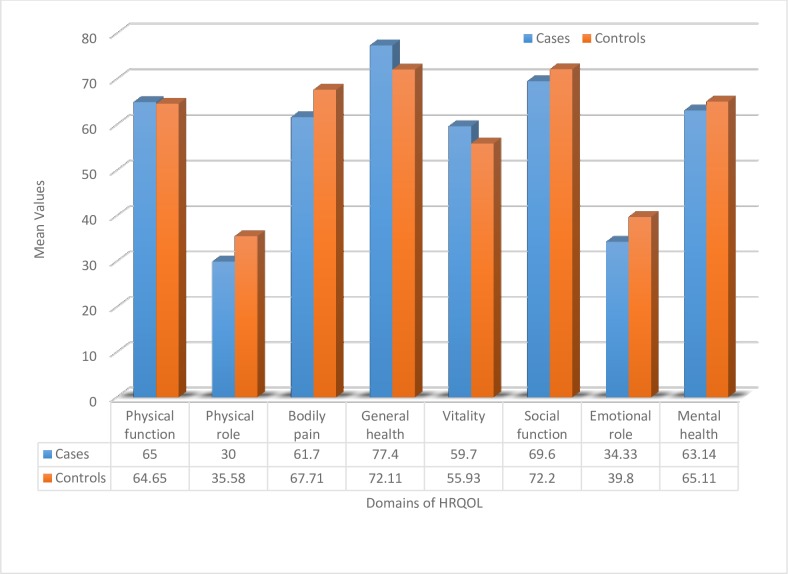
There were no statistically significant differences in mean scores for health related quality of life between cases and controls (57.61±16.42 and 59.13±22.10) nor were there significant differences in physical functioning, role disruption due to physical problems, vitality, social functioning, role disruption due to emotional distress, or overall mental health. Individuals with MDR-TB were significantly more likely to be single, a current student, and with lower education and families with more than 5 people than individuals with Drug sensitive TB, all of which were significantly associated with poorer HRQOL (p<0.05). There was good internal consistency of the scale scores, with a Cronbach's alpha value of 0.73.
Individuals with MDR-TB reported statistically worse general health but less bodily pain than individuals with Drug sensitive TB. To regain the role function they lost, we recommend that health facilities, media and all other stakeholders educate the community, households and students about pulmonary tuberculosis, treatment, prevention methods and therapeutic approaches towards TB patients, specifically MDR-TB.
肺结核(TB)会损害呼吸生理和功能能力,导致经济和社会上依赖他人。结核病患者,特别是耐多药(MDR-TB)患者,遭受社会隔离、污名化、缺乏支持和经济限制。在埃塞俄比亚,MDR-TB 的趋势正在增加,成为一个严重的公共卫生问题。然而,除了治疗结果、经济负担和心理困扰外,对患者的了解甚少,并且严重缺乏与健康相关的生活质量(HRQOL)相关的数据。因此,本研究旨在评估 MDR-TB 患者与药敏肺结核(DSTB)患者的 HRQOL。
我们纳入了 100 例 MDR 和 300 例 DSTB 对照病例,按性别匹配。使用 SF-36v2 TM 问卷收集数据,并使用 SPSS 版本 20 进行分析。考虑到 P 值小于 0.05,进行独立 t 检验和条件逻辑回归分析。还对两组进行了 8 次深入访谈,并以逐字引述和叙述文本表示。
病例组和对照组的健康相关生活质量平均得分没有统计学差异(57.61±16.42 和 59.13±22.10),在身体机能、因身体问题导致的角色障碍、活力、社会功能、因情绪困扰导致的角色障碍或整体心理健康方面也没有统计学差异。与药敏肺结核患者相比,耐多药肺结核患者单身、正在上学、受教育程度较低、家庭人口超过 5 人,这些因素与较差的 HRQOL 显著相关(p<0.05)。量表评分具有良好的内部一致性,Cronbach's alpha 值为 0.73。
耐多药肺结核患者报告的总体健康状况较差,但身体疼痛程度较轻。为了恢复他们失去的角色功能,我们建议卫生机构、媒体和所有其他利益攸关方对社区、家庭和学生进行肺结核、治疗、预防方法和治疗方法的教育,特别是针对耐多药肺结核患者。