Goudsmit Miriam, van Campen Jos, Schilt Thelma, Hinnen Chris, Franzen Sanne, Schmand Ben
Department of Medical Psychology/Hospital Psychiatry, Medical Centre Slotervaart, Amsterdam, the Netherlands.
Department of Geriatrics, Medical Centre Slotervaart, Amsterdam, the Netherlands.
Dement Geriatr Cogn Dis Extra. 2018 Aug 29;8(2):290-305. doi: 10.1159/000490174. eCollection 2018 May-Aug.
Diagnosing dementia in elderly immigrants is often difficult due to language and cultural barriers, low education, and illiteracy. We compared the diagnostic accuracy of the Rowland Universal Dementia Assessment Scale (RUDAS) to that of the Mini Mental State Examination (MMSE).
A total of 144 patients (42 with intact cognition, 44 with mild cognitive impairment [MCI], and 58 with dementia) were administered both instruments and were diagnosed by specialists blinded for MMSE and RUDAS results.
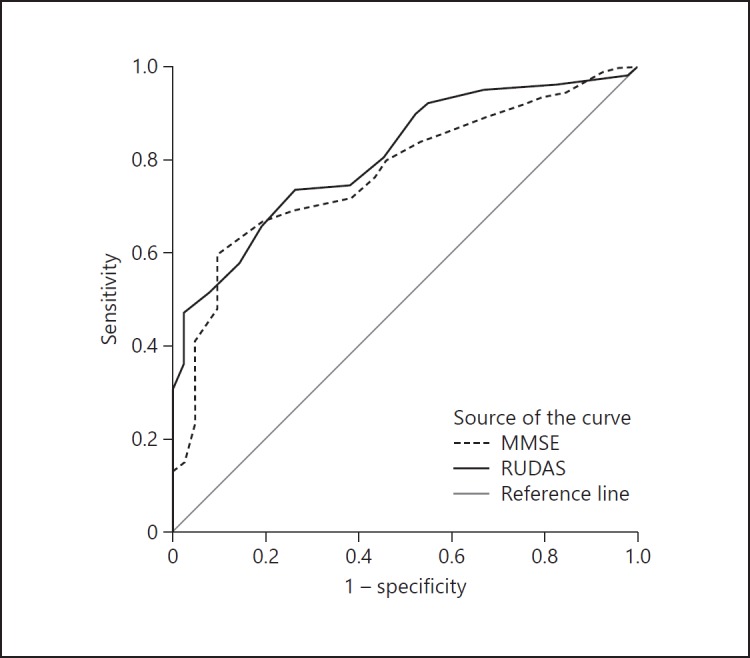
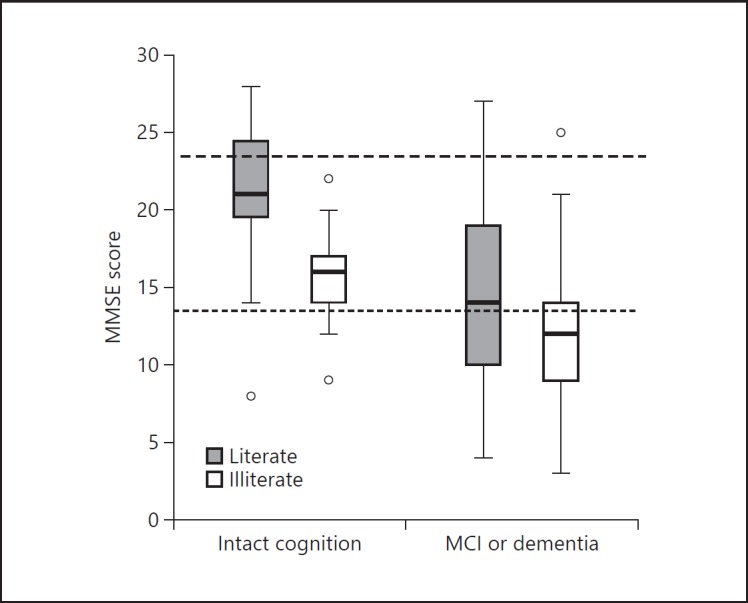
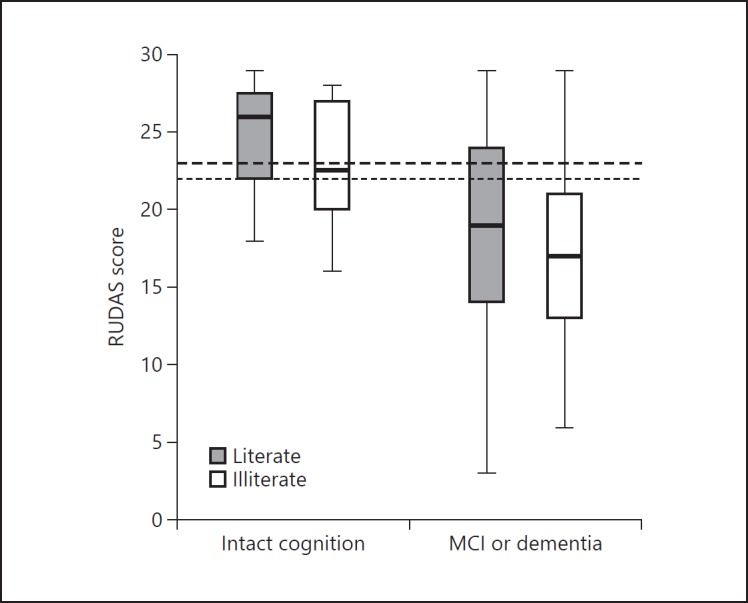
Areas under the curve for discriminating intact cognition from MCI and dementia were comparable for RUDAS (0.81; 95% confidence interval 0.74-0.88) and MMSE (0.75; 95% confidence interval 0.69-0.85). Education and literacy were not correlated with the RUDAS but had a medium-large correlation with the MMSE (rho = 0.39).
The study provides additional evidence for the usefulness of the RUDAS in a highly illiterate, culturally diverse geriatric outpatient population.
由于语言和文化障碍、低教育水平及文盲问题,对老年移民进行痴呆症诊断往往很困难。我们比较了罗兰通用痴呆评估量表(RUDAS)与简易精神状态检查表(MMSE)的诊断准确性。
共对144名患者(42名认知功能正常者、44名轻度认知障碍[MCI]者和58名痴呆症患者)使用了这两种工具,并由对MMSE和RUDAS结果不知情的专家进行诊断。
RUDAS区分认知功能正常与MCI及痴呆症的曲线下面积(0.81;95%置信区间0.74 - 0.88)与MMSE(0.7走;95%置信区间0.69 - 0.85)相当。教育程度和识字能力与RUDAS无相关性,但与MMSE有中等程度的相关性(rho = 0.39)。
该研究为RUDAS在高度文盲、文化多元的老年门诊人群中的实用性提供了更多证据。