Riva Antonella, Ronchi Massimo, Petrangolini Giovanna, Bosisio Stefania, Allegrini Pietro
Research and Development Department, Indena SpA, 20139, Milan, Italy.
Eur J Drug Metab Pharmacokinet. 2019 Apr;44(2):169-177. doi: 10.1007/s13318-018-0517-3.
The importance of quercetin and flavonoids in the diet and as food supplements is well known, and literature studies support their potential use to treat several human diseases. Many beneficial properties have been described for quercetin, so much effort has been directed into overcoming the major drawbacks of this natural compound-its poor solubility and low oral absorption. The aims of this study were to compare a new food-grade lecithin-based formulation of quercetin, Quercetin Phytosome, to unformulated quercetin in terms of solubility in simulated gastrointestinal fluids and oral absorption in a randomized crossover pharmacokinetic study of healthy volunteers.
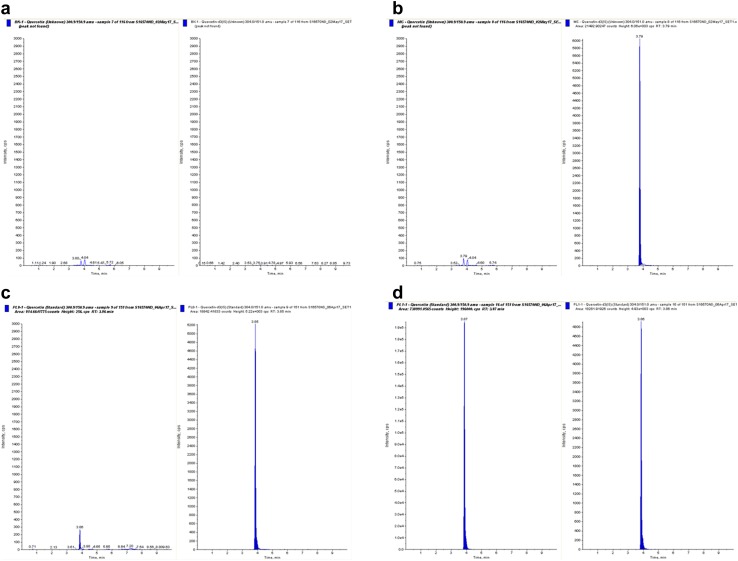
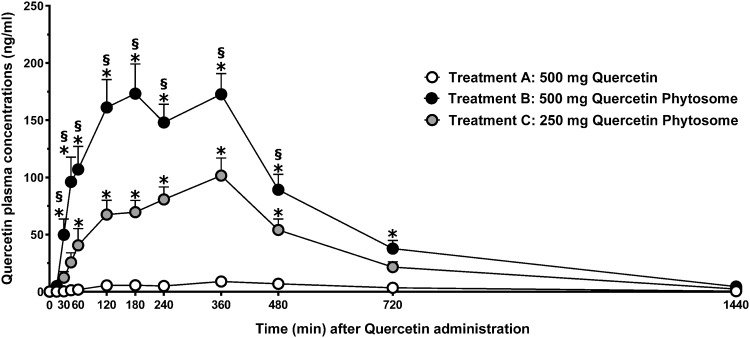
The solubility of the new formulation was determined by in vitro incubation in simulated gastrointestinal fluids, and quercetin was detected by ultra performance liquid chromatography. A single-dose, randomized, six-sequence/three-period crossover clinical trial (3 × 3 × 3 crossover design) with a balanced carryover effect was conducted in healthy volunteers under fasting conditions. Twelve healthy volunteers of both sexes with an age range of 18-50 years were recruited; one dose of quercetin and two different doses of Quercetin Phytosome were administered orally as film-coated tablets. Pharmacokinetic samples were collected at twelve time points (from 0 h to 24 h) after administration, and quercetin levels were measured by HPLC/MS/MS. Data were analyzed using the Phoenix WinNonlin (v.6.4) software package, and the most significant pharmacokinetic parameters were calculated. Statistical analysis involved performing a two-way ANOVA with repeated measures followed by post hoc analysis (Tukey's test).
Significant improvements in both in vitro solubility and oral absorption (in terms of both exposure and maximum concentration achieved) by healthy volunteers in a human clinical study were obtained with the Quercetin Phytosome formulation as compared to unformulated quercetin.
A more soluble formulation of quercetin based on lecithin, Quercetin Phytosome, has recently been developed, and was found to facilitate the attainment of very high plasma levels of quercetin-up to 20 times more than usually obtained following a dose of quercetin-when the novel formulation was administered orally in human volunteers, and it did not have any notable side effects. These results suggest that Quercetin Phytosome allows the oral administration of quercetin in a safe and bioavailable manner, thus facilitating the effective utilization of this natural compound to treat various human diseases.
槲皮素和类黄酮在饮食及作为食品补充剂方面的重要性已广为人知,且文献研究支持它们在治疗多种人类疾病方面的潜在用途。槲皮素具有许多有益特性,因此人们付出了诸多努力来克服这种天然化合物的主要缺点——其溶解度低和口服吸收率低。本研究的目的是在一项针对健康志愿者的随机交叉药代动力学研究中,比较一种新的基于食品级卵磷脂的槲皮素制剂(槲皮素磷脂体)与未制剂化的槲皮素在模拟胃肠液中的溶解度和口服吸收情况。
通过在模拟胃肠液中进行体外孵育来测定新制剂的溶解度,并用超高效液相色谱法检测槲皮素。在禁食条件下,对健康志愿者进行了一项单剂量、随机、六序列/三周期交叉临床试验(3×3×3交叉设计),具有平衡的残留效应。招募了12名年龄在18至50岁之间的健康男女志愿者;以薄膜包衣片的形式口服一剂槲皮素和两种不同剂量的槲皮素磷脂体。给药后在12个时间点(从0小时到24小时)采集药代动力学样本,并用HPLC/MS/MS测定槲皮素水平。使用Phoenix WinNonlin(v.6.4)软件包分析数据,并计算最显著的药代动力学参数。统计分析包括进行重复测量的双向方差分析,随后进行事后分析(Tukey检验)。
与未制剂化的槲皮素相比,在一项人体临床研究中,槲皮素磷脂体制剂使健康志愿者的体外溶解度和口服吸收(在暴露量和达到的最大浓度方面)均有显著改善。
最近开发了一种基于卵磷脂的更易溶的槲皮素制剂——槲皮素磷脂体,当在人类志愿者中口服这种新制剂时,发现它有助于达到非常高的血浆槲皮素水平——比服用一剂槲皮素后通常获得的水平高出20倍,并且它没有任何明显的副作用。这些结果表明,槲皮素磷脂体能够以安全且生物可利用的方式口服给药槲皮素,从而有助于有效利用这种天然化合物来治疗各种人类疾病。