Donders Institute for Brain, Cognition and Behaviour, Radboud University, Nijmegen, The Netherlands.
Department of Cognitive, Linguistic and Psychological Sciences, Brown University, Providence, Rhode Island, United States of America.
PLoS Biol. 2018 Oct 18;16(10):e2005979. doi: 10.1371/journal.pbio.2005979. eCollection 2018 Oct.
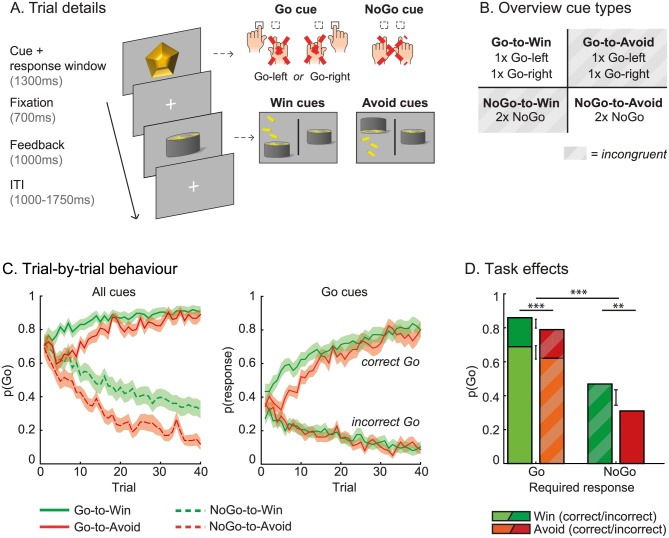
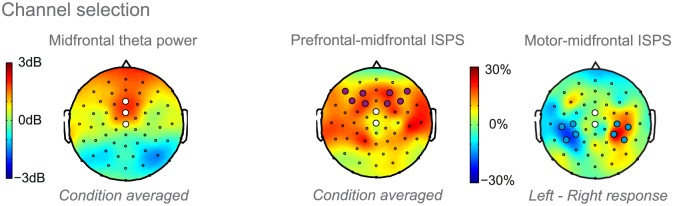
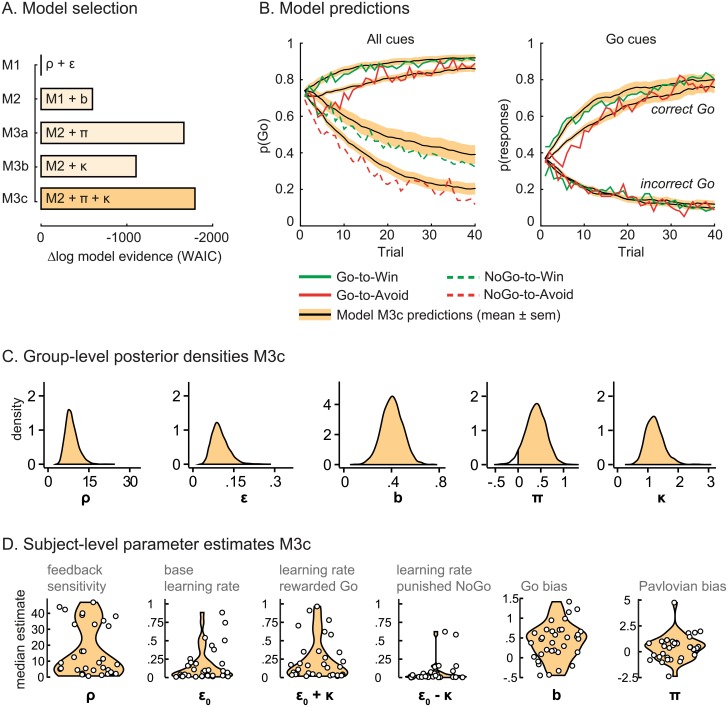
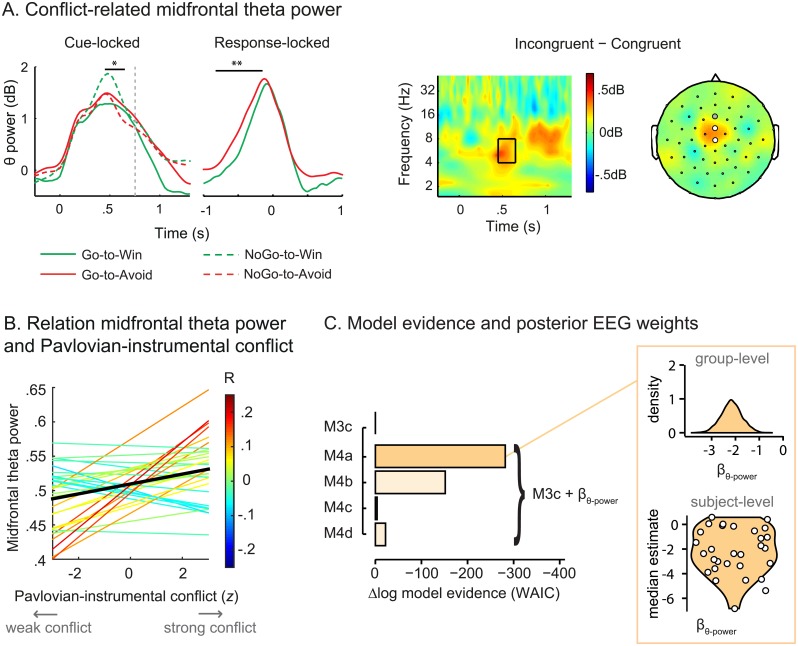
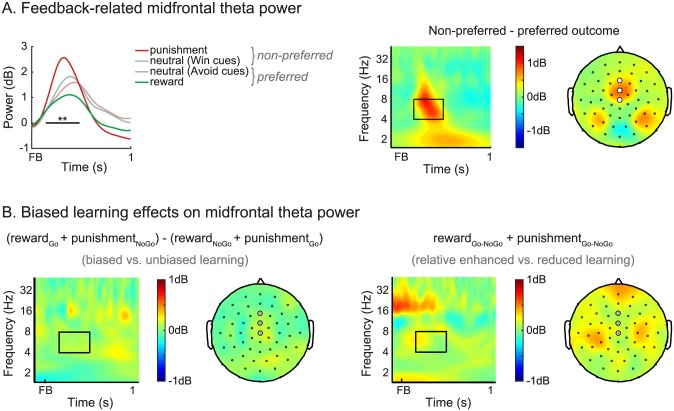
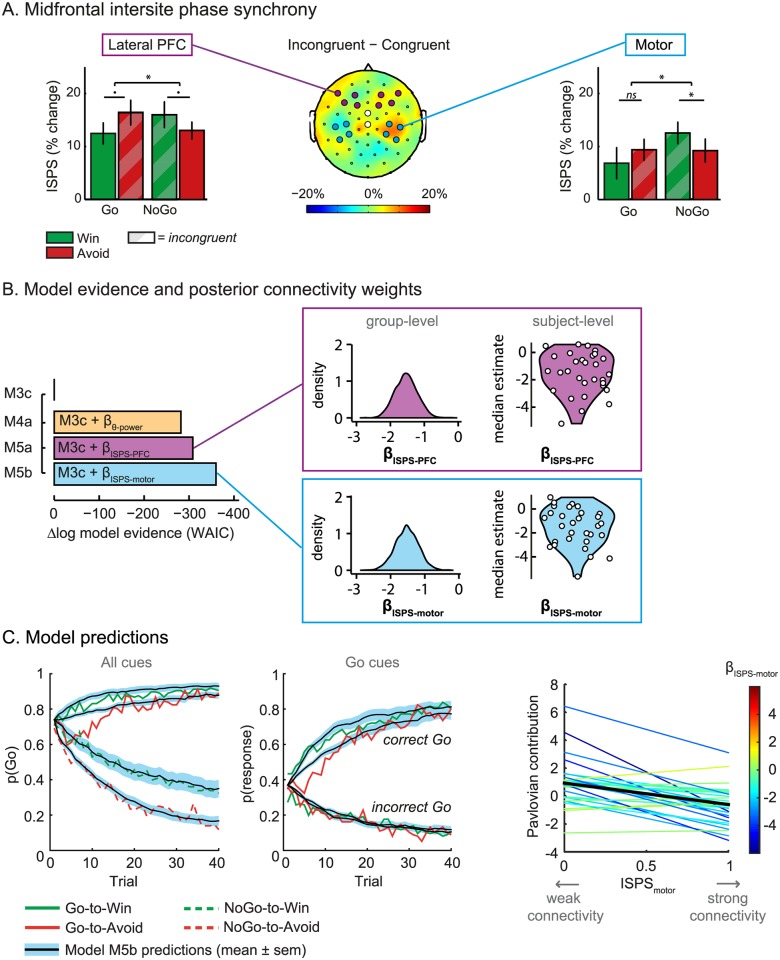
Motivation exerts control over behavior by eliciting Pavlovian responses, which can either match or conflict with instrumental action. We can overcome maladaptive motivational influences putatively through frontal cognitive control. However, the neurocomputational mechanisms subserving this control are unclear; does control entail up-regulating instrumental systems, down-regulating Pavlovian systems, or both? We combined electroencephalography (EEG) recordings with a motivational Go/NoGo learning task (N = 34), in which multiple Go options enabled us to disentangle selective action learning from nonselective Pavlovian responses. Midfrontal theta-band (4 Hz-8 Hz) activity covaried with the level of Pavlovian conflict and was associated with reduced Pavlovian biases rather than reduced instrumental learning biases. Motor and lateral prefrontal regions synchronized to the midfrontal cortex, and these network dynamics predicted the reduction of Pavlovian biases over and above local, midfrontal theta activity. This work links midfrontal processing to detecting Pavlovian conflict and highlights the importance of network processing in reducing the impact of maladaptive, Pavlovian biases.
动机通过引发巴甫洛夫反应来控制行为,这些反应既可以与工具性行为相匹配,也可以与之冲突。我们可以通过前额叶认知控制来克服适应性不良的动机影响。然而,支持这种控制的神经计算机制尚不清楚;控制是否需要上调工具系统,下调巴甫洛夫系统,还是两者兼而有之?我们结合了脑电图(EEG)记录和动机 Go/NoGo 学习任务(N=34),其中多个 Go 选项使我们能够从非选择性巴甫洛夫反应中分离出选择性动作学习。中前额叶θ波段(4Hz-8Hz)活动与巴甫洛夫冲突的程度相关,并与减少巴甫洛夫偏见而不是减少工具性学习偏见有关。运动和外侧前额叶区域与中前额叶皮层同步,这些网络动态预测了巴甫洛夫偏见的减少,超过了局部中前额叶θ活动。这项工作将中前额叶处理与检测巴甫洛夫冲突联系起来,并强调了网络处理在减少适应性、巴甫洛夫偏见的影响方面的重要性。