Department of Child and Adolescent Psychiatry, Psychosomatics and Psychotherapy, Centre of Mental Health, University of Würzburg, Würzburg, Germany.
Donders Institute for Brain, Cognition and Behaviour, Radboud University, Nijmegen, the Netherlands.
PLoS Biol. 2024 Nov 14;22(11):e3002877. doi: 10.1371/journal.pbio.3002877. eCollection 2024 Nov.
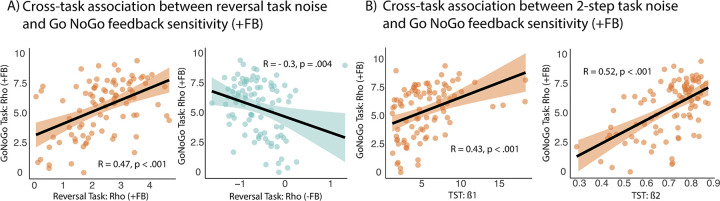
Learning and decision-making undergo substantial developmental changes, with adolescence being a particular vulnerable window of opportunity. In adolescents, developmental changes in specific choice behaviors have been observed (e.g., goal-directed behavior, motivational influences over choice). Elevated levels of decision noise, i.e., choosing suboptimal options, were reported consistently in adolescents. However, it remains unknown whether these observations, the development of specific and more sophisticated choice processes and higher decision noise, are independent or related. It is conceivable, but has not yet been investigated, that the development of specific choice processes might be impacted by age-dependent changes in decision noise. To answer this, we examined 93 participants (12 to 42 years) who completed 3 reinforcement learning (RL) tasks: a motivational Go/NoGo task assessing motivational influences over choices, a reversal learning task capturing adaptive decision-making in response to environmental changes, and a sequential choice task measuring goal-directed behavior. This allowed testing of (1) cross-task generalization of computational parameters focusing on decision noise; and (2) assessment of mediation effects of noise on specific choice behaviors. Firstly, we found only noise levels to be strongly correlated across RL tasks. Second, and critically, noise levels mediated age-dependent increases in more sophisticated choice behaviors and performance gain. Our findings provide novel insights into the computational processes underlying developmental changes in decision-making: namely a vital role of seemingly unspecific changes in noise in the specific development of more complex choice components. Studying the neurocomputational mechanisms of how varying levels of noise impact distinct aspects of learning and decision processes may also be key to better understand the developmental onset of psychiatric diseases.
学习和决策会经历显著的发展变化,而青春期是一个特别脆弱的机会窗口。在青少年中,已经观察到特定选择行为的发展变化(例如,目标导向行为、动机对选择的影响)。在青少年中,一直报告有较高水平的决策噪声,即选择次优选项。然而,目前尚不清楚这些观察结果、特定和更复杂的选择过程的发展以及更高的决策噪声是独立的还是相关的。可以想象,但尚未研究,特定选择过程的发展可能受到决策噪声随年龄变化的影响。为了回答这个问题,我们测试了 93 名参与者(12 至 42 岁),他们完成了 3 项强化学习(RL)任务:一个动机性 Go/NoGo 任务,评估动机对选择的影响;一个反转学习任务,捕捉对环境变化的适应性决策;以及一个顺序选择任务,测量目标导向行为。这允许测试:(1)关注决策噪声的计算参数的跨任务泛化;(2)评估噪声对特定选择行为的中介效应。首先,我们发现只有噪声水平在 RL 任务中高度相关。其次,也是至关重要的是,噪声水平中介了年龄相关的更复杂选择行为和绩效提升。我们的研究结果为决策制定发展变化的计算过程提供了新的见解:即看似非特异性的噪声变化在更复杂选择成分的特定发展中起着重要作用。研究不同水平的噪声如何影响学习和决策过程的不同方面的神经计算机制,也可能是更好地理解精神疾病发展发作的关键。