Department of Neuroscience, Physiology and Pharmacology, University College London, London, UK; Centre for Mathematics and Physics in the Life Sciences and Experimental Biology (CoMPLEX), University College London, London, UK.
Department of Neuroscience, Physiology and Pharmacology, University College London, London, UK; Centre for Mathematics and Physics in the Life Sciences and Experimental Biology (CoMPLEX), University College London, London, UK; Neuroscience and Behaviour Laboratory, Istituto Italiano di Tecnologia, Rome, Italy.
Trends Cogn Sci. 2018 Dec;22(12):1076-1090. doi: 10.1016/j.tics.2018.09.004. Epub 2018 Oct 15.
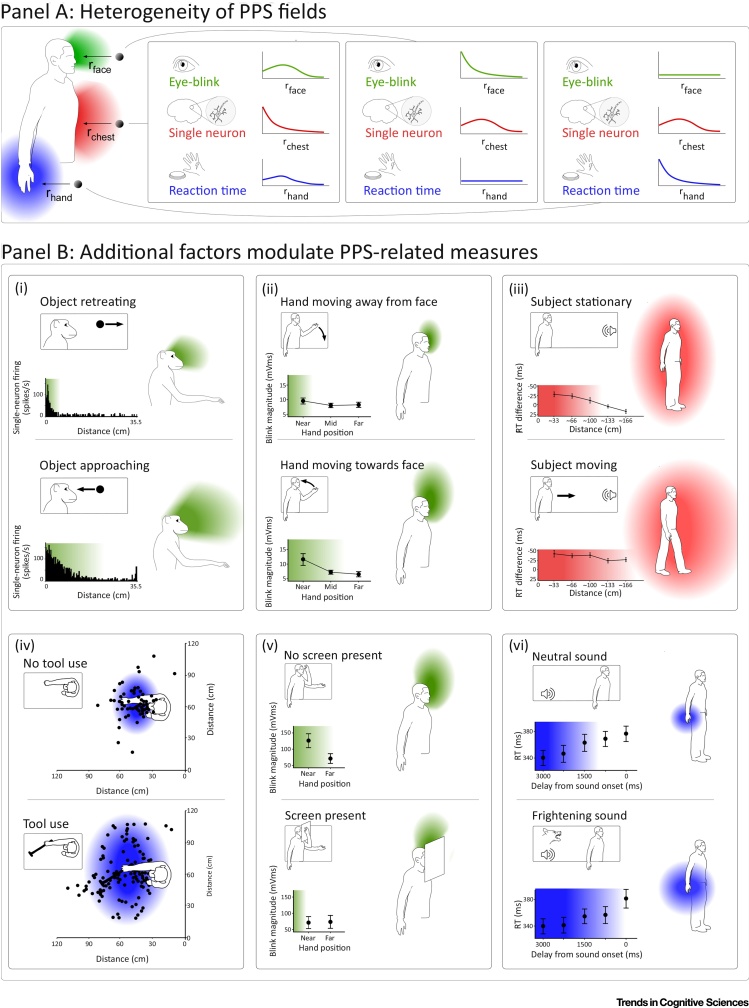
Predominant conceptual frameworks often describe peripersonal space (PPS) as a single, distance-based, in-or-out zone within which stimuli elicit enhanced neural and behavioural responses. Here we argue that this intuitive framework is contradicted by neurophysiological and behavioural data. First, PPS-related measures are not binary, but graded with proximity. Second, they are strongly influenced by factors other than proximity, such as walking, tool use, stimulus valence, and social cues. Third, many different PPS-related responses exist, and each can be used to describe a different space. Here, we reconceptualise PPS as a set of graded fields describing behavioural relevance of actions aiming to create or avoid contact between objects and the body. This reconceptualisation incorporates PPS into mainstream theories of action selection and behaviour.
主导性的概念框架通常将个体自身空间(PPS)描述为一个单一的、基于距离的、内外有别的区域,在这个区域内,刺激会引发增强的神经和行为反应。在这里,我们认为这种直观的框架与神经生理学和行为数据相矛盾。首先,与 PPS 相关的测量不是二元的,而是随着距离的接近而逐渐变化的。其次,它们受到许多除了距离之外的因素的强烈影响,例如行走、使用工具、刺激的效价和社会线索。第三,存在许多不同的与 PPS 相关的反应,每种反应都可以用来描述不同的空间。在这里,我们将 PPS 重新概念化为一组渐变场,描述旨在在物体和身体之间创建或避免接触的行为的行为相关性。这种重新概念化将 PPS 纳入到主流的行为选择和行为理论中。