Zamawe Collins, King Carina, Jennings Hannah Maria, Mandiwa Chrispin, Fottrell Edward
Faculty of Population Health Sciences, Institute for Global Health, University College London, London, UK.
School of Public Health, Tongji Medical College, Huazhong University of Science and Technology, Wuhan, China.
BMJ Open. 2018 Oct 17;8(10):e022499. doi: 10.1136/bmjopen-2018-022499.
The use of herbal medicines for induction of labour (IOL) is common globally and yet its effects are not well understood. We assessed the efficacy and safety of herbal medicines for IOL.
Systematic review and meta-analysis of published literature.
We searched in MEDLINE, AMED and CINAHL in April 2017, updated in June 2018.
We considered experimental and non-experimental studies that compared relevant pregnancy outcomes between users and non-user of herbal medicines for IOL.
Data were extracted by two reviewers using a standardised form. A random-effects model was used to synthesise effects sizes and heterogeneity was explored through I statistic. The risk of bias was assessed using 'John Hopkins Nursing School Critical Appraisal Tool' and 'Cochrane Risk of Bias Tool'.
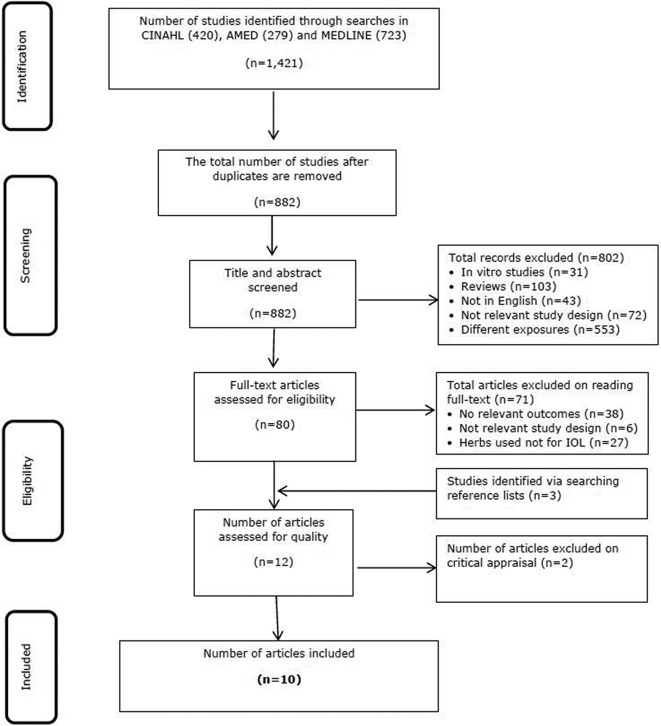
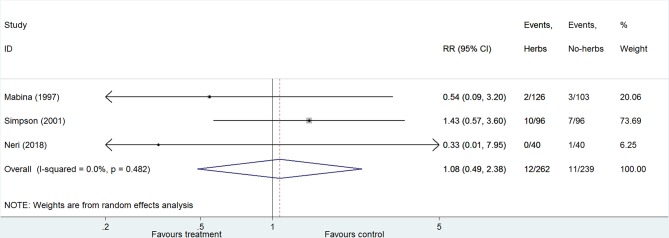
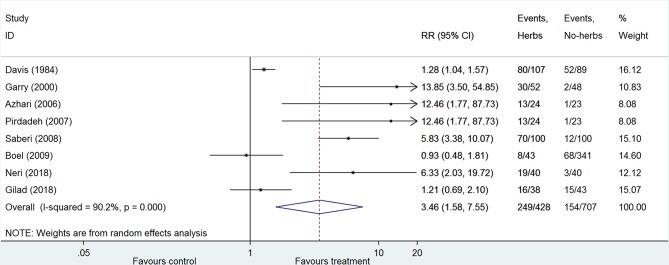
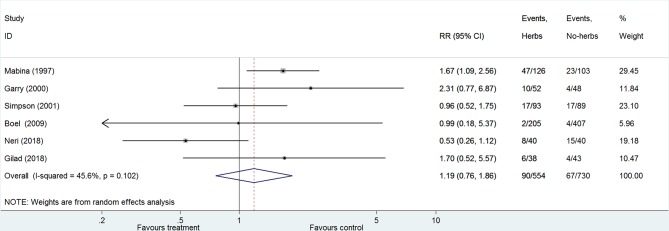
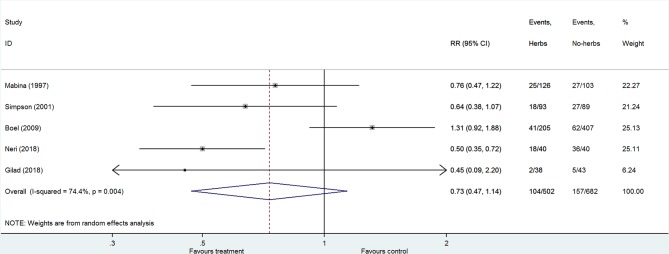
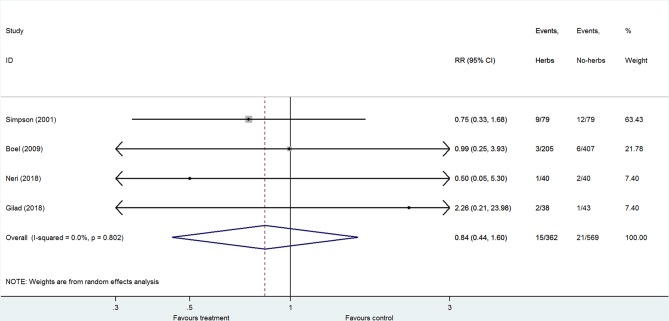
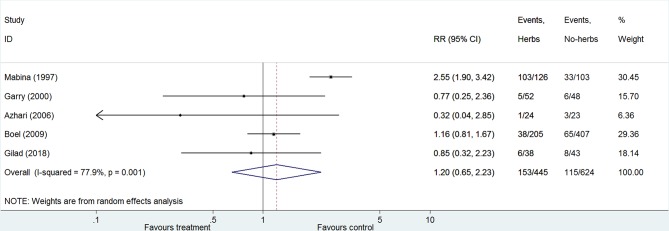
A total of 1421 papers were identified through the searches, but only 10 were retained after eligibility and risk of bias assessments. The users of herbal medicine for IOL were significantly more likely to give birth within 24 hours than non-users (Risk Ratio (RR) 4.48; 95% CI 1.75 to 11.44). No significant difference in the incidence of caesarean section (RR 1.19; 95% CI 0.76 to 1.86), assisted vaginal delivery (RR 0.73; 95% CI 0.47 to 1.14), haemorrhage (RR 0.84; 95% CI 0.44 to 1.60), meconium-stained liquor (RR 1.20; 95% CI 0.65 to 2.23) and admission to nursery (RR 1.08; 95% CI 0.49 to 2.38) was found between users and non-users of herbal medicines for IOL.
The findings suggest that herbal medicines for IOL are effective, but there is inconclusive evidence of safety due to lack of good quality data. Thus, the use of herbal medicines for IOL should be avoided until safety issues are clarified. More studies are recommended to establish the safety of herbal medicines.
全球范围内使用草药引产很常见,但对其效果了解不足。我们评估了草药引产的有效性和安全性。
对已发表文献进行系统评价和荟萃分析。
我们于2017年4月在MEDLINE、AMED和CINAHL中进行了检索,并于2018年6月更新。
我们纳入了比较使用和未使用草药引产的人群相关妊娠结局的实验性和非实验性研究。
由两名审阅者使用标准化表格提取数据。采用随机效应模型合成效应量,并通过I统计量探讨异质性。使用“约翰霍普金斯护理学院批判性评价工具”和“Cochrane偏倚风险工具”评估偏倚风险。
通过检索共识别出1421篇论文,但在纳入标准和偏倚风险评估后仅保留了10篇。使用草药引产的人群在24小时内分娩的可能性显著高于未使用者(风险比(RR)4.48;95%置信区间1.75至11.44)。在使用和未使用草药引产的人群之间,剖宫产发生率(RR 1.19;95%置信区间0.76至1.86)、阴道助产率(RR 0.73;95%置信区间0.47至1.14)、出血率(RR 0.84;95%置信区间0.44至1.60)、羊水粪染率(RR 1.20;95%置信区间0.65至2.23)和新生儿入住重症监护室率(RR 1.08;95%置信区间0.49至2.38)均无显著差异。
研究结果表明,草药引产是有效的,但由于缺乏高质量数据,安全性证据不确凿。因此,在安全性问题明确之前,应避免使用草药引产。建议开展更多研究以确定草药的安全性。