CIBER Fisiopatología de la Obesidad y Nutrición, Instituto de Salud Carlos III, 28029 Madrid, Spain.
Department of Preventive Medicine and Public Health, School of Medicine, University of Valencia, 46010 Valencia, Spain.
Nutrients. 2018 Oct 18;10(10):1539. doi: 10.3390/nu10101539.
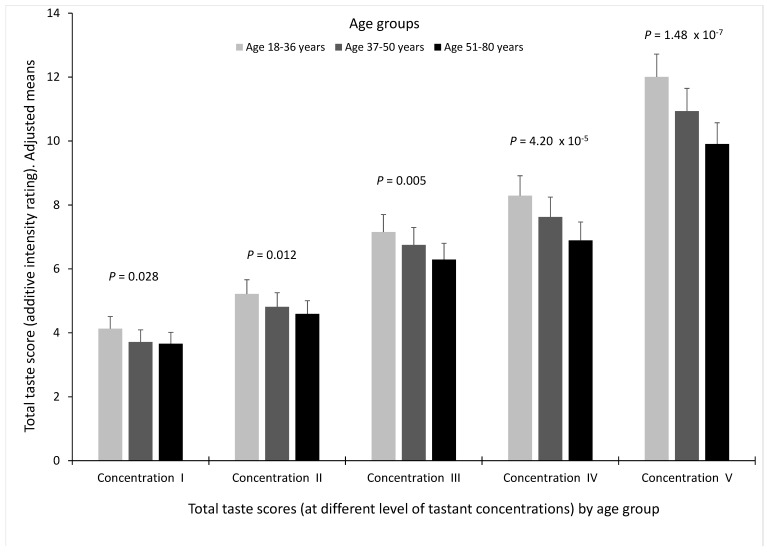
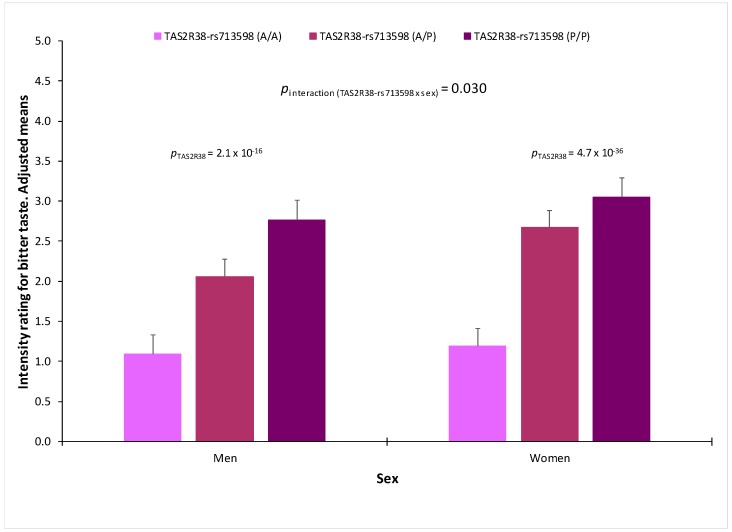
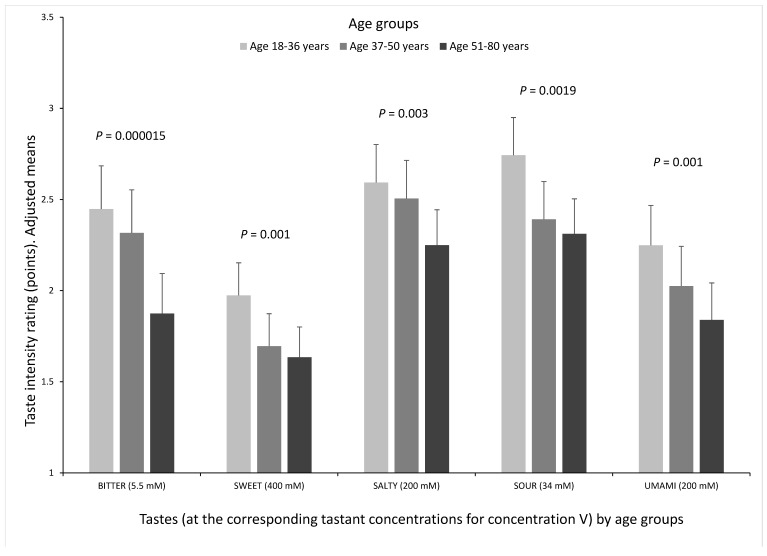
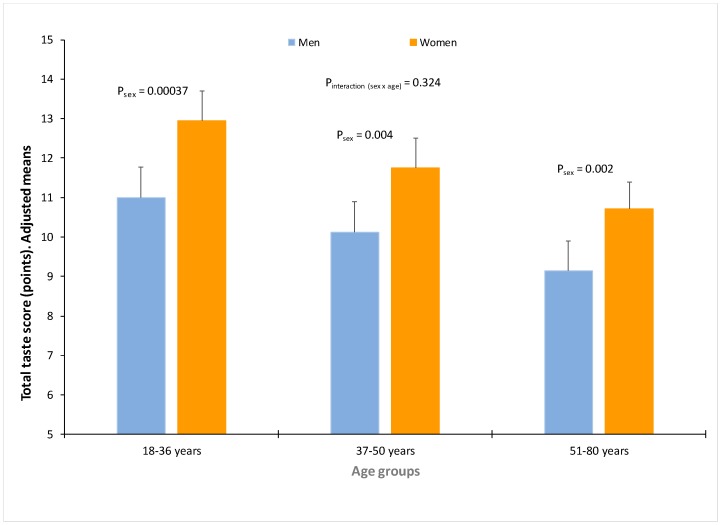
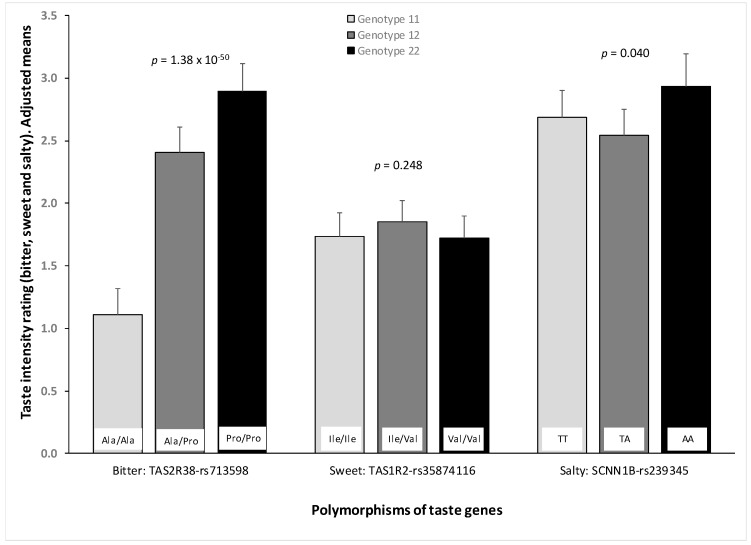
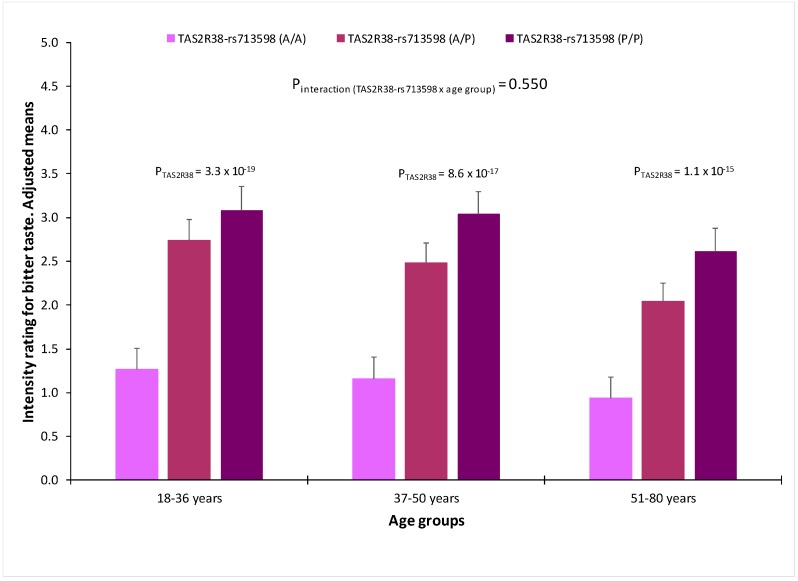
There is growing interest in relating taste perception to diet and healthy aging. However, there is still limited information on the influence of age, sex and genetics on taste acuity as well as on the relationship between taste perception and taste preferences. We have analysed the influence of age on the intensity rating of the five basic tastes: sweet, salty, bitter, sour and umami (separately and jointly in a "total taste score") and their modulation by sex and genetics in a relatively healthy population (men and women) aged 18⁻80 years ( = 1020 Caucasian European participants). Taste perception was determined by challenging subjects with solutions of the five basic tastes using standard prototypical tastants (6-n-propylthiouracil (PROP), NaCl, sucrose, monopotassium glutamate and citric acid) at 5 increasing concentrations (I to V). We also measured taste preferences and determined the polymorphisms of the genes taste 2 receptor member 38 (TAS2R38), taste 1 receptor member 2 (TAS2R38) and sodium channel epithelial 1 beta subunit (SCNN1B), as TAS2R38-rs713598, TAS1R2-rs35874116 and SCNN1B-rs239345 respectively. We found a statistically significant decrease in taste perception ("total taste score") with increasing age for all the concentrations analysed. This association was stronger for the higher concentrations ( = 0.028; = 0.012; = 0.005; = 4.20 × 10 and = 1.48 × 10, for I to V in the multivariable-adjusted models). When we analysed taste qualities (using concentration V), the intensity rating of all the 5 tastes was diminished with age ( 0.05 for all). This inverse association differed depending on the test quality, being higher for bitter (PROP) and sour. Women perceived taste significantly more intense than men ( = 1.4 × 10 for total taste score). However, there were differences depending on the taste, umami being the lowest ( = 0.069). There was a complex association between the ability to perceive a taste and the preference for the same. Significant associations were, nevertheless, found between a higher perception of sour taste and a higher preference for it in women. In contrast, the higher perception of sweet was significantly associated with a higher preference for bitter in both, men and women. The TAS2R38-rs713598 was strongly associated with bitter (PROP) taste ( = 1.38 × 10), having a significant interaction with sex ( = 0.030). The TAS1R2-rs35874116 was not significantly associated with sweet, whereas the SCNN1B-rs239345 was associated ( = 0.040) with salty taste. In conclusion, the inverse association between age and perceived taste intensity as well as the additional influence of sex and some genetic polymorphisms give rise to large inter-individual differences in taste perception and taste preferences that should be taken into account in future studies and for applications in precision nutrition for healthy aging.
人们越来越关注味觉感知与饮食和健康衰老之间的关系。然而,关于年龄、性别和遗传对味觉敏锐度的影响,以及味觉感知与味觉偏好之间的关系,仍然知之甚少。我们分析了年龄对五种基本味觉(甜、咸、苦、酸和鲜味)的强度评价的影响:分别和联合的“总味觉评分”)以及性别和遗传在相对健康人群(18-80 岁的男性和女性,共 1020 名白种欧洲参与者)中的调节作用。味觉感知是通过用标准原型味觉剂(6-正丙基硫代尿嘧啶(PROP)、NaCl、蔗糖、单谷氨酸和柠檬酸)在 5 个递增浓度(I 到 V)刺激受试者来确定的。我们还测量了味觉偏好,并确定了味觉 2 受体成员 38(TAS2R38)、味觉 1 受体成员 2(TAS2R38)和钠通道上皮 1β亚基(SCNN1B)的基因多态性,分别为 TAS2R38-rs713598、TAS1R2-rs35874116 和 SCNN1B-rs239345。我们发现,随着年龄的增长,所有分析浓度的味觉感知(“总味觉评分”)呈统计学显著下降。这种关联在较高浓度时更强(=0.028;=0.012;=0.005;=4.20×10和=1.48×10,在多变量调整模型中,I 到 V)。当我们分析味觉质量(使用浓度 V)时,所有 5 种味觉的强度评价都随着年龄的增长而降低(所有味觉均为 0.05)。这种负相关因味觉而异,苦味(PROP)和酸味更强。女性的味觉感知明显比男性强烈(总味觉评分中为 1.4×10)。然而,味觉也存在差异,鲜味最低(=0.069)。味觉感知能力和对同一味觉的偏好之间存在复杂的关联。然而,在女性中,酸味的感知能力与酸味的偏好之间存在显著关联。相反,在男性和女性中,甜味的感知能力与苦味的偏好显著相关。TAS2R38-rs713598 与苦味(PROP)味觉强烈相关(=1.38×10),与性别存在显著相互作用(=0.030)。TAS1R2-rs35874116 与甜味无显著相关性,而 SCNN1B-rs239345 与咸味相关(=0.040)。总之,年龄与味觉感知强度之间的负相关以及性别的额外影响和一些遗传多态性导致味觉感知和味觉偏好存在很大的个体差异,这在未来的研究和健康老龄化的精准营养应用中应予以考虑。