Department of Public Health, University of West Florida, 11000 University Parkway, Bldg. 38/Room 127, Pensacola, FL, 32514, USA.
Department of Mathematics and Statistics, University of West Florida, Pensacola, FL, USA.
BMC Complement Altern Med. 2018 Oct 19;18(1):281. doi: 10.1186/s12906-018-2342-2.
Although a quarter of Americans are estimated to have multiple chronic conditions, information on the impact of chronic disease dyads and triads on use of complementary and alternative medicine (CAM) is scarce. The purpose of this study is to: 1) estimate the prevalence and odds of CAM use among participants with hypercholesterolemia, hypertension, diabetes, and obesity; and 2) examine the effects of chronic condition dyads and triads on the use of CAM modalities, specifically manipulative and body-based methods, biological treatments, mind-body interventions, energy therapies, and alternative medical systems.
Data were obtained from the 2012 National Health Interview Survey and the Adult Alternative Medicine supplement. Statistical analyses were restricted to persons with self-reported hypercholesterolemia, hypertension, diabetes, or obesity (n = 15,463).
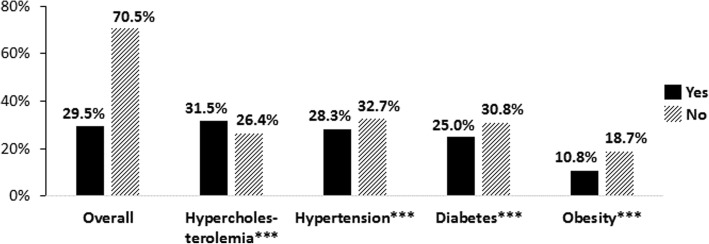
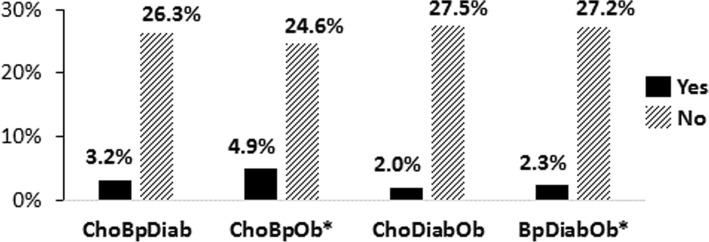
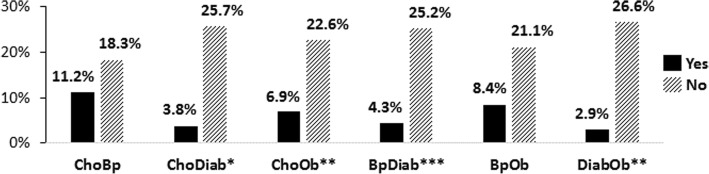
Approximately 37.2% of the participants had just one of the four chronic conditions, while 62.4% self-reported multiple comorbidities. CAM use among participants was as follows (p < 0.001): hypercholesterolemia (31.5%), hypertension (28.3%), diabetes (25.0%), and obesity (10.8%). All combinations of disease dyads and triads were consistently and significantly associated with the use of mind-body interventions (2-4%, p < 0.001). Two sets of three dyads were associated with use of manipulative methods (23-27%, p < 0.05) and energy therapies (0.2-0.3%, p < 0.05). Use of biological treatments (0.04%, p < 0.05) and alternative systems (3%, p < 0.05) were each significant for one dyad. One triad was significant for use of manipulative methods (27%, p < 0.001).
These findings point to future directions for research and have practical implications for family practitioners treating multimorbid patients.
据估计,有四分之一的美国人患有多种慢性疾病,但关于慢性疾病二联症和三联症对补充和替代医学(CAM)使用的影响的信息却很少。本研究的目的是:1)估计患有高胆固醇血症、高血压、糖尿病和肥胖症的参与者中 CAM 使用的流行率和几率;2)研究慢性疾病二联症和三联症对 CAM 模式使用的影响,特别是手法和身体为基础的方法、生物治疗、身心干预、能量治疗和替代医疗系统。
数据来自 2012 年全国健康访谈调查和成人替代医学补充调查。统计分析仅限于自我报告患有高胆固醇血症、高血压、糖尿病或肥胖症的人(n=15463)。
大约 37.2%的参与者只有一种慢性疾病,而 62.4%的参与者报告患有多种合并症。参与者中 CAM 的使用情况如下(p<0.001):高胆固醇血症(31.5%)、高血压(28.3%)、糖尿病(25.0%)和肥胖症(10.8%)。疾病二联症和三联症的所有组合均与身心干预的使用显著相关(2-4%,p<0.001)。两组三个二联症与手法治疗(23-27%,p<0.05)和能量治疗(0.2-0.3%,p<0.05)的使用相关。生物治疗(0.04%,p<0.05)和替代系统(3%,p<0.05)的使用与一个二联症显著相关。一个三联症与手法治疗的使用显著相关(27%,p<0.001)。
这些发现为未来的研究指明了方向,对治疗多种合并症的家庭医生具有实际意义。