Meyer Denny, Jayawardana Madawa W, Muir Samuel D, Ho David Yen-Teh, Sackett Olivia
Department of Statistics, Data Science and Epidemiology, Swinburne University of Technology, Melbourne, Australia.
Centre of Mental Health, Faculty of Health, Arts and Design, Swinburne University of Technology, Melbourne, Australia.
J Med Internet Res. 2018 Oct 19;20(10):e267. doi: 10.2196/jmir.9058.
Workplace programs designed to improve the health and psychological well-being of employees are becoming increasingly popular. However, there are mixed reports regarding the effectiveness of such programs and little analysis of what helps people to engage with such programs.
This evaluation of a particularly broad, team-based, digital health and well-being program uses mixed methods to identify the elements of the program that reduce work stress and promote psychological well-being, sleep quality, and productivity of employees.
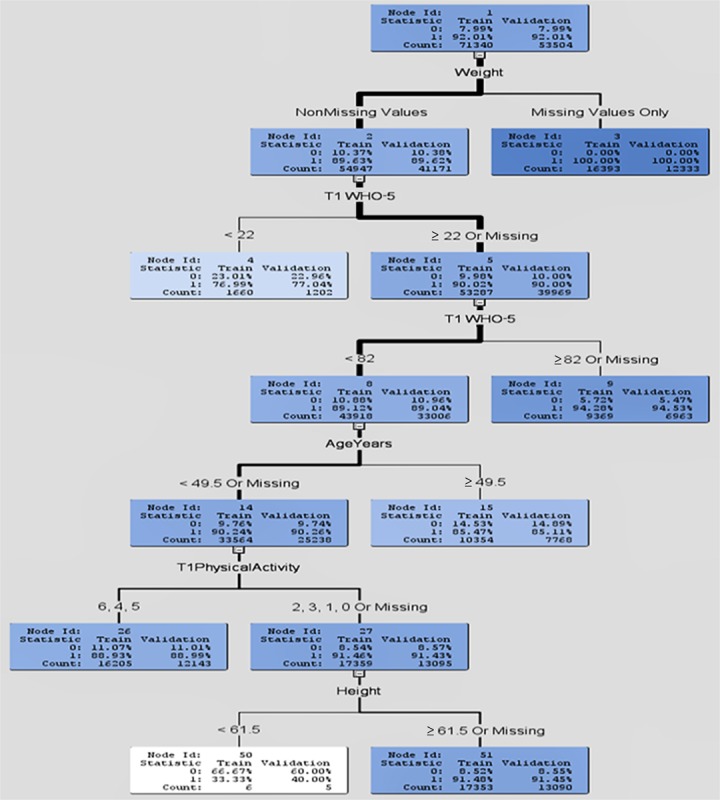
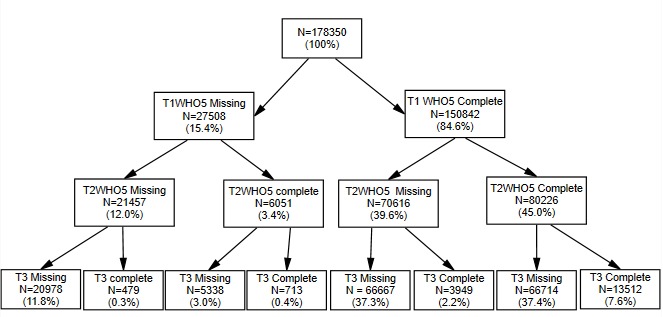
Participation in the Virgin Pulse Global Challenge program during May to September 2016 was studied. Self-reported stress, sleep quality, productivity, and psychological well-being data were collected both pre- and postprogram. Participant experience data were collected through a third final survey. However, the response rates for the last 2 surveys were only 48% and 10%, respectively. A random forest was used to estimate the probability of the completion of the last 2 surveys based on the preprogram assessment data and the demographic data for the entire sample (N=178,350). The inverse of these estimated probabilities were used as weights in hierarchical linear models in an attempt to address any estimation bias caused by the low response rates. These linear models described changes in psychological well-being, stress, sleep, and productivity over the duration of the program in relation to gender and age, engagement with each of the modules, each of the program features, and participant descriptions of the Virgin Pulse Global Challenge. A 0.1% significance level was used due to the large sample size for the final survey (N=18,653).
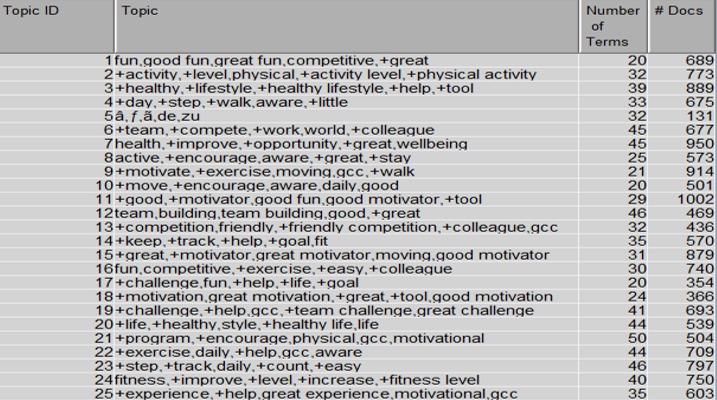
The final analysis suggested that the program is more beneficial for older people, with 2.9% greater psychological well-being improvements observed on average in the case of women than men (P<.001). With one exception, all the program modules contributed significantly to the outcome measures with the following average improvements observed: psychological well-being, 4.1%-6.0%; quality of sleep, 3.2%-6.9%; work-related stress, 1.7%-6.8%; and productivity, 1.9%-4.2%. However, only 4 of the program features were found to have significant associations with the outcome measures with the following average improvements observed: psychological well-being, 3.7%-5.6%; quality of sleep, 3.4%-6.5%; work-related stress, 4.1%-6.4%; and productivity, 1.6%-3.2%. Finally, descriptions of the Virgin Pulse Global Challenge produced 5 text topics that were related to the outcome measures. Healthy lifestyle descriptions showed a positive association with outcomes, whereas physical activity and step count tracking descriptions showed a negative association with outcomes.
The complementary use of qualitative and quantitative survey data in a mixed-methods analysis provided rich information that will inform the development of this and other programs designed to improve employee health. However, the low response rates and the lack of a control group are limitations, despite the attempts to address these problems in the analysis.
旨在改善员工健康和心理健康的职场项目越来越受欢迎。然而,关于此类项目的有效性,报告结果不一,且对于促使人们参与此类项目的因素分析甚少。
本研究对一个特别广泛的、基于团队的数字健康与幸福项目进行评估,采用混合方法来确定该项目中能够减轻工作压力、促进员工心理健康、睡眠质量和工作效率的要素。
对2016年5月至9月期间参与维珍活力全球挑战项目的情况进行研究。在项目前后收集了自我报告的压力、睡眠质量、工作效率和心理健康数据。通过第三次最终调查收集了参与者的体验数据。然而,最后两次调查的回复率分别仅为48%和10%。使用随机森林方法,根据项目前评估数据和整个样本(N = 178,350)的人口统计学数据,估计完成最后两次调查的概率。这些估计概率的倒数被用作分层线性模型中的权重,以试图解决因低回复率导致的任何估计偏差。这些线性模型描述了在项目持续期间,心理健康、压力、睡眠和工作效率相对于性别和年龄、与每个模块的参与度、每个项目特征以及参与者对维珍活力全球挑战的描述的变化情况。由于最终调查的样本量较大(N = 18,653),使用了0.1%的显著性水平。
最终分析表明,该项目对老年人更有益,女性的心理健康平均改善幅度比男性高2.9%(P <.001)。除一个例外,所有项目模块对结果指标都有显著贡献,观察到的平均改善如下:心理健康,4.1% - 6.0%;睡眠质量,3.2% - 6.9%;与工作相关的压力,1.7% - 6.8%;工作效率,1.9% - 4.2%。然而,仅发现4个项目特征与结果指标有显著关联,观察到的平均改善如下:心理健康,3.7% - 5.6%;睡眠质量,3.4% - 6.5%;与工作相关的压力,4.1% - 6.4%;工作效率,1.6% - 3.2%。最后,对维珍活力全球挑战的描述产生了5个与结果指标相关的文本主题。健康生活方式的描述与结果呈正相关,而体育活动和步数追踪的描述与结果呈负相关。
在混合方法分析中定性和定量调查数据的互补使用提供了丰富的信息,这将为该项目及其他旨在改善员工健康的项目的开发提供参考。然而,尽管在分析中试图解决这些问题,但低回复率和缺乏对照组仍是局限性。