Pigna Eva, Sanna Krizia, Coletti Dario, Li Zhenlin, Parlakian Ara, Adamo Sergio, Moresi Viviana
Department of Anatomy, Histology, Forensic Medicine & Orthopedics, Histology & Medical Embryology Section, Sapienza University of Rome, Italy.
Interuniversity Institute of Myology, Italy.
Eur J Transl Myol. 2018 Aug 23;28(3):7687. doi: 10.4081/ejtm.2018.7687. eCollection 2018 Jul 10.
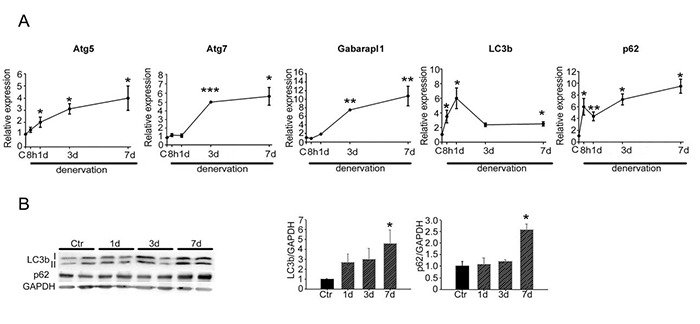
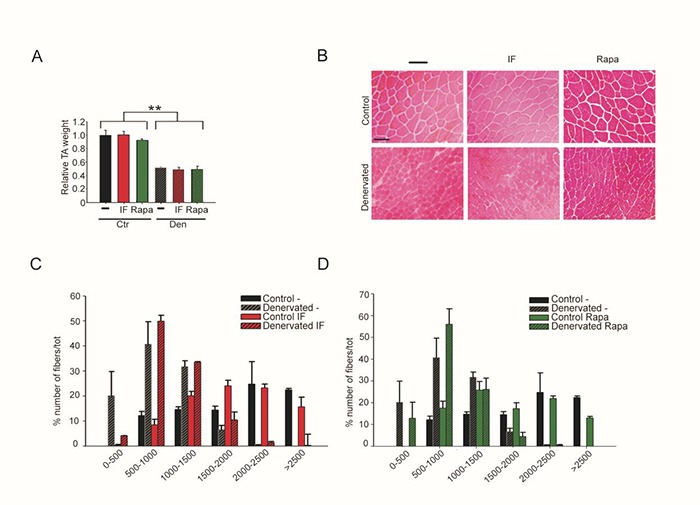
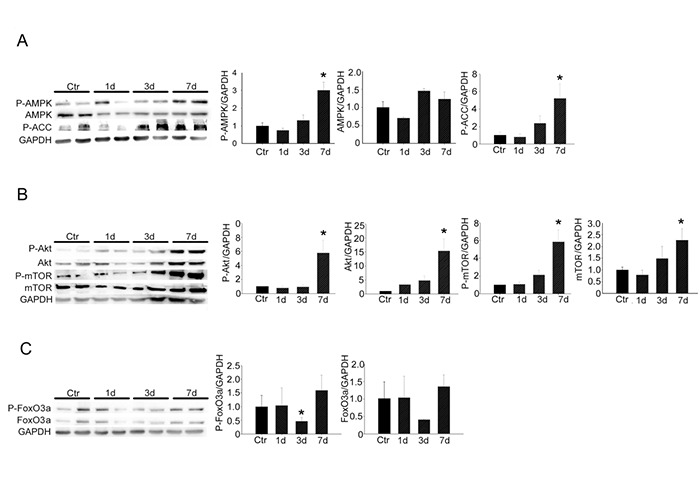
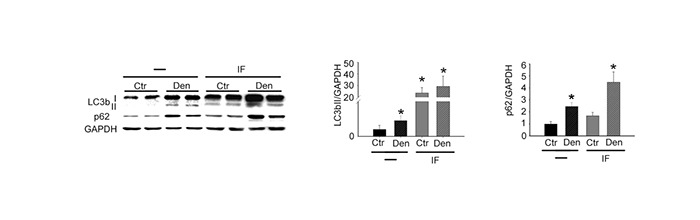
Physiological autophagy plays a crucial role in the regulation of muscle mass and metabolism, while the excessive induction or the inhibition of the autophagic flux contributes to the progression of several diseases. Autophagy can be activated by different stimuli, including cancer, exercise, caloric restriction and denervation. The latter leads to muscle atrophy through the activation of catabolic pathways, i.e. the ubiquitin-proteasome system and autophagy. However, the kinetics of autophagy activation and the upstream molecular pathways in denervated skeletal muscle have not been reported yet. In this study, we characterized the kinetics of autophagic induction, quickly triggered by denervation, and report the Akt/mTOR axis activation. Besides, with the aim to assess the relative contribution of autophagy in neurogenic muscle atrophy, we triggered autophagy with different stimuli along with denervation, and observed that four week-long autophagic induction, by either intermitted fasting or rapamycin treatment, did not significantly affect muscle mass loss. We conclude that: i) autophagy does not play a major role in inducing muscle loss following denervation; ii) nonetheless, autophagy may have a regulatory role in denervation induced muscle atrophy, since it is significantly upregulated as early as eight hours after denervation; iii) Akt/mTOR axis, AMPK and FoxO3a are activated consistently with the progression of muscle atrophy, further highlighting the complexity of the signaling response to the atrophying stimulus deriving from denervation.
生理性自噬在肌肉质量和代谢的调节中起关键作用,而自噬通量的过度诱导或抑制会促进多种疾病的进展。自噬可被不同刺激激活,包括癌症、运动、热量限制和去神经支配。后者通过激活分解代谢途径,即泛素-蛋白酶体系统和自噬,导致肌肉萎缩。然而,去神经支配的骨骼肌中自噬激活的动力学和上游分子途径尚未见报道。在本研究中,我们描述了由去神经支配快速触发的自噬诱导动力学,并报告了Akt/mTOR轴的激活。此外,为了评估自噬在神经源性肌肉萎缩中的相对作用,我们在去神经支配的同时用不同刺激触发自噬,观察到为期四周的间歇性禁食或雷帕霉素治疗诱导的自噬并未显著影响肌肉质量损失。我们得出以下结论:i)自噬在去神经支配后诱导肌肉损失中不起主要作用;ii)尽管如此,自噬可能在去神经支配诱导的肌肉萎缩中具有调节作用,因为它在去神经支配后8小时就显著上调;iii)Akt/mTOR轴、AMPK和FoxO3a随着肌肉萎缩的进展而被激活,进一步突出了对去神经支配引起的萎缩刺激的信号反应的复杂性。