Shukla Ratnakar, Ghoshal Ujjala, Ranjan Prabhat, Ghoshal Uday C
Departments of Microbiology, Sanjay Gandhi Postgraduate Institute of Medical Sciences, Lucknow, India.
Departments of Gastroenterology, Sanjay Gandhi Postgraduate Institute of Medical Sciences, Lucknow, India.
J Neurogastroenterol Motil. 2018 Oct 1;24(4):628-642. doi: 10.5056/jnm18130.
BACKGROUND/AIMS: A Subset of patients with irritable bowel syndrome (IBS) may have mild inflammation due to immune activation. Toll-like receptors (TLRs) and cytokines may cause intestinal inflammation. We studied their expression in relation to gut microbiota.
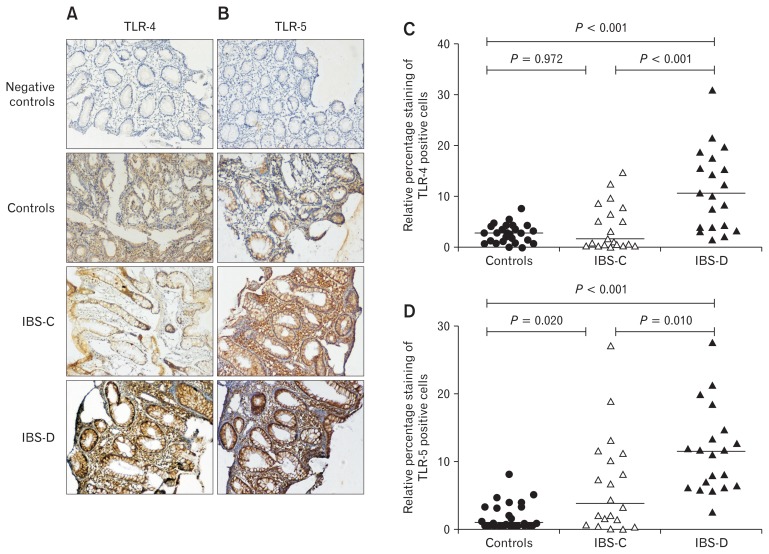
Expression of TLRs and cytokines was assessed in 47 IBS patients (Rome III) and 25 controls using quantitative real-time polymerase chain reaction. Immunohistochemistry was further performed to confirm the expression of TLR-4 and TLR-5.
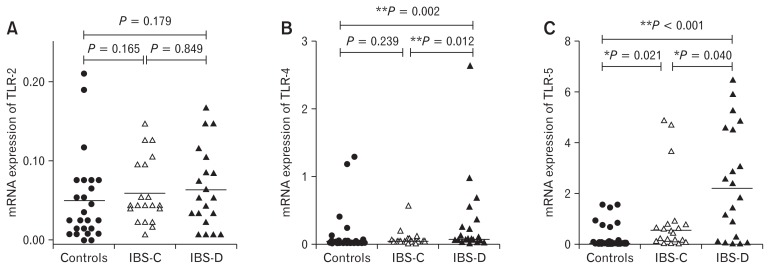
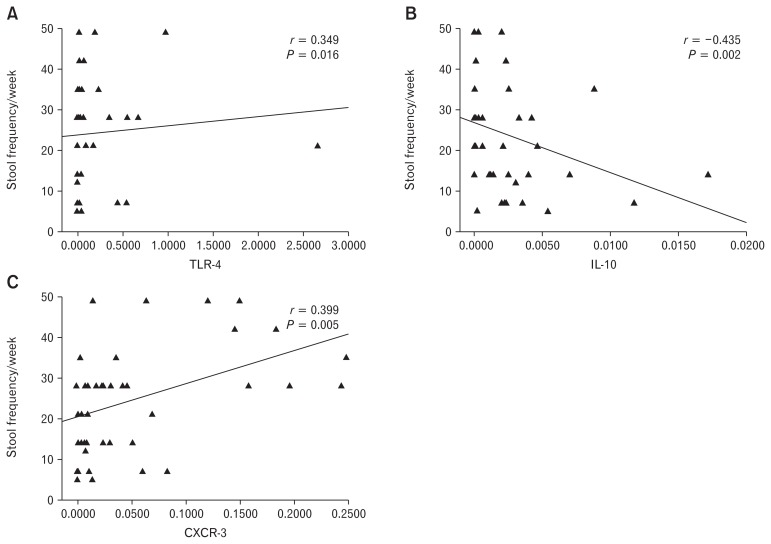
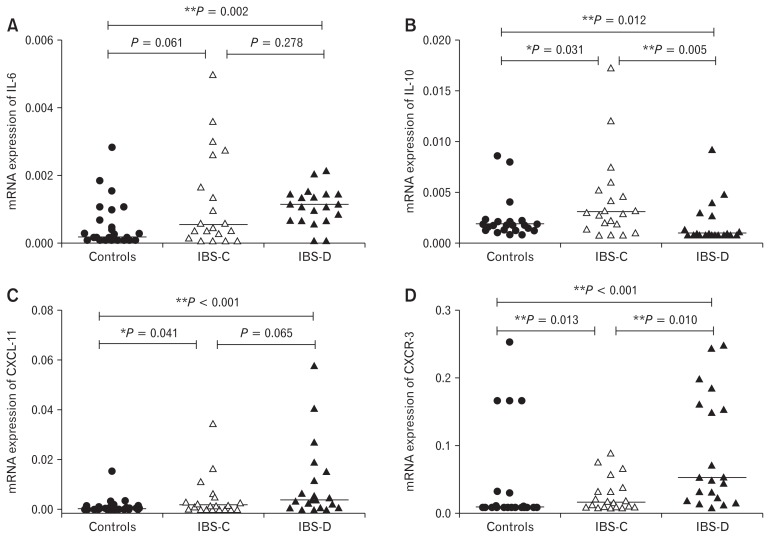
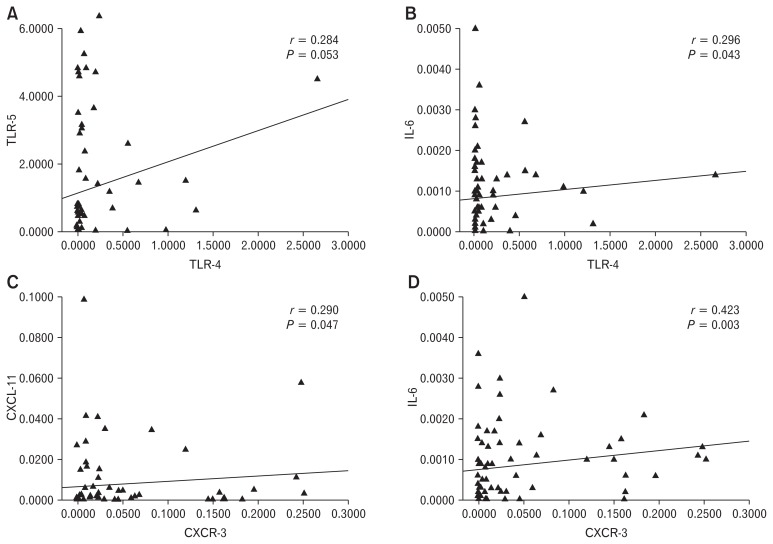
Of 47 patients with IBS, 20 had constipation (IBS-C), 20 diarrhea (IBS-D), and 7 unclassified (IBS-U). The mRNA levels of TLR-4 and TLR-5 were up-regulated in IBS patients than controls ( = 0.013 and < 0.001, respectively). Expression of TLR-4 and TLR-5 at protein level was 4.2-folds and 6.6-folds higher in IBS-D than controls. The mRNA levels of IL-6 ( = 0.003), C-X-C motif chemokine ligand 11 (CXCL-11) ( < 0.001) and C-X-C motif chemokine receptor 3 (CXCR-3) ( < 0.001) were higher among IBS patients than controls. Expression of IL-6 ( = 0.002), CXCL-11 ( < 0.001), and CXCR-3 ( < 0.001) were up-regulated and IL-10 ( = 0.012) was down-regulated in IBS-D patients than controls. Positive correlation was seen between TLR-4 and IL-6 ( = 0.043), CXCR-3, and CXCL-11 ( = 0.047), and IL-6 and CXCR-3 ( = 0.003). Stool frequency per week showed positive correlation with mRNA levels of TLR-4 ( = 0.016) and CXCR-3 ( = 0.005), but inversely correlated with IL-10 ( = 0.002). Copy number of ( = 0.045) and ( = 0.011) showed correlation with IL-10 in IBS-C, while Gram-positive ( = 0.031) and Gram-negative bacteria ( = 0.010) showed correlation with CXCL-11 in IBS-D patients.
Altered immune activation in response to dysbiotic microbiota may promote intestinal inflammation in a subset of patients with IBS.
背景/目的:一部分肠易激综合征(IBS)患者可能因免疫激活而存在轻度炎症。Toll样受体(TLR)和细胞因子可能导致肠道炎症。我们研究了它们与肠道微生物群相关的表达情况。
采用定量实时聚合酶链反应评估47例IBS患者(罗马III型)和25例对照者中TLR和细胞因子的表达。进一步进行免疫组织化学以证实TLR-4和TLR-5的表达。
47例IBS患者中,20例为便秘型(IBS-C),20例为腹泻型(IBS-D),7例未分类(IBS-U)。IBS患者中TLR-4和TLR-5的mRNA水平高于对照者(分别为P = 0.013和P < 0.001)。IBS-D患者中TLR-4和TLR-5的蛋白水平分别比对照者高4.2倍和6.6倍。IBS患者中白细胞介素-6(IL-6)(P = 0.003)、C-X-C基序趋化因子配体11(CXCL-11)(P < 0.001)和C-X-C基序趋化因子受体3(CXCR-3)(P < 0.001)的mRNA水平高于对照者。IBS-D患者中IL-6(P = 0.002)、CXCL-11(P < 0.001)和CXCR-3(P < 0.001)表达上调,而白细胞介素-10(IL-10)(P = 0.012)表达下调。TLR-4与IL-6(P = 0.043)、CXCR-3与CXCL-11(P = 0.047)以及IL-6与CXCR-3(P = 0.003)之间呈正相关。每周排便次数与TLR-4(P = 0.016)和CXCR-3(P = 0.005)的mRNA水平呈正相关,但与IL-10(P = 0.002)呈负相关。在IBS-C中,双歧杆菌属(P = 0.045)和真杆菌属(P = 0.011)的拷贝数与IL-10相关,而在IBS-D患者中,革兰氏阳性菌(P = 0.031)和革兰氏阴性菌(P = 0.010)与CXCL-11相关。
对生态失调的微生物群作出反应的免疫激活改变可能在一部分IBS患者中促进肠道炎症。