Department of Disease Control, London School of Hygiene and Tropical Medicine, London, UK.
Institut Pierre Richet (IPR)/Institut National de Santé Publique (INSP), Bouaké, Côte d'Ivoire.
Malar J. 2018 Oct 22;17(1):374. doi: 10.1186/s12936-018-2517-9.
The widespread emergence of insecticide resistance in African malaria vectors remains one of the main challenges facing control programmes. Electrostatic coating that uses polarity to bind insecticide particles is a new way of delivering insecticides to mosquitoes. Although previous tests demonstrated the resistance breaking potential of this application method, studies screening and investigating the residual efficacy of a broader range of insecticides are necessary.
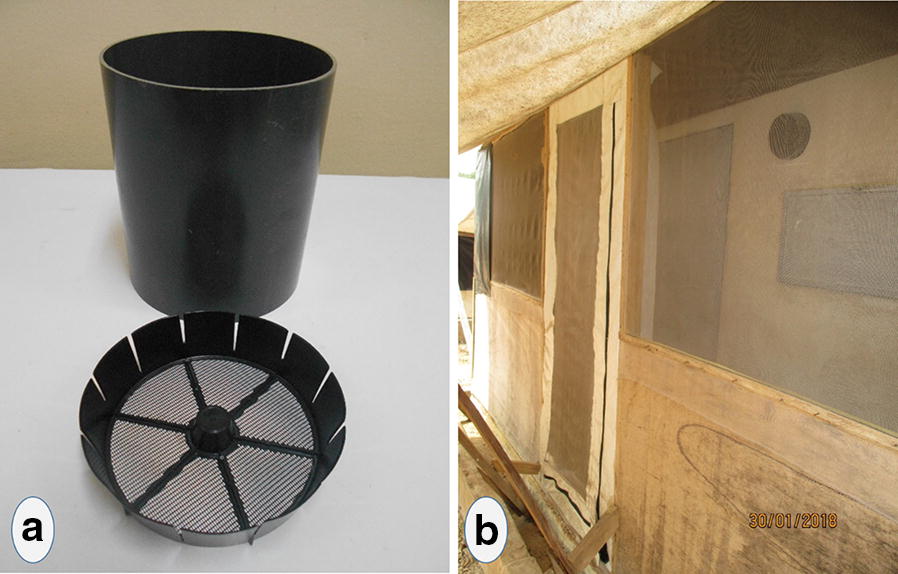
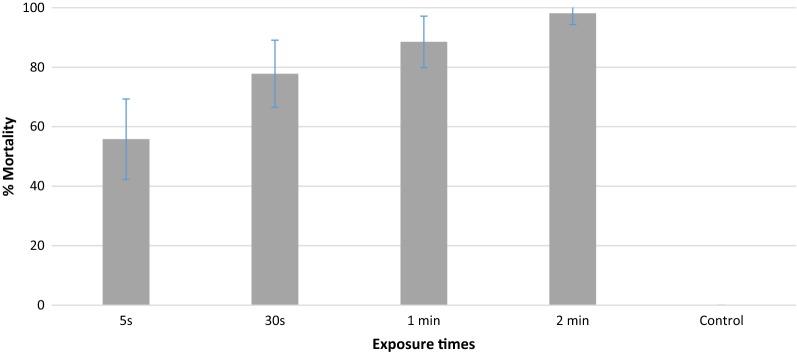
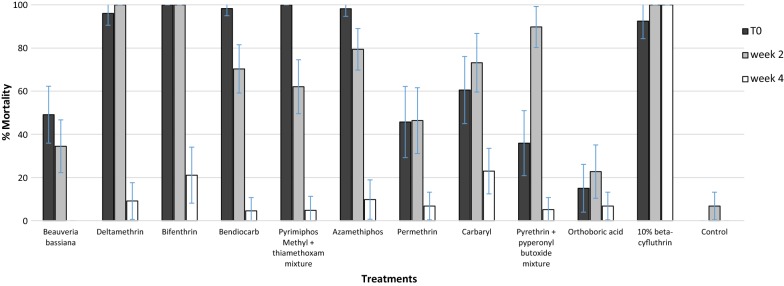
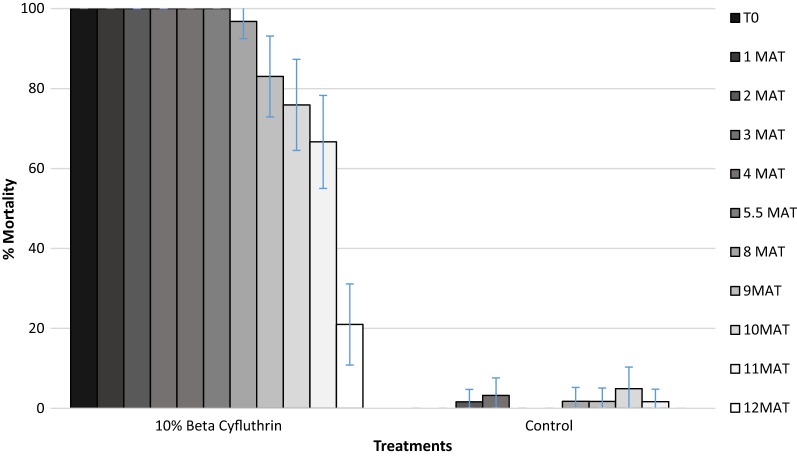
Eleven insecticide powder formulations belonging to six insecticide classes (pyrethroid, carbamate, organophosphate, neonicotinoid, entomopathogenic fungus and boric acid) were initially screened for residual activity over 4 weeks against pyrethroid resistant Anopheles gambiae sensu lato (s.l.) from the M'bé valley, central Côte d'Ivoire. Tests were performed using the eave tube assay that simulates the behavioural interaction between mosquitoes and insecticide-treated inserts. With the best performing insecticide, persistence was monitored over 12 months and the actual contact time lethal to mosquitoes was explored, using a range of transient exposure time (5 s, 30 s, 1 min up to 2 min) in the tube assays in laboratory. The mortality data were calibrated against overnight release-recapture data from enclosure around experimental huts incorporating treated inserts at the M'bé site. The natural recruitment rate of mosquitoes to the tube without insecticide treatment was assessed using fluorescent dust particles.
Although most insecticides assayed during the initial screening induced significant mortality (45-100%) of pyrethroid resistant An. gambiae during the first 2 weeks, only 10% beta-cyfluthrin retained high residual efficacy, killing 100% of An. gambiae during the first month and > 80% over 8 subsequent months. Transient exposure for 5 s of mosquitoes to 10% beta-cyfluthrin produced 56% mortality, with an increase to 98% when contact time was extended to 2 min (P = 0.001). In the experimental hut enclosures, mortality of An. gambiae with 10% beta-cyfluthrin treated inserts was 55% compared to similar rate (44%) of mosquitoes that contacted the inserts treated with fluorescent dusts. This suggests that all host-seeking female mosquitoes that contacted beta-cyfluthrin treated inserts during host-seeking were killed.
The eave tube technology is a novel malaria control approach which combines house proofing and targeted control of anopheline mosquitoes using insecticide treated inserts. Beta-cyfluthrin showed great promise for providing prolonged control of pyrethroid resistant An. gambiae and has potential to be deployed year-round in areas where malaria parasites are transmitted by highly pyrethroid resistant An. gambiae across sub-Saharan Africa.
杀虫剂在非洲疟疾病媒中的广泛出现仍然是控制项目面临的主要挑战之一。利用极性将杀虫剂颗粒结合起来的静电涂层是向蚊子传递杀虫剂的一种新方法。尽管先前的测试证明了这种应用方法具有抗药性的潜力,但仍需要筛选和研究更广泛的杀虫剂的残留效果。
最初筛选了 11 种杀虫剂粉末配方,属于六种杀虫剂类别(拟除虫菊酯、氨基甲酸酯、有机磷、新烟碱、昆虫病原真菌和硼酸),针对来自科特迪瓦中部 Mbé 山谷的对拟除虫菊酯具有抗药性的按蚊属按蚊 sensu lato(s.l.),在 4 周内测试了其残留活性。使用模拟蚊子与经杀虫剂处理的插入物之间行为相互作用的屋檐管测定法进行了测试。对于表现最好的杀虫剂,监测了 12 个月的持久性,并在实验室中的管测定法中探索了实际接触时间对蚊子的致死作用,使用了 5 s、30 s、1 分钟至 2 分钟的短暂暴露时间。死亡率数据与在 Mbé 现场结合了经处理的插入物的实验小屋周围的封闭区进行了整夜释放捕获数据进行了校准。使用荧光粉尘颗粒评估了蚊子在没有杀虫剂处理的情况下自然进入管中的繁殖率。
尽管在最初的筛选中测试的大多数杀虫剂在最初的 2 周内都会导致抗拟除虫菊酯的按蚊属按蚊 sensu lato(s.l.)产生显著的死亡率(45-100%),但只有 10%的 beta-氯氟氰菊酯保持了高的残留效果,在第一个月杀死了 100%的按蚊属按蚊 sensu lato(s.l.),在接下来的 8 个月中杀死了超过 80%的蚊子。蚊子短暂暴露 5 秒接触 10%的 beta-氯氟氰菊酯会产生 56%的死亡率,当接触时间延长至 2 分钟时,死亡率增加到 98%(P=0.001)。在实验小屋的封闭区中,接触了经 10% beta-氯氟氰菊酯处理的插入物的按蚊属按蚊 sensu lato(s.l.)的死亡率为 55%,而与接触经荧光粉尘处理的插入物的蚊子的死亡率相似(44%)。这表明,在寻找宿主的过程中接触到经 beta-氯氟氰菊酯处理的插入物的所有雌性按蚊属按蚊 sensu lato(s.l.)都被杀死了。
屋檐管技术是一种新颖的疟疾控制方法,它结合了房屋防蚊和使用经杀虫剂处理的插入物对按蚊属蚊子进行有针对性的控制。beta-氯氟氰菊酯在提供对拟除虫菊酯具有抗药性的按蚊属按蚊 sensu lato(s.l.)的长期控制方面显示出巨大的潜力,并且有可能在整个撒哈拉以南非洲地区的疟疾寄生虫通过高度对拟除虫菊酯具有抗药性的按蚊属按蚊 sensu lato(s.l.)传播的地区全年部署。