Centre for Lymphoid Cancer, BC Cancer, Vancouver, BC, Canada.
Institute of Human Genetics, University of Ulm and Ulm University Medical Center, Ulm, Germany.
Blood Adv. 2018 Oct 23;2(20):2755-2765. doi: 10.1182/bloodadvances.2018023572.
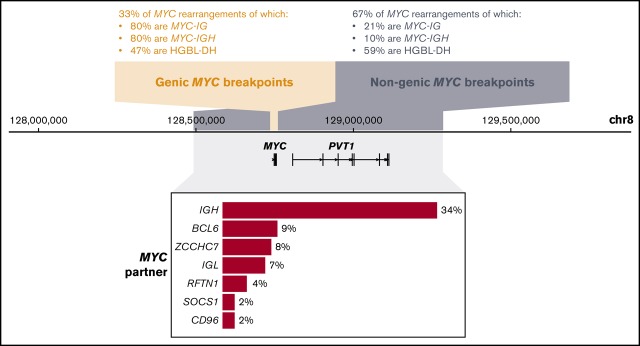
Genomic rearrangements in the locus occur in ∼12% of lymphomas with diffuse large B-cell lymphoma (DLBCL) morphology and are associated with inferior outcome. Previous studies exploring rearrangements have primarily used fluorescence in situ hybridization (FISH) assays to characterize break-apart status but have rarely examined breakpoint location, and in some cases have not examined partner identity. We performed targeted sequencing of , , , and the immunoglobulin () loci in 112 tumors with DLBCL morphology harboring rearrangement. We characterized the location of the rearrangement at base pair resolution and identified the partner in 88 cases. We observed a cluster of breakpoints upstream of the coding region and in intron 1 (the "genic cluster"). Genic cluster rearrangements were enriched for translocations involving (80%), whereas nongenic rearrangements occurred mostly downstream of the gene with a variety of partners, including and Other recurrent partners included , , and , which has not previously been described as a partner. We compared 2 commercially available FISH break-apart assays for the locus and observed discordant results in 32% of cases examined, including some with - and - rearrangements. In cases of high-grade B-cell lymphoma with and and/or rearrangement (HGBL-DH), so-called "double-hit" lymphomas, the majority of rearrangements had non- partners (65%), with breakpoints outside the genic cluster (72%). In patients with de novo HGBL-DH of DLBCL morphology, - rearrangements showed a trend toward inferior time to progression and overall survival compared with -non- rearrangements. Our data reveal clinically relevant architecture of rearrangements in lymphomas with DLBCL morphology.
基因在 12%的具有弥漫性大 B 细胞淋巴瘤 (DLBCL) 形态的淋巴瘤中发生重排,与预后不良相关。以前的研究主要使用荧光原位杂交 (FISH) 检测来探索 重排,以确定断裂分离状态,但很少检查断点位置,在某些情况下也没有检查伙伴身份。我们对 112 例具有 DLBCL 形态且存在 重排的肿瘤进行了靶向测序,这些肿瘤包括 、 、 和免疫球蛋白 ( ) 基因座。我们以碱基分辨率对 重排的位置进行了特征描述,并在 88 例中确定了伙伴。我们观察到在 编码区上游和内含子 1(“基因簇”)处存在断点簇。基因簇重排主要富集涉及 的易位 (80%),而非基因重排主要发生在 基因下游,涉及多种伙伴,包括 和 。其他常见的伙伴包括 、 和 ,以前尚未描述为 伙伴。我们比较了两种市售的针对 基因座的 FISH 断裂分离检测方法,在检查的 32%的病例中观察到不一致的结果,包括一些具有 和 - 重排的病例。在具有 和 以及/或 重排的高级别 B 细胞淋巴瘤 (HGBL-DH),即所谓的“双打击”淋巴瘤中,大多数 重排具有非伙伴 (65%),且断点位于基因簇外 (72%)。在具有 DLBCL 形态的新发 HGBL-DH 患者中,与 -非- 重排相比,- 重排的疾病进展时间和总生存期有下降趋势。我们的数据揭示了具有 DLBCL 形态的淋巴瘤中 重排的临床相关结构。