Jin Yuefei, Zhang Rongguang, Wu Weidong, Duan Guangcai
Department of Epidemiology, College of Public Health, Zhengzhou University, Zhengzhou, China.
Department of Occupational and Environmental Health, School of Public Health, Xinxiang Medical University, Xinxiang, China.
Front Microbiol. 2018 Oct 8;9:2422. doi: 10.3389/fmicb.2018.02422. eCollection 2018.
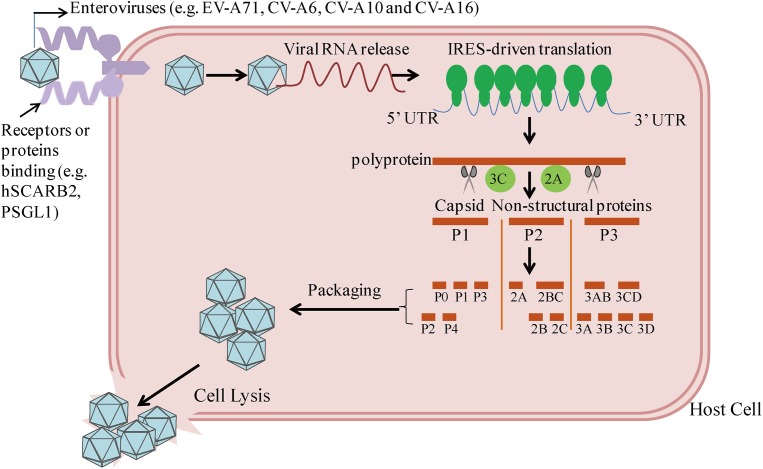
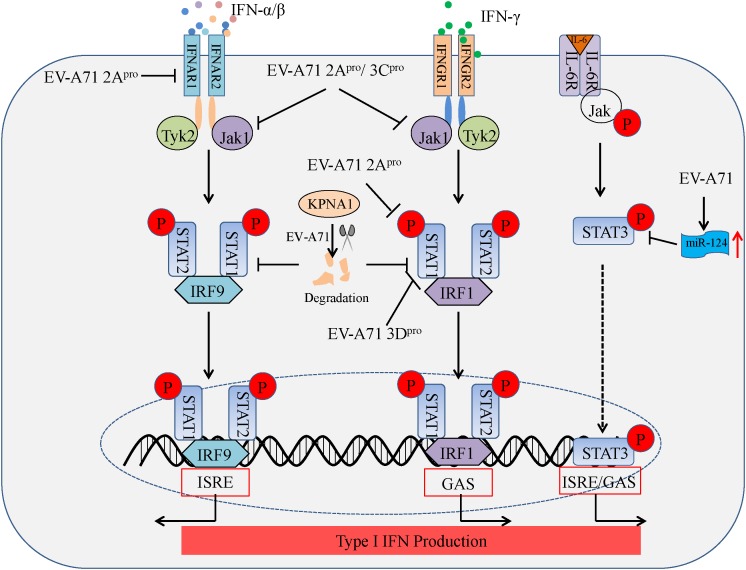
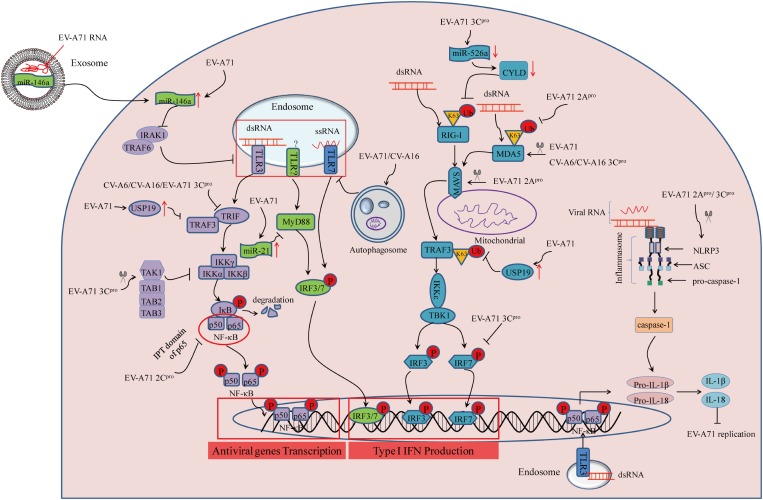
Enterovirus (EV) infections are a major threat to global public health, and are responsible for mild respiratory illness, hand, foot, and mouth disease (HFMD), acute hemorrhagic conjunctivitis, aseptic meningitis, myocarditis, severe neonatal sepsis-like disease, and acute flaccid paralysis epidemic. Among them, HFMD is a common pediatric infectious disease caused by EVs of the family including EV-A71, coxsackieviruses (CV)-A2, CV-A6, CV-A10, and CV-A16. Due to lack of vaccines and specific antiviral therapeutics, millions of children still suffer from HFMD. Innate immune system detects foreign invaders by means of a relatively limited number of sensors, such as pattern recognition receptors (PRRs) [e.g., retinoic acid-inducible gene I (RIG-I)-like receptors (RLRs), Toll-like receptors (TLRs), and NOD-like receptors (NLRs)] and even some secreted functional proteins. However, a range of research, highlighted in this review, suggest that EV-associated with HFMD have evolved different strategies to avoid detection by innate immunity different proteases (e.g., 2A, 3C, 2C, and 3D). Ongoing efforts to better understand virus-host interactions that control innate immunity and then distill how that influences HFMD development promises to have real-world significance. In this review, we address this complex topic in nine sections including multiple proteins associated with PRR and type I interferon (IFN) signaling. Recognizing how EVs linked to HFMD evade host innate immune system, we also describe the interactions between them and, finally, suggest future directions to better inform drug development and public health.
肠道病毒(EV)感染是对全球公共卫生的重大威胁,可导致轻度呼吸道疾病、手足口病(HFMD)、急性出血性结膜炎、无菌性脑膜炎、心肌炎、严重的新生儿败血症样疾病以及急性弛缓性麻痹流行。其中,手足口病是一种常见的儿科传染病,由该病毒家族的肠道病毒引起,包括肠道病毒A71型(EV-A71)、柯萨奇病毒A组(CV-A)2型、CV-A6型、CV-A10型和CV-A16型。由于缺乏疫苗和特异性抗病毒疗法,仍有数百万儿童患手足口病。天然免疫系统通过相对有限数量的传感器来检测外来入侵者,例如模式识别受体(PRR)[例如维甲酸诱导基因I(RIG-I)样受体(RLR)、Toll样受体(TLR)和NOD样受体(NLR)],甚至一些分泌型功能蛋白。然而,本综述中强调的一系列研究表明,与手足口病相关的肠道病毒已经进化出不同策略来逃避天然免疫的检测——不同的蛋白酶(例如2A、3C、2C和3D)。持续努力更好地理解控制天然免疫的病毒-宿主相互作用,进而探究其如何影响手足口病的发展,有望具有现实意义。在本综述中,我们分九个部分探讨这个复杂的主题,包括与PRR和I型干扰素(IFN)信号相关的多种蛋白质。认识到与手足口病相关的肠道病毒如何逃避宿主天然免疫系统后,我们还描述了它们之间的相互作用,最后提出未来方向,以更好地指导药物开发和公共卫生。