Heinemann Lutz, Stuhr Andreas, Brown Adam, Freckmann Guido, Breton Marc D, Russell Steven, Heinemann Lutz
Science Consulting in Diabetes GmbH, Neuss, Germany.
Ascensia Diabetes Care, NJ, US.
Eur Endocrinol. 2018 Sep;14(2):24-29. doi: 10.17925/EE.2018.14.2.24. Epub 2018 Sep 10.
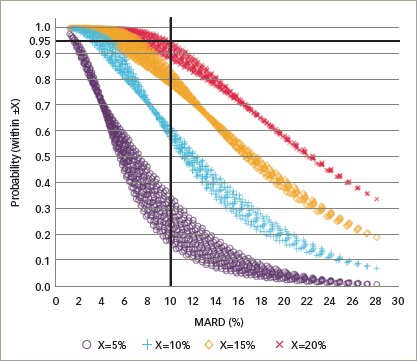
Monitoring glycaemic control in patients with diabetes has evolved dramatically over the past decades. The introduction of easy-to-use systems for self-monitoring of blood glucose (SMBG) utilising capillary blood samples has resulted in the availability of a wide range of systems, providing different measurement quality. Systems for continuous glucose monitoring (CGM) - used mainly in patients with type 1 diabetes (T1D) - were made possible by the development of glucose sensors that measure glucose levels in the interstitial fluid (ISF) in the subcutaneous tissue of the skin. CGM readings might not correspond exactly to SMBG measurement results taken at the same time, especially during rapid changes in either blood glucose or ISF glucose levels. The mean absolute relative difference is the most popular method used for characterising the measurement performance of CGM systems. Unlike the International Organization for Standardization 15197:2013 criteria for SMBG systems, no accuracy standards for CGM systems exist. Measurement quality of CGM systems can vary based on several factors, limiting their safety and effective use in managing diabetes. Patients have to be trained adequately to make safe and efficient use of CGM systems (like with SMBG systems). Also, systems for CGM must be evaluated in terms of patient safety and the ability to provide accurate measurements regardless of the fluctuation of glucose levels. As new technological advancements in glucose monitoring are essential for improved management options of diabetes, such as automated insulin dosing systems, there is a need for a critical view of all such developments. It is likely that both, SMBG and CGM systems, will play important future roles in the treatment of diabetes.
在过去几十年里,糖尿病患者血糖控制的监测方式发生了巨大变化。利用毛细血管血样的易于使用的血糖自我监测(SMBG)系统的引入,带来了各种各样的系统,其测量质量各不相同。连续血糖监测(CGM)系统——主要用于1型糖尿病(T1D)患者——由于葡萄糖传感器的发展而成为可能,该传感器可测量皮肤皮下组织间质液(ISF)中的葡萄糖水平。CGM读数可能与同一时间采集的SMBG测量结果不完全一致,尤其是在血糖或ISF葡萄糖水平快速变化期间。平均绝对相对差值是用于表征CGM系统测量性能的最常用方法。与国际标准化组织15197:2013关于SMBG系统的标准不同,目前不存在CGM系统的准确性标准。CGM系统的测量质量可能因多种因素而异,这限制了它们在糖尿病管理中的安全性和有效使用。患者必须接受充分培训,才能安全有效地使用CGM系统(如同使用SMBG系统一样)。此外,必须从患者安全以及无论葡萄糖水平如何波动都能提供准确测量的能力方面对CGM系统进行评估。由于血糖监测方面的新技术进展对于改善糖尿病管理选项(如自动胰岛素给药系统)至关重要,因此需要对所有此类进展进行批判性审视。SMBG和CGM系统很可能在未来的糖尿病治疗中都发挥重要作用。