Morgan Sanell, Coetzee Frederik F
Department of Physiotherapy, University of the Free State, South Africa.
Department of Exercise and Sport Sciences, University of the Free State, South Africa.
S Afr J Physiother. 2018 Sep 26;74(1):454. doi: 10.4102/sajp.v74i1.454. eCollection 2018.
Patellar tendinopathy (PT) is an overuse injury of the knee. The mechanism of injury is associated with repetitive stress on the patellar tendon of the knee as a result of explosive movement. Patellar tendinopathy is prevalent in all populations and is associated with intrinsic and extrinsic risk factors.
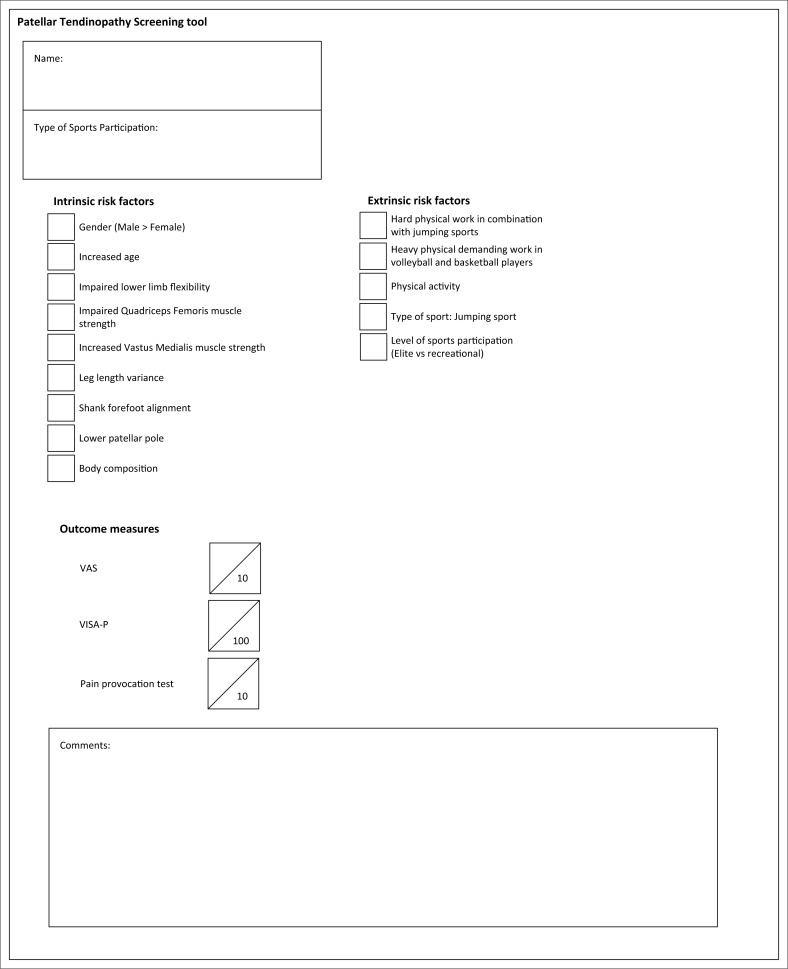
Primarily, the objective was to report on the intrinsic and extrinsic risk factors for PT, entailing a systematic review of the literature; the secondary objective was to use these risk factors to compile a proposed PT screening tool from the review and standard outcome measures.
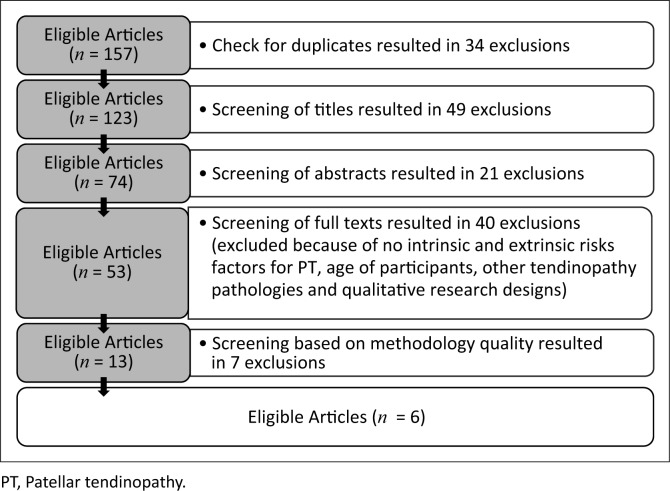
A systematic review was undertaken according to the Preferred Reporting Items for Systematic Reviews and Meta-Analyses (PRISMA) guidelines. Elimination criteria of the articles included duplicates, titles, abstracts and methodological quality. The evidence was collected, characterised with regard to the intrinsic and extrinsic risk factors and summarised descriptively.
The search yielded 157 feasible articles prior to commencement of article elimination. Six articles were included with a mean methodological quality score of 69%. Eight intrinsic and five extrinsic risk factors were identified. These identified risk factors are all relevant to the pathology and formed the basis for a proposed PT screening tool. The Victorian Institute of Sports Assessment for Patellar Tendinopathy Questionnaire, Visual Analog Scale and the Pain Provocation Test are also included in the proposed test.
Intrinsic and extrinsic risk factors for PT were identified, and consequently, the proposed PT screening tool was formulated for possible future testing in appropriate studies.
Prevention of PT through intrinsic and extrinsic risk factor identification, and implementation in the clinical setup as a possible outcome measurement tool with which to verify functional improvement in PT rehabilitation.
髌腱病(PT)是一种膝关节过度使用损伤。损伤机制与膝关节髌腱因爆发性运动而承受的反复应力有关。髌腱病在所有人群中都很常见,且与内在和外在风险因素相关。
主要目的是报告髌腱病的内在和外在风险因素,包括对文献进行系统综述;次要目的是利用这些风险因素,根据综述和标准结局指标编制一份拟议的髌腱病筛查工具。
根据系统评价和Meta分析的首选报告项目(PRISMA)指南进行系统综述。文章的排除标准包括重复、标题、摘要和方法学质量。收集证据,根据内在和外在风险因素进行特征描述,并进行描述性总结。
在开始排除文章之前,检索到157篇可行的文章。纳入6篇文章,平均方法学质量评分为69%。确定了8个内在风险因素和5个外在风险因素。这些确定的风险因素均与病理相关,构成了拟议的髌腱病筛查工具的基础。拟议的测试还包括维多利亚运动评估髌腱病问卷、视觉模拟量表和疼痛激发试验。
确定了髌腱病的内在和外在风险因素,因此制定了拟议的髌腱病筛查工具,以便未来在适当的研究中进行测试。
通过识别内在和外在风险因素预防髌腱病,并在临床环境中实施,作为一种可能的结局测量工具,用于验证髌腱病康复中的功能改善。